Math
Vector magnitude and direction calculator
Enter a vector's components to get its length and the direction it points: the angle from the positive x-axis and the bearing for 2D vectors, the direction cosines for 3D ones. Switch the first menu to go the other way, from a magnitude and angle back to components.
2 components for a direction angle and bearing, 3 for direction cosines. i, j, k form works too.
Show the working, step by step
Magnitude by Pythagoras.
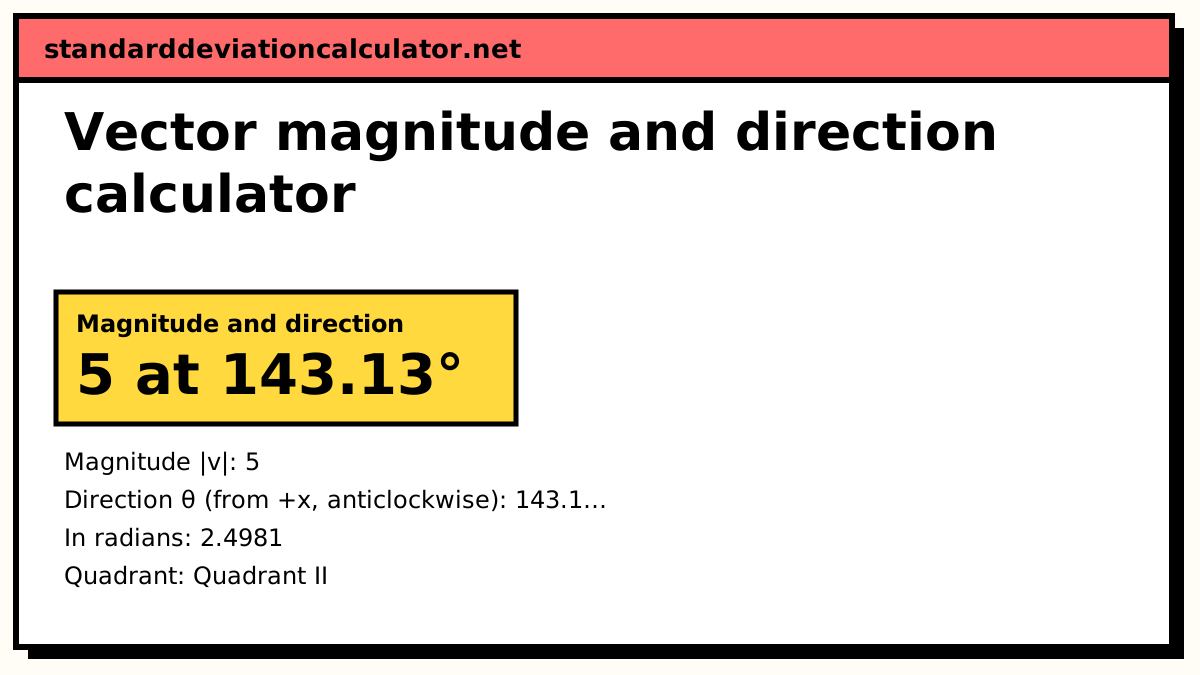
|v| = √((−4)² + 3²) = √25 = 5
The point (−4, 3) is in the Quadrant II.
arctan(y/x) = arctan(3/−4) = −36.87° (reference angle 36.87°)
x is negative, so add 180° to the calculator value of arctan(y/x).
θ = atan2(3, −4) = 143.13°
For a bearing, measure clockwise from north instead.
bearing = (90° − 143.13°) mod 360° = 306.87°, i.e. N 53.13° W
Plain arctan(y/x) only returns angles between −90° and 90°, so it gets quadrants II and III wrong. atan2(y, x) uses the signs of both components.
The formulas
|v| = √(x² + y²) 2D θ = atan2(y, x), 0° ≤ θ < 360° bearing = (90° − θ) mod 360° |v| = √(x² + y² + z²) 3D cos α = x/|v|, cos β = y/|v|, cos γ = z/|v|, cos²α + cos²β + cos²γ = 1 x = |v| cos θ, y = |v| sin θ back to components
A worked example
The default vector is ⟨−4, 3⟩: 4 units left and 3 up.
- Magnitude: √((−4)² + 3²) = √(16 + 9) = √25 = 5.
- Quadrant: x is negative and y positive, so the vector is in quadrant II.
- Reference angle: tan⁻¹(3/4) = 36.87°.
- Direction: in quadrant II, θ = 180° − 36.87° = 143.13°. A calculator's tan⁻¹(3/−4) gives −36.87°, which points into quadrant IV, the opposite way; adding 180° fixes it.
- Bearing: 90° − 143.13° = −53.13°, plus 360° gives 306.87°, or N 53.13° W.
Getting the quadrant right
tan⁻¹ only returns angles between −90° and 90°, so it cannot tell ⟨4, −3⟩ from ⟨−4, 3⟩: both
have y/x = −0.75. The fix depends on where the vector points. atan2(y, x), found in every
programming language and in Excel as ATAN2(x, y) (note the order), makes these
corrections automatically.
| Signs | Quadrant | Direction θ from tan⁻¹(y/x) | Example |
|---|---|---|---|
| x > 0, y > 0 | I | tan⁻¹(y/x) | ⟨3, 3⟩ → 45° |
| x < 0, y > 0 | II | tan⁻¹(y/x) + 180° | ⟨−4, 3⟩ → 143.13° |
| x < 0, y < 0 | III | tan⁻¹(y/x) + 180° | ⟨−3, −3⟩ → 225° |
| x > 0, y < 0 | IV | tan⁻¹(y/x) + 360° | ⟨3, −4⟩ → 306.87° |
| x = 0 | on the y-axis | 90° if y > 0, 270° if y < 0 | ⟨0, 5⟩ → 90° |
Bearings
Navigation, surveying and many physics problems give directions as bearings: clockwise from north, usually as three figures (a bearing of 045° is north-east). Compass (quadrant) bearings name the nearer of north or south first and then turn towards east or west: S 36.87° E means face south and turn 36.87° towards east, a true bearing of 143.13°. Mixing the two conventions up is the usual reason an answer comes out mirrored in the line y = x.
3D vectors: direction cosines
A 3D vector has no single direction angle, so it is described by the angles α, β, γ it makes with the three axes. For ⟨2, −1, 2⟩: |v| = √(4 + 1 + 4) = 3, the direction cosines are 2/3, −1/3 and 2/3, and the angles are α = 48.19°, β = 109.47° and γ = 48.19°. β is over 90° because the y-component is negative. The elevation above the xy-plane is sin⁻¹(2/3) = 41.81°.
Going back to components
Resolving a vector is the reverse: x = |v| cos θ and y = |v| sin θ. A force of 10 N acting at 210° has components ⟨−8.66025, −5⟩, both negative because 210° lies in quadrant III. Given a bearing instead, say 10 N on a bearing of 120°, convert first: θ = 90° − 120° = −30°, or 330°, which gives ⟨8.66025, −5⟩.
Common questions
How do you find the magnitude of a vector?
Square each component, add them and take the square root: |v| = √(x² + y²) in 2D and √(x² + y² + z²) in 3D. For ⟨−4, 3⟩ that is √(16 + 9) = √25 = 5. The signs of the components do not matter, because squaring removes them.
How do you find the direction angle of a vector?
θ = atan2(y, x), measured anticlockwise from the positive x-axis. If you use a calculator's tan⁻¹(y/x) instead, correct for the quadrant: add 180° when x is negative, and add 360° when x is positive and y is negative. For ⟨−4, 3⟩, tan⁻¹(3/−4) = −36.87°, and adding 180° gives the true direction, 143.13°.
What is the difference between a direction angle and a bearing?
A direction angle in maths is measured anticlockwise from east (the +x axis). A bearing is measured clockwise from north. Convert with bearing = 90° − θ (adding 360° if the result is negative). The direction 143.13° is a bearing of 306.87°, which as a compass bearing is N 53.13° W.
What are direction cosines?
For a 3D vector, the cosines of the angles it makes with the x, y and z axes: cos α = x/|v|, cos β = y/|v|, cos γ = z/|v|. They are the components of the unit vector, so their squares always add to 1. For ⟨2, −1, 2⟩, |v| = 3 and the direction cosines are 2/3, −1/3 and 2/3.
How do I get the components from the magnitude and angle?
x = |v| cos θ and y = |v| sin θ, with θ measured from the +x axis. A force of 10 at 210° has components 10 cos 210° = −8.66025 and 10 sin 210° = −5. If the angle is a bearing, convert it first with θ = 90° − bearing; the calculator does this when you choose “Clockwise from north”.
Related calculators
-
Vector calculator
Add, subtract and scale vectors; dot product, angle and projection.
-
Cross product
a × b with its magnitude as the parallelogram area.
-
Vector analysis
Triple products, independence and Gram–Schmidt.
-
Matrix calculator
Determinant, inverse, rank and eigenvalues.