Probability calculators
Calculators for the chance of an event, the number of ways something can happen, and the probabilities a distribution assigns to each outcome. They are grouped into basic probability, distributions, dice and games, and diagnostic tests, so students, analysts and clinicians can go straight to the tool that fits their question.
Probability categories
-
Basic probability
Calculators for event probability, conditional and joint probability, Bayes, combinations, permutations, odds and expected value, with worked steps. 16 calculators.
-
Distributions
Calculators for binomial, Poisson, normal, geometric, hypergeometric, exponential, Weibull and other distributions: probabilities, percentiles and moments. 15 calculators.
-
Dice, coins and games
Coin flip and dice probability calculators, dice and coin simulators, roulette odds, and the birthday, Monty Hall and other probability puzzles explained. 16 calculators.
-
Diagnostic tests and risk
Sensitivity, specificity, PPV, confusion matrix, post-test probability, Youden index, relative risk and NNT calculators for tests, classifiers and trials. 9 calculators.
Which calculator do I need?
| You have or want | Use |
|---|---|
| Two events and you want P(A or B), P(A and B) or P(not A) | Probability calculator |
| The chance of A once you know B has happened, from probabilities or a 2×2 table | Conditional probability calculator |
| A prior and a test result, and you want the updated (posterior) probability | Bayes' theorem calculator |
| The number of ways to choose r items from n when order does not matter | Combination calculator |
| The number of successes in n independent yes/no trials | Binomial distribution calculator |
| The number of events in a fixed time or space at a known average rate | Poisson distribution calculator |
| A mean and SD, and the share of values above, below or between cut-offs | Normal distribution calculator |
| The long-run average payoff of a bet or game | Expected value calculator |
Events, counting and odds
The everyday questions: how likely an event is, how many ways it can happen, and what that means as odds.
-
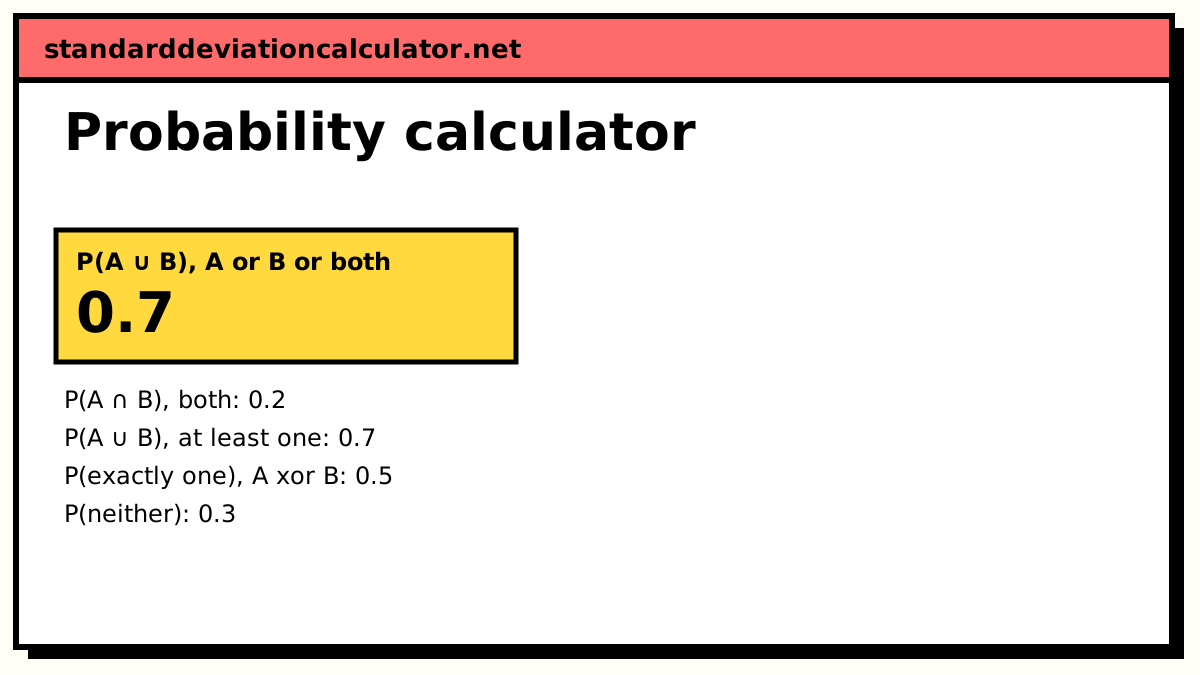
Probability calculator
Union, intersection, complement and conditional probabilities of two events, or P(at least one).
-
Conditional probability calculator
P(A|B) from probabilities or from a 2×2 table of counts.
-
Bayes' theorem calculator
Posterior probability for a medical test, with natural frequencies, or across several hypotheses.
-
Combination calculator
nCr with or without repetition, and a list of every combination for small sets.
-
Permutation calculator
nPr, nʳ with repetition, and the distinct arrangements of the letters in a word.
-
Expected value calculator
E[X], variance and standard deviation from a table of outcomes and probabilities, with a fair-game check.
-
Odds calculator
Convert between probability, odds for and against, and fractional, decimal and American odds.
Distributions, dice and tests
The distributions and applied tools people reach for most often.
-
Binomial distribution calculator
P(X = k), at most, at least and between for n independent trials with success probability p.
-
Normal distribution calculator
Areas under the bell curve left of, right of or between values, from the mean and SD.
-
Poisson distribution calculator
The chance of k events in an interval when they happen at an average rate λ.
-
Dice probability calculator
The chance of rolling a sum exactly, at least, at most or in a range with N dice.
-
Sensitivity and specificity calculator
Sensitivity, specificity, PPV, NPV and likelihood ratios with Wilson or exact confidence intervals.
How the probability calculators fit together
Most probability questions fall into one of four kinds. Basic probability covers single events and combinations of events: unions, intersections, conditional probability, Bayes' theorem, and the counting rules (combinations and permutations) that give you the numerator and denominator of a probability. Distributions describe a whole random variable at once, such as the number of successes in n trials or a measurement that follows a bell curve. Dice, coins and games apply those ideas to games of chance and to the classic puzzles that trip up intuition. Diagnostic tests and risk apply conditional probability to screening, classification and comparing groups.
A worked comparison: binomial or Poisson?
Suppose 3% of parts from a machine are faulty and you inspect 100. The exact model is binomial with n = 100 and p = 0.03. The binomial calculator gives P(X = 3) = 0.2275. The Poisson calculator with λ = np = 3 gives 0.2240, and both give P(X ≤ 3) = 0.6472 to four places. When n is large and p is small, the Poisson is a good shortcut; when p is near 0.5 or n is small, stay with the binomial.
Common mix-ups
- P(A | B) is not P(B | A). The chance of a positive test given disease is the sensitivity; the chance of disease given a positive test also depends on how common the disease is. The Bayes' theorem calculator converts one into the other.
- Odds are not probabilities. A probability of 0.2 is odds of 1 to 4 for, or 4 to 1 against. The odds calculator converts between the forms.
- Combinations ignore order; permutations count it. Picking 3 people from 10 gives 120 combinations but 720 ordered arrangements.
- Independent is not the same as mutually exclusive. Mutually exclusive events with non-zero probability can never be independent, because knowing one happened rules the other out.