Dice probability calculator
Find the chance of rolling a given total with several dice. Choose the number of dice, their sides and the sum you want, and the calculator counts the ways to make it and gives the exact probability.
| Sum | Ways | Probability |
|---|---|---|
| 3 | 1 | 0.00463 |
| 4 | 3 | 0.01389 |
| 5 | 6 | 0.02778 |
| 6 | 10 | 0.0463 |
| 7 | 15 | 0.06944 |
| 8 | 21 | 0.09722 |
| 9 | 25 | 0.1157 |
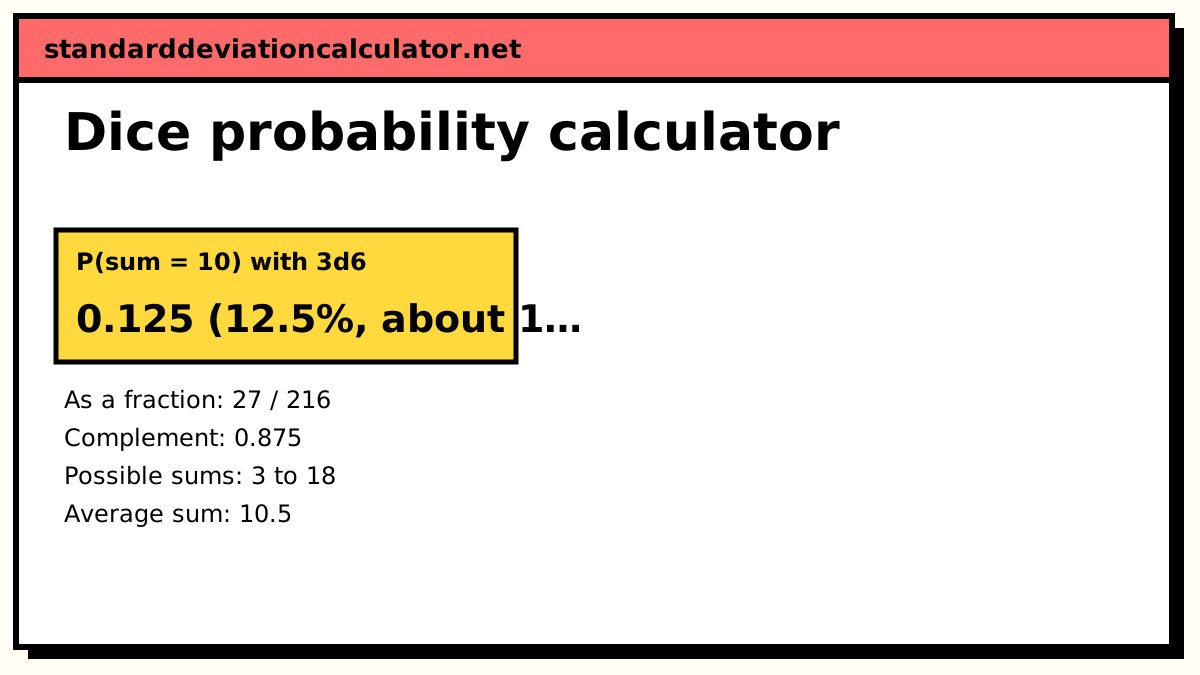
| 10 | 27 | 0.125 |
| 11 | 27 | 0.125 |
| 12 | 25 | 0.1157 |
| 13 | 21 | 0.09722 |
| 14 | 15 | 0.06944 |
| 15 | 10 | 0.0463 |
| 16 | 6 | 0.02778 |
| 17 | 3 | 0.01389 |
| 18 | 1 | 0.00463 |
Show the working, step by step
Each of the 3 dice shows 1 to 6 with equal chance, so there are 63 = 216 equally likely outcomes.
Count the outcomes for each sum by adding one die at a time: the ways to make a sum with one more die are the ways to make each of the 6 smaller sums before it.
waysk(x) = waysk−1(x − 1) + … + waysk−1(x − 6)
Add the ways for every sum in the event and divide by the total:
P(sum = 10) = 27 ÷ 216 = 0.125
The average sum is n(s + 1)/2 = 10.5 and the standard deviation is √(n(s² − 1)/12) = 2.958.
The method
N fair dice with S sides have Sᴺ equally likely outcomes. The probability of a sum is the number of outcomes that make it divided by Sᴺ. The counts are built one die at a time: the number of ways to make a sum x with k dice is the total of the ways to make x − 1, x − 2, …, x − S with k − 1 dice.
waysk(x) = waysk−1(x − 1) + waysk−1(x − 2) + … + waysk−1(x − S) P(sum = x) = waysN(x) ÷ Sᴺ
The same recurrence works for “at least”, “at most” and “between”: add the ways for every sum in the range. The sum of N dice averages N(S + 1)/2 with standard deviation √(N(S² − 1)/12).
A worked example
The default is the chance of a sum of exactly 10 with three six-sided dice. There are 6³ = 216 outcomes. Counting with the recurrence, the ways to make 3, 4, 5, … with three dice are 1, 3, 6, 10, 15, 21, 25, 27, 27, 25, … and a sum of 10 has 27 of them:
P(sum = 10) = 27 ÷ 216 = 0.125 = 1/8
Sums of 10 and 11 tie as the most likely, each with 27 ways, because 3d6 averages 10.5 and the distribution is symmetric about it. The table under the chart lists the ways for every sum, so you can check any other total by adding rows.
Reading the chart
Each bar is the probability of one sum, and the bars in your event are solid. With one die the bars are flat; with two they form a triangle peaking at 7; with three or more they round into a bell. The more dice you add, the more tightly the totals cluster around the average relative to the full range, which is why games that roll several dice feel more predictable than those that roll one big die.
Other questions the calculator answers
“At least” is the usual question in games: the chance of beating a target number. With 2d6 the chance of 10 or more is 6/36 = 1/6, and of 8 or more 15/36 = 0.417. “Between” answers range questions, such as the chance that 2d6 lands from 6 to 8, which is 16/36 = 0.444, almost half of all rolls. For many dice, such as 100d6, the exact count is too large to write as a fraction, so the calculator reports the probability alone, still summed exactly rather than approximated.
Common mistakes
- Treating the sums as equally likely. There are 11 sums of two dice, but 7 is six times as likely as 2.
- Counting 3 + 4 and 4 + 3 as one outcome. They are different outcomes, which is why there are 36 pairs, not 21.
- Using the normal approximation for a handful of dice when the exact count is easy. The calculator uses exact counts.
Common questions
What is the most likely sum of two dice?
7, with probability 6/36 = 1/6. Six of the 36 equally likely pairs add to 7: 1+6, 2+5, 3+4, 4+3, 5+2 and 6+1. The sums 2 and 12 are the least likely, one way each (1/36).
Why do sums in the middle come up more often?
Because there are more ways to make them. Every individual combination of faces is equally likely, but a total like 10 on 3d6 can be made 27 ways while 3 can only be made one way (1+1+1). As you add dice the distribution becomes a bell curve, as the central limit theorem predicts.
What is the probability of rolling at least 15 on 3d6?
20/216 = 0.0926. The ways to make 15, 16, 17 and 18 are 10, 6, 3 and 1. Choose “At least t” with t = 15 to check it.
Does it handle dice other than d6?
Yes. Enter any number of sides from 2 up. The counting is the same: each die is equally likely to show 1 to s, and the calculator adds one die at a time to count the ways to make each sum.
What about the chance of rolling a particular number on at least one die?
That is a different question from the sum. The chance of at least one 6 on n dice is 1 − (5/6)ⁿ: 0.306 for 2 dice and 0.518 for 4. The probability calculator has an at-least-one mode for this.
Related calculators
-
Dice average calculator
The expected total and spread of any roll.
-
Dice roller
Roll dice online and keep a history.
-
Probability calculator
Union, intersection and at-least-one probabilities.