Dice average calculator
Work out the average total of a dice roll. Enter the number of dice, the sides and any modifier, and optionally drop the lowest or highest dice, to get the expected value, the standard deviation and the chance of every total.
4, 6, 8, 10, 12, 20, 100 or any other number.
Show the working, step by step
One fair d8 is equally likely to show 1 to 8, so its average is the midpoint.
E[d8] = (1 + 8) ÷ 2 = 4.5 Var[d8] = (8² − 1) ÷ 12 = 5.25
Averages and variances of independent dice add, and the modifier shifts the average only.
E[total] = 3 × 4.5 + 2 = 15.5 Var[total] = 3 × 5.25 = 15.75, SD = √15.75 = 3.9686
The solid bars in the chart are the totals within one standard deviation of the average.
The formula
A fair die with s sides is equally likely to show each whole number from 1 to s, so its average is the midpoint of 1 and s. Averages of independent dice add, and a modifier adds straight on:
E[NdS + M] = N × (S + 1) ÷ 2 + M Var[NdS + M] = N × (S² − 1) ÷ 12 SD = √Var
The variance formula comes from the variance of a discrete uniform distribution on 1…S. The modifier does not appear in it, because shifting every total by the same amount does not change how spread out they are.
A worked example
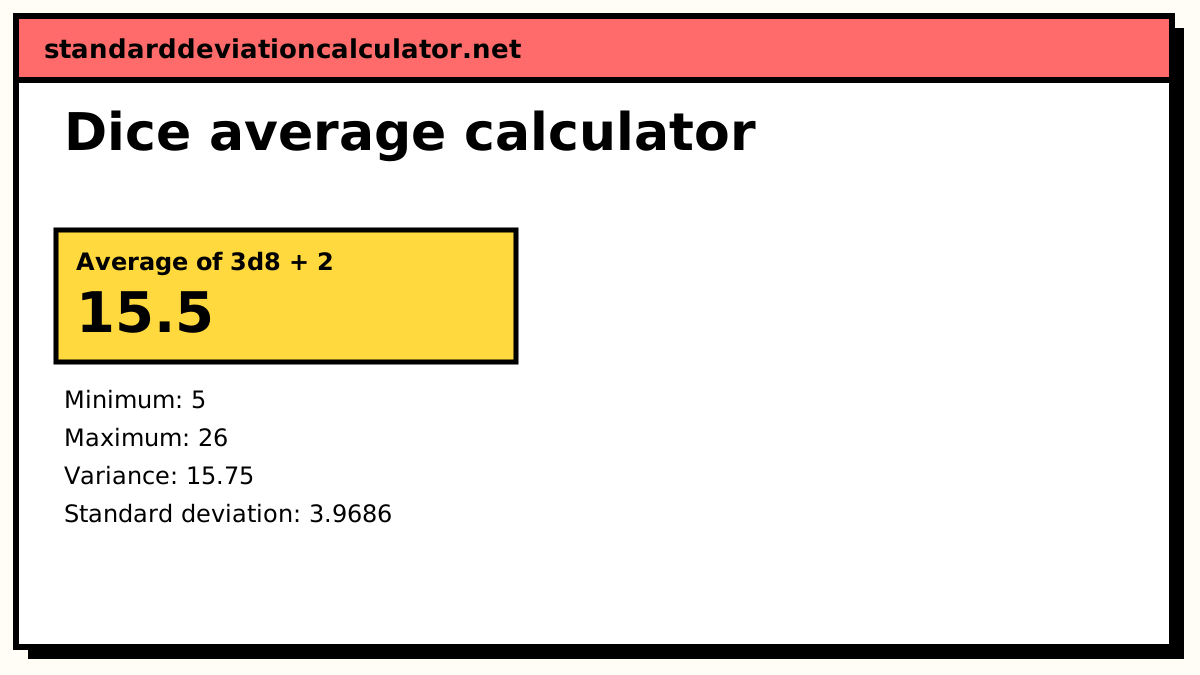
The default is 3d8 + 2. One d8 averages (1 + 8) ÷ 2 = 4.5, so three of them average 13.5, and the modifier brings the total to 15.5.
E = 3 × 4.5 + 2 = 15.5 Var = 3 × (64 − 1) ÷ 12 = 15.75 SD = √15.75 = 3.97
The lowest possible total is 3 + 2 = 5 and the highest is 24 + 2 = 26. The chart shows the distribution; the solid bars are the totals within one standard deviation of 15.5, from 12 to 19, which covers most rolls.
Dropping dice
Once you drop the lowest or highest die the simple formula stops working, because the dice you keep are no longer a random sample of faces. The calculator lists every outcome instead. For the classic ability-score roll, 4d6 drop the lowest, it goes through all 6⁴ = 1,296 outcomes and finds an average of 12.24 and a standard deviation of 2.85. Rolling 2d20 and keeping the higher (advantage) averages 13.825; keeping the lower (disadvantage) averages 7.175.
Interpreting the average
The average is what the total works out to per roll over many rolls. Any single roll can land well away from it. The standard deviation tells you how far: for sums of several dice the distribution is bell-shaped, so roughly two rolls in three fall within one SD of the average and about 95% within two. With one die the distribution is flat and every face is equally likely, so the average is a poor guide to any one roll.
Common mistakes
- Using S ÷ 2 instead of (S + 1) ÷ 2. A d6 averages 3.5, not 3.
- Multiplying the modifier by the number of dice. In 3d8 + 2 the +2 is added once to the total.
- Treating 2d6 like 1d12. Both can reach 12, but 2d6 averages 7 and bunches in the middle, while 1d12 averages 6.5 and is flat.
- Assuming 4d6 drop lowest averages 3 × 3.5 = 10.5. The dropped die pushes it up to 12.24.
Common questions
What is the average roll of each common die?
(sides + 1) ÷ 2: a d4 averages 2.5, a d6 3.5, a d8 4.5, a d10 5.5, a d12 6.5, a d20 10.5 and a d100 50.5. The average is never a number the die can actually show, which is fine: it is the long-run mean, not a typical roll.
What is the average of 4d6 drop the lowest?
15,869 ÷ 1,296 = 12.24, with a standard deviation of 2.85. Plain 3d6 averages 10.5, so rolling a fourth die and dropping the lowest adds about 1.74 to each ability score.
What does rolling with advantage do to the average of a d20?
Advantage means rolling 2d20 and keeping the higher, which is 2d20 drop lowest 1: the average rises from 10.5 to 13.825. Disadvantage (drop the highest) lowers it to 7.175. Choose “Drop the lowest” or “Drop the highest” with 2 dice of 20 sides to see the full distribution.
Does the modifier change the standard deviation?
No. Adding +3 moves every possible total up by 3, so the average goes up by 3 but the spread is unchanged. More dice, on the other hand, widen the spread: the variance grows in proportion to the number of dice, and the standard deviation with its square root.
How does this relate to “average damage” in games?
It is the same number. A weapon that deals 2d6 + 3 averages 2 × 3.5 + 3 = 10 per hit. To compare weapons over many attacks, multiply by the chance of hitting.
Related calculators
-
Dice probability calculator
The chance of rolling a given sum or more.
-
Dice roller
Roll any combination of dice with a modifier.
-
Quiz: dice averages
Practise working out dice averages in your head.