Roulette payout calculator
Roulette is a clean example of expected value and variance. Pick the wheel and a bet to see its payout, its probability of winning, the house edge built into the price, and how the expected loss and the spread of results grow over many spins.
For the expected result over a session.
┄ Expected ± 2 SD (about 95% of sessions) ━ Expected result
| Bet | Pays | Covers | P(win) | House edge |
|---|---|---|---|---|
| Straight up (1 number) | 35 to 1 | 1/37 | 2.70% | 2.70% |
| Split (2 numbers) | 17 to 1 | 2/37 | 5.41% | 2.70% |
| Street (3 numbers) | 11 to 1 | 3/37 | 8.11% | 2.70% |
| Corner (4 numbers) | 8 to 1 | 4/37 | 10.81% | 2.70% |
| First four: 0, 1, 2, 3 | 8 to 1 | 4/37 | 10.81% | 2.70% |
| Six line (6 numbers) | 5 to 1 | 6/37 | 16.22% | 2.70% |
| Dozen (1–12, 13–24, 25–36) | 2 to 1 | 12/37 | 32.43% | 2.70% |
| Column (12 numbers) | 2 to 1 | 12/37 | 32.43% | 2.70% |
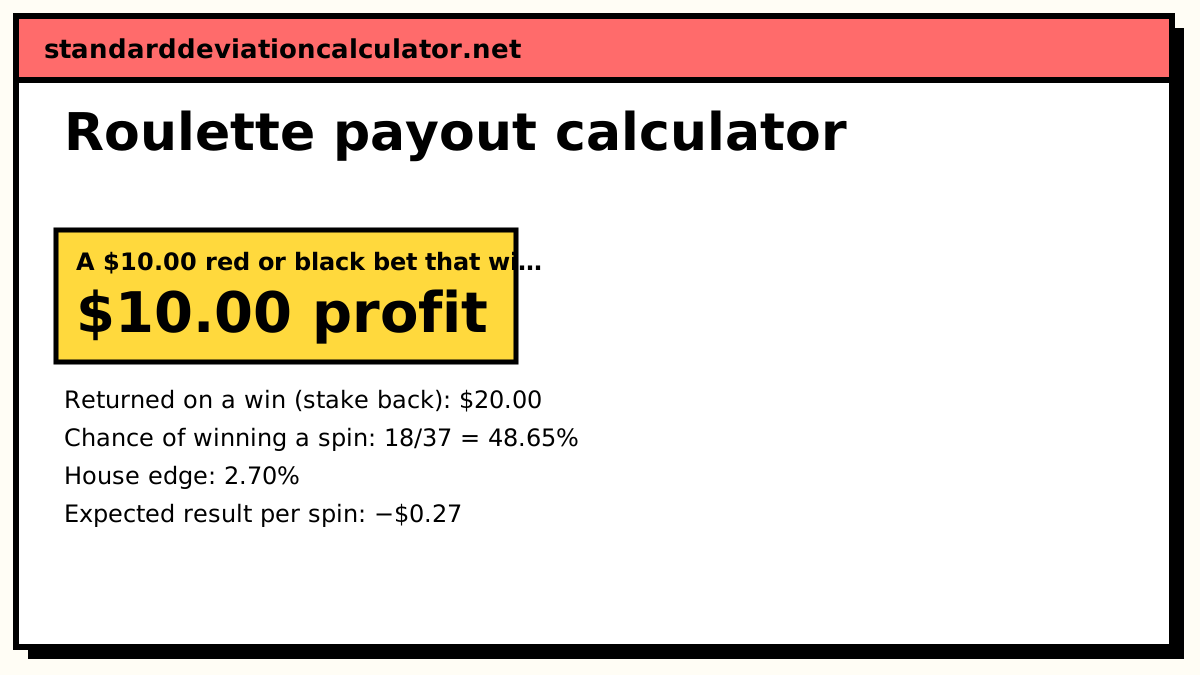
| Red or black | 1 to 1 | 18/37 | 48.65% | 2.70% |
| Odd or even | 1 to 1 | 18/37 | 48.65% | 2.70% |
| Low (1–18) or high (19–36) | 1 to 1 | 18/37 | 48.65% | 2.70% |
Show the working, step by step
The ball lands in one of 37 equally likely pockets, and this bet covers 18 of them.
P(win) = 18 ÷ 37 = 0.48649
A win pays 1 to 1: a profit of 1 × stake, and the stake comes back too.
profit = 1 × $10.00 = $10.00, returned = $20.00
Expected value per spin: the chance of winning times the profit, minus the chance of losing times the stake.
EV = 0.48649 × $10.00 − 0.51351 × $10.00 = −$0.27
The house edge is the expected loss as a share of the stake.
edge = $0.27 ÷ $10.00 = 2.70%
Over 100 independent spins the expected results add, and the standard deviation grows with the square root of the number of spins.
100 × −$0.27 = −$27.03, SD = $10.00 × √100 = $99.96
On a single-zero wheel every bet has the same edge, 1/37 = 2.70%, because the payouts are set as if there were 36 pockets.
The formulas
A bet covering c numbers on a wheel with N pockets (37 on a European wheel, 38 on an American one) wins with probability c ÷ N and pays x to 1. For a stake of b:
profit on a win = x × b returned = (x + 1) × b EV per spin = (c ÷ N) × x × b − (1 − c ÷ N) × b house edge = −EV ÷ b
Roulette payouts are set as if the wheel had 36 pockets: x = 36 ÷ c − 1. That makes the edge (N − 36) ÷ N for nearly every bet, 1/37 = 2.70% or 2/38 = 5.26%. The American five-number bet pays 6 to 1 where fair pricing on 36 pockets would be 6.2 to 1, so its edge is higher: 3/38 = 7.89%.
A worked example
The default is $10 on red on a European wheel. Red covers 18 of the 37 pockets and pays 1 to 1.
P(win) = 18 ÷ 37 = 48.65% EV = 0.4865 × $10 − 0.5135 × $10 = −$0.27 edge = 0.27 ÷ 10 = 2.70%
A win returns $20: your $10 back plus $10 profit. Over 100 spins the expected result is 100 × −$0.27 = −$27.03. Each spin has a standard deviation of almost exactly $10, so over 100 spins the spread is $10 × √100 = $99.96. Being ahead after 100 spins needs 51 or more wins, which happens with probability 35.5%.
Put the same $10 on a single number and a win pays $350, but only 1 time in 37. The expected result per spin is still −$0.27; what changes is the spread, about $58 per spin instead of $10.
Interpreting the result
The house edge is the share of every amount you stake that you should expect to lose in the long run. It does not predict one night: over a few dozen spins, luck is far bigger than the edge. The table under the results shows every bet on the chosen wheel. Notice that the edge column is the same for almost every row, which is why the choice between inside and outside bets is a choice about variance, not value.
Session results and variance
The standard deviation per spin is what makes roulette feel so different from its expected value. For even-money bets it is about one stake, and for a straight-up bet about 5.8 stakes. Over n spins the expected loss grows in proportion to n, but the spread grows only with √n. That is why the chance of finishing ahead falls as a session gets longer: 35.5% after 100 spins on red, and far less after 10,000.
Common mistakes
- Confusing “pays 35 to 1” with “returns 35”. A winning $1 straight-up bet gives back $36 in total.
- Treating an American and a European table as the same game. The extra 00 nearly doubles the edge.
- Believing red is due after a run of black. Each spin is independent; the wheel does not balance out.
Common questions
What does a straight-up bet pay in roulette?
35 to 1. A $10 bet on a single number that wins returns $360: $350 profit plus the $10 stake. The chance of winning is 1/37 on a European wheel and 1/38 on an American one.
Which roulette bet has the best odds?
On any one wheel, every bet has the same house edge except the American five-number bet. On a European wheel it is 1/37 = 2.70% for every bet; with la partage, even-money bets drop to 1.35%. On an American wheel it is 2/38 = 5.26%, and 7.89% for the five-number top line. The bets differ in how often you win and how much, not in how much you lose on average.
What is la partage?
A rule on many French and some European tables: if the ball lands on zero, even-money bets (red/black, odd/even, low/high) lose only half the stake. It halves the house edge on those bets to 1/74 = 1.35%. En prison is a similar rule with the same edge. The calculator applies la partage only where it exists: even-money bets on a single-zero wheel.
Can a betting system beat the house edge?
No. Each spin has a negative expected value, and the expected value of any sequence of bets is the sum of the expected values of the bets in it. Doubling after a loss (the Martingale) turns many small wins into occasional large losses; the average loss per unit staked stays at the house edge.
Why is my chance of being ahead after 100 spins so high if the house wins?
Because the edge is small next to the swings. For $10 on red, 100 spins lose $27 on average, but the standard deviation is about $100, so about 36% of sessions finish ahead. The more you play, the more the average loss dominates: after 10,000 spins you would expect to lose $2,703 with a standard deviation of about $1,000.
Related calculators
-
Probability calculator
Combine the chances of independent events.
-
Binomial distribution
The chance of winning k of n spins.
-
Dice probability calculator
Exact odds for sums of dice.