The standard deviation symbol: σ, s, and everything around them
The population standard deviation is written σ, the lowercase Greek letter sigma. The sample standard deviation is written s. On a calculator the same pair appears as Sx (sample, divides by n − 1) and σx (population, divides by n): which to use. Choosing the wrong one is the most common notation error in introductory statistics, and this page explains the system that makes the choice obvious.
The complete notation table
| Symbol | Say it | Means | Population or sample |
|---|---|---|---|
| σ | sigma | Standard deviation | Population |
| s | ess | Standard deviation | Sample |
| σ² | sigma squared | Variance | Population |
| s² | ess squared | Variance | Sample |
| μ | mu | Mean | Population |
| x̄ | x-bar | Mean | Sample |
| N | big en | Number of values | Population |
| n | little en | Number of values | Sample |
| Σ | capital sigma | "Add all of these up" | Either |
| σx̄ / SE | sigma x-bar | Standard error of the mean | Either |
| σp / sp | sigma pooled | Pooled standard deviation | Either |
| z | zee / zed | Z-score, in standard deviations | Either |
| CV / %RSD | – | Spread relative to the mean | Either |
The rule behind the whole system
Statistics uses a consistent convention that makes almost all of this table predictable:
- Greek letters describe populations. σ, μ, ρ, β. These are parameters: fixed, real, and usually unknowable.
- Roman letters describe samples. s, x̄, r, b. These are statistics: computed from data you actually have, and different for every sample you might draw.
So the question "σ or s?" is really the question "is this number describing a whole population, or a sample drawn from one?", the same question that decides which denominator to use in the formula. Answer it once and the notation follows. For the other letters inside the formula itself (xᵢ, x̄, n and Σ), see what lowercase s and the other formula symbols mean.
σ and Σ are not the same symbol
Both are called sigma and they appear in the same formula, which causes real confusion:
σ = √[ Σ(x − μ)² / N ]
Lowercase σ is a quantity: the standard deviation itself, the thing being defined. Capital Σ is an instruction: an operator that says "sum the following over every value". One is a noun, the other is a verb.
How to type each symbol
| Symbol | Windows | Mac | LaTeX | HTML | Unicode |
|---|---|---|---|---|---|
| σ | Alt+229 | Char viewer | \sigma | σ | U+03C3 |
| Σ | Alt+228 | Option+w (∑) | \Sigma | Σ | U+03A3 |
| μ | Alt+230 | Option+m | \mu | μ | U+03BC |
| x̄ | x then Alt+0772 | x + combining macron | \bar{x} | x̄ | U+0304 |
In Word, typing the Unicode hex code and pressing Alt+X converts it in
place, so 03C3 then Alt+X gives σ. On a Mac,
Ctrl+Cmd+Space opens the character viewer where you can
search by name.
Note that x̄ is not a single character: it is the letter x followed by U+0304, the combining macron. That is why it sometimes renders badly in fonts that lack proper combining-mark support, and why copying it out of a PDF often loses the bar.
Sx or σx? Reading the symbols on your calculator
Run one-variable statistics on any calculator and it returns two standard deviations, not one. Neither is wrong and neither is a rounding of the other; they are the sample and population figures, sitting next to each other, and the machine will not tell you which one your assignment wants.
On a TI, Sx is the sample standard deviation (the n − 1 one) and σx is the population standard deviation (the N one). If you are working from a sample (which, in a statistics class, you almost always are), the answer you want is Sx.
| Calculator | Sample SD (n − 1) | Population SD (N) | Mean |
|---|---|---|---|
| TI-84 Plus, TI-84 Plus CE, TI-83 | Sx | σx | x̄ |
| TI-Nspire | sx := sn−1x | σx := σnx | x̄ |
| Casio fx-991, fx-115, fx-83 | sx (older: xσn−1) | σx (older: xσn) | x̄ |
| Sharp EL-W516, EL-531 | sx | σx | x̄ |
| HP 35s, HP Prime | sx | σx | x̄ |
| Excel and Sheets | STDEV.S | STDEV.P | AVERAGE |
Two traps worth knowing. The lowercase x in Sx and σx is just the name of the variable, not part of the statistic; on a list called L2 the same figures may appear as SL2 and σL2. And the σx a calculator prints is not the standard error, even though the standard error is also written σx̄; the bar over the x is the entire difference between them.
If the two numbers on your screen are far apart, your sample is small; that gap is Bessel's correction, and it shrinks to nothing as n grows. The TI-84 and Casio guides have the full keystrokes.
How to pronounce them out loud
| Written | Said aloud | Not |
|---|---|---|
| σ | "sigma" | "sigmar", "signa" |
| σ² | "sigma squared" | "sigma two" |
| s | "ess" | "sample" |
| x̄ | "x-bar" | "x-dash", "x-line" |
| μ | "mew" (rhymes with few) | "moo" |
| σ̂ | "sigma-hat" | "sigma-caret" |
| Σ | "sum over" or "capital sigma" | "sigma" alone, which invites confusion with σ |
| Sx | "ess sub x" or just "ess ex" | – |
Reading a formula aloud, σ = √[ Σ(x − μ)² / N ] is "sigma equals the square root
of the sum of x minus mu, squared, over big N". Saying "sum over" for Σ rather than "sigma"
keeps the operator and the quantity audibly distinct.
Copy and paste the symbols
Plain Unicode, safe to paste into Word, Google Docs, email or a spreadsheet cell:
| Symbol | Name |
|---|---|
| σ | Population standard deviation |
| s | Sample standard deviation |
| σ² | Population variance |
| μ | Population mean |
| x̄ | Sample mean |
| Σ | Summation |
| σ̂ | Estimated sigma |
| √ | Square root |
The whole formulas, as one line each:
σ = √(Σ(x − μ)² / N) and s = √(Σ(x − x̄)² / (n − 1)).
The formula page has these in LaTeX, Excel and
code form as well.
Notation you may also meet
σ̂ (sigma hat)
A hat over a symbol means "estimated from data", so σ̂ is an estimate of the population standard deviation σ. In most introductory texts it is simply the sample standard deviation s, though some authors use σ̂ for the version that divides by n instead of n − 1, so check which one a book means. In regression output, σ̂ usually denotes the residual standard error: the typical distance of the points from the fitted line. The same convention gives p̂ (an estimated proportion), μ̂ and β̂.
Other notation
- SD: plain text for standard deviation, common in journals: "mean 24.1 (SD 3.2)".
- SEM: standard error of the mean. Frequently confused with SD in published figures; check which one an error bar represents, because SEM is always the smaller and more flattering of the two.
- sx and σx: the standard deviation of a variable named x, used when several variables are in play.
Related calculators
-
Standard deviation calculator
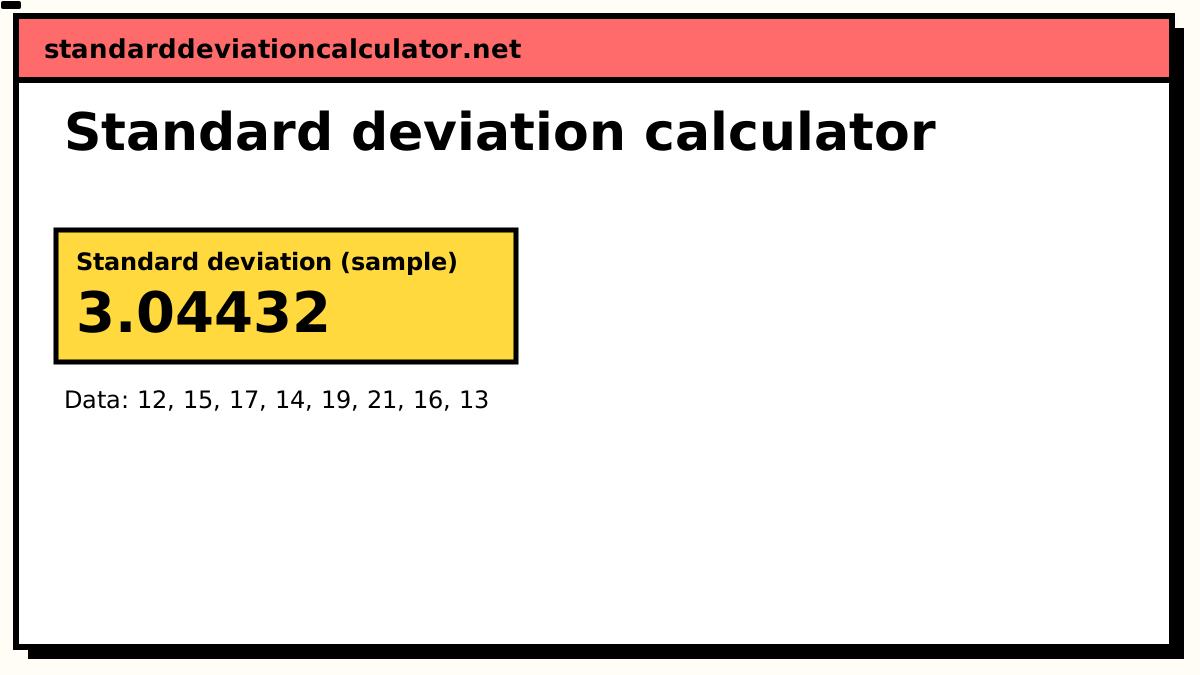
Compute σ or s from your own numbers.
-
SD on TI-84
Find Sx and σx on a calculator in three keystrokes.
-
Standard error
The σx̄ in the table above, calculated.
-
Variance calculator
The same calculation, stopped before the square root.
-
Sample vs population
The distinction that σ and s exist to mark.
-
The formula explained
Where each of these symbols appears, and what it does there.
Common questions
What is Sx in statistics?
Sx is the sample standard deviation of the x values, the one that divides by n − 1. It is what TI and Casio calculators print for s. The σx shown next to it is the population standard deviation, which divides by n. If your data is a sample from a larger group, which it usually is in a class exercise, report Sx.
Is Sx or σx the standard deviation?
Both are. Sx is the sample standard deviation (n − 1) and σx the population one (n). For the same data Sx is always slightly larger; the gap shrinks as n grows. Use σx only when the list is the entire group you care about. On a keyboard without a σ key, σx is often typed as "ox"; it is the same population standard deviation.
What is the symbol (sign) for standard deviation?
It depends on which standard deviation you mean. The symbol that represents the population standard deviation is the lowercase Greek sigma, σ. The sample standard deviation is a plain italic s. SD and "std dev" are written abbreviations for the words, not symbols, and do not say which of the two you mean: the SD symbol is σ for a population and s for a sample. Using σ for a sample statistic is the single most common notation mistake in introductory statistics.
What is the difference between σ and s?
σ is a parameter: a fixed, usually unknown property of a whole population. s is a statistic: a number computed from a sample, which varies from sample to sample and is used to estimate σ.
The convention runs throughout statistics: Greek letters for the truth you cannot see, Roman letters for the estimates you can compute. μ and x̄ follow the same pattern.
How do I type the σ symbol?
Windows: hold Alt and type 229 on the numeric keypad, or use
Win+. and search "sigma".
Mac: Option+w gives ∑ (summation); for σ use
Ctrl+Cmd+Space and search "sigma".
Word: type 03C3 then press Alt+X.
LaTeX: \sigma for σ, \Sigma for Σ.
HTML: σ and Σ.
What does the Σ symbol mean?
Capital sigma, Σ, is the summation operator: it means "add up everything that follows".
It is a different symbol from lowercase σ despite sharing a name. In
Σ(x − x̄)² it instructs you to compute (x − x̄)² for every value and total the
results.
What is σ² and what is σx̄?
σ² is the variance: the standard deviation squared. σx̄ (sometimes written σ_M or SE) is the standard error of the mean, the standard deviation of the sampling distribution of the mean, equal to σ/√n.
What does Sx mean on a calculator?
Sx is the sample standard deviation that your calculator computes when you run the statistics mode. The "x" tells you it is working on the x-list (the data you entered), and the "S" tells you it divides by n − 1. On TI and Casio calculators it appears in the stats summary screen alongside σx, the population version that divides by n. If your data is a sample, which it almost always is in a class exercise, Sx is the one to report.
What is the symbol for population standard deviation?
The symbol for population standard deviation is the lowercase Greek sigma, σ. It follows the convention that Greek letters describe whole populations. On a calculator, population standard deviation is shown as σx or sometimes just σ.
What is the symbol for sample standard deviation?
The symbol for sample standard deviation is a plain italic s. On TI and Casio calculators it appears as Sx. The italic s follows the convention that Roman letters describe samples. It divides by n − 1, which is why it is slightly larger than the population value for the same data.
What is sx and sy in statistics?
Sx is the sample standard deviation of the x-values (your primary dataset). Sy is the sample standard deviation of the y-values, used in regression. Both divide by n − 1. The corresponding population symbols are σx and σy.
How rare is a 3-sigma event?
For a normal distribution, 99.73% of values lie within ±3σ of the mean, so 0.27% (about 1 in 370) fall outside on one side or the other, and 0.135% (about 1 in 741) beyond +3σ alone. Real data with heavy tails produces 3-sigma events more often than that.
How do you calculate x − x̄?
Subtract the sample mean x̄ from each value x. For 2, 4 and 9 the mean is 5, so the deviations x − x̄ are −3, −1 and 4. They always add up to zero, which is why the standard deviation squares them before adding.
What is s²ₓ (s squared x)?
The sample variance of the variable x: the square of its sample standard deviation Sx. If a calculator shows Sx = 3, then s²ₓ = 9.
What is sp in statistics?
sp is the pooled standard deviation: one estimate of spread that combines several groups assumed to share the same σ. It is not better or worse than a single group's Sx; it answers a different question. See the pooled standard deviation calculator.
What does s mean in regression output?
In regression, s (or σ̂) is the residual standard error: the typical distance of the data points from the fitted line, in the units of y. It is the square root of the residual sum of squares divided by its degrees of freedom.
Frequently asked questions about standard deviation symbols
Common questions
What is the standard deviation symbol and how do I type it?
Copy-paste symbols: σ (U+03C3), Σ (U+03A3, sum), μ (U+03BC, mean), x̄ (x + U+0304), σx (population SD on calculators), Sx (sample SD on calculators). See standard deviation symbol for typing shortcuts.
How do I copy and paste the standard deviation symbol?
Copy-paste symbols: σ (U+03C3), Σ (U+03A3, sum), μ (U+03BC, mean), x̄ (x + U+0304), σx (population SD on calculators), Sx (sample SD on calculators). See standard deviation symbol for typing shortcuts.