Math calculators
Every math calculator on the site, grouped into nine topics from everyday arithmetic to calculus and linear algebra. Each one shows its working, so students can check homework step by step and anyone else can see where a number came from.
Math categories
-
Arithmetic
Arithmetic calculators with the working shown: long division, percentages, ratios, averages, primes, GCD and LCM, modular arithmetic and base conversion. 16 calculators.
-
Algebra
Algebra calculators that show each step: quadratic and linear equations, systems, polynomials, simplifying expressions, functions, sequences and binomials. 9 calculators.
-
Geometry
Geometry calculators with diagrams: area, perimeter, volume and surface area, triangles, circles, rectangles and regular polygons, with unit conversion. 8 calculators.
-
Trigonometry
Trigonometry calculators with exact values: sine, cosine, tangent and their inverses, triangle solving, trig equations on an interval and trig graphs. 9 calculators.
-
Calculus
Calculus calculators with steps: derivatives, integrals, limits, partial derivatives, series convergence, differential equations and multivariable calculus. 7 calculators.
-
Coordinate geometry
Coordinate geometry calculators: distance and midpoint, equations of lines, intersections, section formula, curves, conic sections, and lines and planes in 3D. 8 calculators.
-
Vectors and matrices
Vector and matrix calculators in exact fractions: dot and cross products, magnitude and direction, triple products, inverses, determinants and eigenvalues. 7 calculators.
-
Discrete math
Discrete math calculators: permutations and combinations, recurrences, inclusion–exclusion, sets and Venn diagrams, relations, Boolean algebra and graph theory. 9 calculators.
-
Applied math
Applied math calculators: SUVAT and energy, Ohm’s law, moles and pH, present value and NPV, elasticity, frequency tables and clinical 2×2 tables. 7 calculators.
Which calculator do I need?
| You have or want | Use |
|---|---|
| A percent of a number, or how much something rose or fell in percent | Percentage calculator |
| The roots of ax² + bx + c = 0 | Quadratic equation calculator |
| The area of a room, plot or shape | Area calculator |
| The missing sides and angles of a triangle | Triangle solver |
| The derivative of a function, with each rule named | Derivative calculator |
| A definite or indefinite integral | Integral calculator |
| The inverse, determinant or eigenvalues of a matrix | Matrix calculator |
| The number of ways to choose or arrange items | Permutation and combination calculator |
Everyday and school math
The calculators people reach for most: percentages, averages, factors and the size of shapes.
-
Percentage calculator
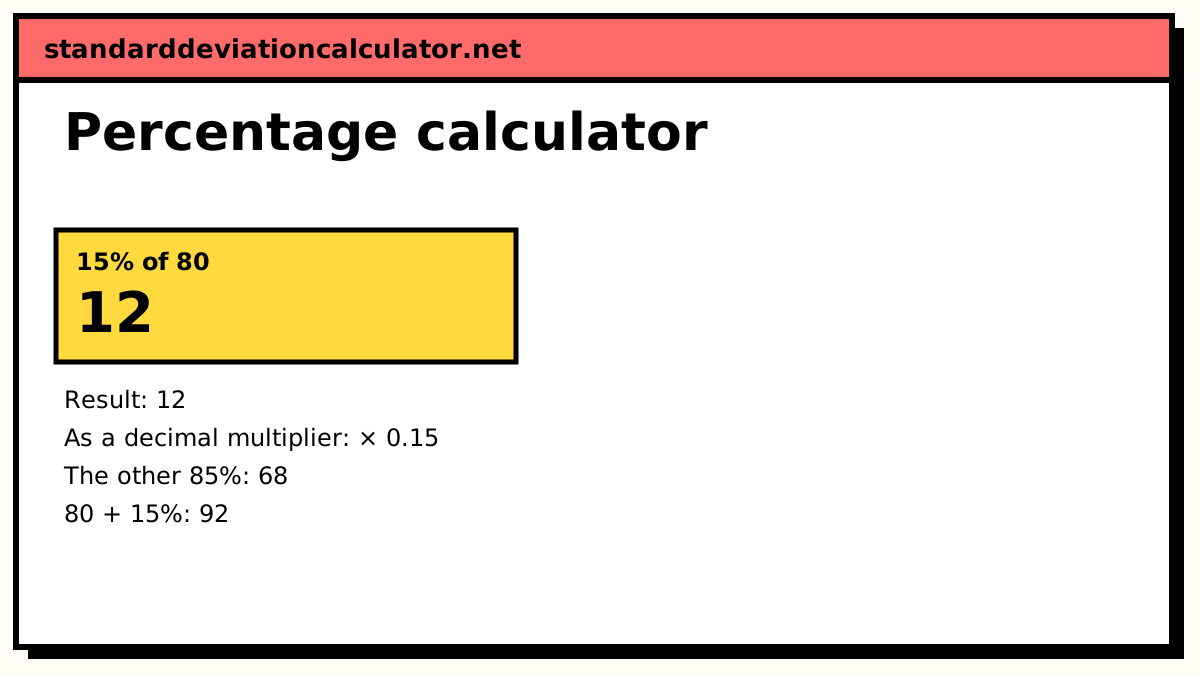
Percent of a number, percentage change, increase or decrease, and reverse percentages.
-
Average calculator
The mean of a list of numbers, plus the geometric, harmonic and trimmed means.
-
GCD and LCM calculator
GCD and LCM by the Euclidean algorithm and by prime factors, with Bézout coefficients.
-
Prime factorization calculator
Prime factors with exponents, the division ladder, and every divisor.
-
Area calculator
The area of thirteen shapes, with a labelled diagram and conversions to ft², acres and hectares.
-
Volume calculator
Volume and surface area of eleven solids, in cubic units, litres and gallons.
Algebra, trigonometry and calculus
Equation solvers and calculus tools for high school and university coursework.
-
Quadratic equation calculator
Roots of ax² + bx + c = 0 in exact surd or complex form, with the vertex and a graph.
-
Linear equation calculator
One linear equation step by step, or 2 × 2 and 3 × 3 systems by elimination or Cramer’s rule.
-
Triangle solver
Solve any triangle from three parts, with the ambiguous SSA case and a drawing to scale.
-
Derivative calculator
Derivatives up to the fourth, with each rule shown as a step, a tangent line and a graph.
-
Integral calculator
Antiderivatives with the method named, and definite or improper integrals, exact and numerical.
-
Matrix calculator
Inverse, determinant, RREF, rank, trace, powers and eigenvalues, in exact fractions.
How the math calculators are organised
The nine categories follow the order most courses teach them. Arithmetic covers the four operations, percentages, ratios and number theory. Algebra solves equations and works with expressions, functions and sequences. Geometry measures shapes and solids, and trigonometry handles angles, triangles and periodic graphs. Coordinate geometry puts points, lines and curves on axes, and calculus deals with rates of change, areas under curves and series.
The last three are more specialised. Vectors and matrices cover linear algebra, discrete math covers counting, sets, logic and graphs, and applied math gathers the formulas used in physics, engineering, chemistry and finance.
Exact answers where they exist
Where an exact answer exists, the calculators give it before the decimal. The quadratic x² − 2x − 1 = 0 returns x = 1 ± √2 as well as 2.4142 and −0.4142. The matrix calculator keeps fractions, so the inverse of [[2, 1], [1, 3]] comes back as (1/5)[[3, −1], [−1, 2]] and not as a row of recurring decimals. Arithmetic on whole numbers is done with arbitrary precision, so a 40-digit product is exact to the last digit.
Picking between close neighbours
- The triangle calculator and the triangle solver both start from three known parts. The solver is built around the sine and cosine rules and flags the ambiguous SSA case. The calculator adds heights, medians, the inradius and the circumradius.
- The matrix calculator works on one matrix (inverse, rank, eigenvalues). The matrix operations calculator combines two (A + B, AB, solving AX = B).
- For averages of data, the site’s statistics averages hub goes further than the average calculator, with the median, mode, weighted and grouped means.
Guides to read alongside
-
Statistics formulas
The formulas behind the averages and spread calculators, with notation explained.
-
Methodology
How the calculators compute and round their results, and how they are tested.
-
Learn statistics
Every guide on the site, from the meaning of standard deviation to software how-tos.