Finance
Compound interest calculator
Compound interest pays interest on the interest already earned, so the balance grows faster each year. Enter a principal, rate and time to see the final amount, add regular deposits if you save as you go, or switch the mode to find the rate, time or starting sum a goal needs.
━ Balance ┄ Principal
| Year | Interest | Balance |
|---|---|---|
| 1 | $511.62 | $10,511.62 |
| 2 | $537.79 | $11,049.41 |
| 3 | $565.31 | $11,614.72 |
| 4 | $594.23 | $12,208.95 |
| 5 | $624.63 | $12,833.59 |
| 6 | $656.59 | $13,490.18 |
| 7 | $690.18 | $14,180.36 |
| 8 | $725.49 | $14,905.85 |
| 9 | $762.61 | $15,668.47 |
| 10 | $801.63 | $16,470.09 |
| Total | $6,470.09 | $16,470.09 |
Show the working, step by step
Grow the principal: 5.00% compounded monthly for 10 years.
P × (1 + 0.0500 ÷ 12)^(12 × 10) = $10,000.00 × 1.647009 = $16,470.09 A = $16,470.09
Rule of 72: the money doubles in about 72 ÷ rate years.
72 ÷ 5.00 = 14.40 years (exact: 13.89 years)
Estimates: the rate is assumed constant, and tax, fees and inflation are left out. This is a calculation, not financial advice.
The formula
A = P(1 + r/n)^(nt) continuous: A = Pe^(rt)
P is the principal, r the nominal annual rate as a decimal (5% = 0.05), n the number of times interest is added each year and t the number of years. The interest earned is A − P. With a deposit D made at the end of each period, the deposits add their own future value:
FV of deposits = D × ((1 + i)^N − 1) ÷ i
where i is the rate per deposit period and N the number of deposits. Deposits made at the start of each period earn one extra period of interest, so multiply by (1 + i).
A worked example
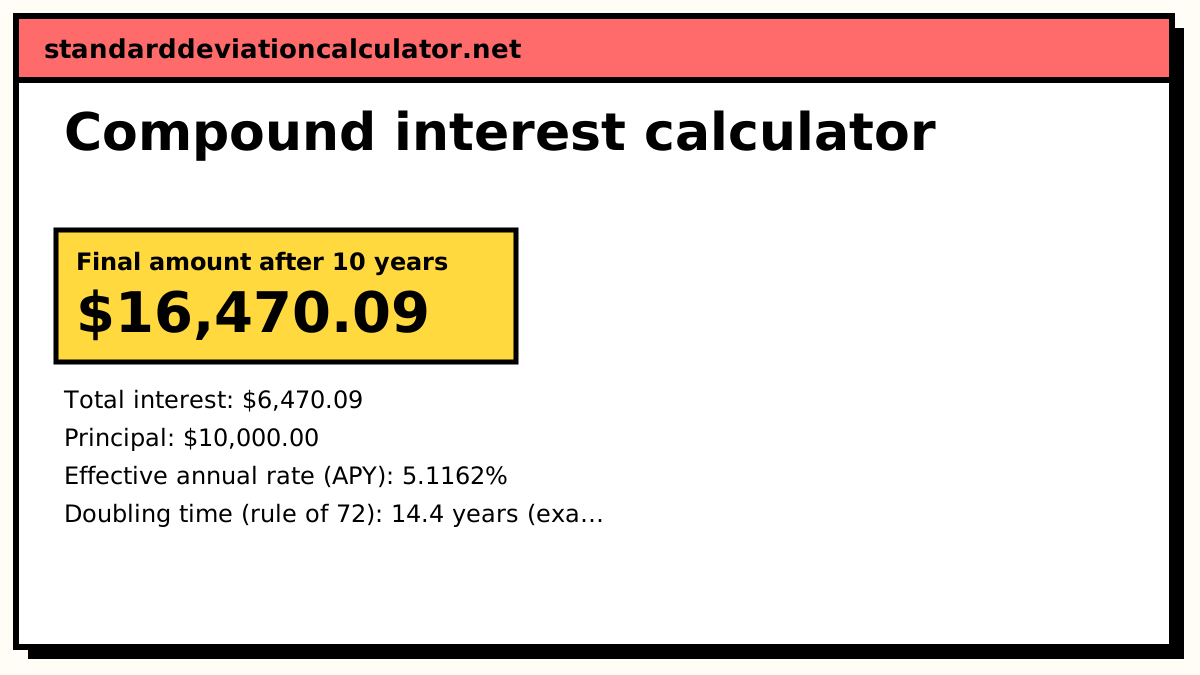
The calculator starts with $10,000 at 5% a year, compounded monthly, for 10 years.
- Rate per month: 0.05 ÷ 12 = 0.0041667.
- Number of compounding periods: 12 × 10 = 120.
- Growth factor: 1.0041667^120 = 1.647009.
- A = $10,000 × 1.647009 = $16,470.09, so the interest is $6,470.09.
Add a $100 deposit at the end of each month and the balance after 10 years is $31,998.32: the same $16,470.09 from the lump sum plus $15,528.23 from the 120 deposits of $100.
Compounding frequency compared
$10,000 at 5% for 10 years:
| Compounding | Final amount | Interest |
|---|---|---|
| Yearly | $16,288.95 | $6,288.95 |
| Half-yearly | $16,386.16 | $6,386.16 |
| Quarterly | $16,436.19 | $6,436.19 |
| Monthly | $16,470.09 | $6,470.09 |
| Daily (365) | $16,486.65 | $6,486.65 |
| Continuous | $16,487.21 | $6,487.21 |
Solving for the rate, time or principal
Rearranging the formula answers the other common questions. To double $10,000 to $20,000 in 10 years with monthly compounding needs r = 12 × (2^(1/120) − 1) = 6.95% a year. At 5% the same doubling takes t = ln 2 ÷ (12 × ln(1 + 0.05/12)) = 13.89 years. And to have $20,000 in 10 years at 5% you need to put in $12,143.22 today.
Common mistakes
- Entering 5 instead of 0.05 in a spreadsheet formula. The calculator takes the percentage and converts it for you.
- Mixing APR and APY. If a bank quotes an APY, it already includes compounding; use it with yearly compounding, or you will count the compounding twice.
- Forgetting inflation. $16,470 in 10 years buys less than $16,470 today. The inflation calculator converts it back to today’s money.
Results are estimates: they assume the rate stays the same for the whole period and ignore tax and fees.
Common questions
What is the compound interest formula?
A = P(1 + r/n)^(nt), where P is the principal, r the annual rate as a
decimal, n the number of compounding periods a year and t the time in years. For continuous
compounding it becomes A = Pe^(rt). $10,000 at 5% compounded monthly for 10 years
grows to $16,470.09.
How much difference does the compounding frequency make?
Less than most people expect once you go past monthly. $10,000 at 5% for 10 years becomes $16,288.95 compounded yearly, $16,470.09 monthly, $16,486.65 daily and $16,487.21 continuously. The jump from yearly to monthly is worth about $181; from monthly to continuous, about $17.
What is the rule of 72?
A shortcut for doubling time: divide 72 by the annual rate in percent. At 5% money doubles in about 72 ÷ 5 = 14.4 years; the exact answer with yearly compounding is 14.21 years, and 13.89 with monthly compounding. The rule is close for rates between about 4% and 12% and drifts further off outside that range.
What is the difference between APR and APY?
APR is the nominal rate r in the formula. APY (the effective annual rate) is what you
actually earn in a year after compounding: (1 + r/n)^n − 1. A 5% APR compounded
monthly is an APY of 5.1162%. When comparing savings accounts, compare APYs.
How do I calculate compound interest in Excel?
For a lump sum, =P*(1+r/n)^(n*t), for example =10000*(1+0.05/12)^(12*10).
With regular deposits use =FV(rate, nper, pmt, pv):
=FV(0.05/12, 120, -100, -10000) returns 31,998.32 for $10,000 plus $100 a month.
The minus signs mean money paid in.
Related calculators
-
Investment calculator
Contributions, a year-by-year table, and the saving a target needs.
-
Finance (TVM) calculator
Solve any of N, I/Y, PV, PMT and FV.
-
Inflation calculator
The same compounding applied to prices.
-
Geometric mean
The average growth rate of uneven returns.