Statistics
Geometric mean calculator
The geometric mean is the average for things that multiply: growth rates, returns, ratios. Enter positive values for their geometric mean, or switch to growth rates to get the average compound rate per period. The arithmetic mean calculator shows the arithmetic, geometric and harmonic means side by side.
Separate with commas, spaces or new lines.
Each dot is a value. The geometric mean always lies between the harmonic and arithmetic means.
| x | ln x |
|---|---|
| 4 | 1.3863 |
| 8 | 2.0794 |
| 16 | 2.7726 |
| 2 | 0.69315 |
| 9 | 2.1972 |
| Σ | 9.1287 |
Show the working, step by step
Multiply the values together.
4 × 8 × 16 × 2 × 9 = 9216
Take the nth root, where n = 5.
GM = 9216^(1/5) = 6.20738
The same answer by logarithms, which is how it is computed here (a long product can overflow):
GM = exp(Σ ln x ÷ n) = exp(9.1287 ÷ 5) = 6.20738
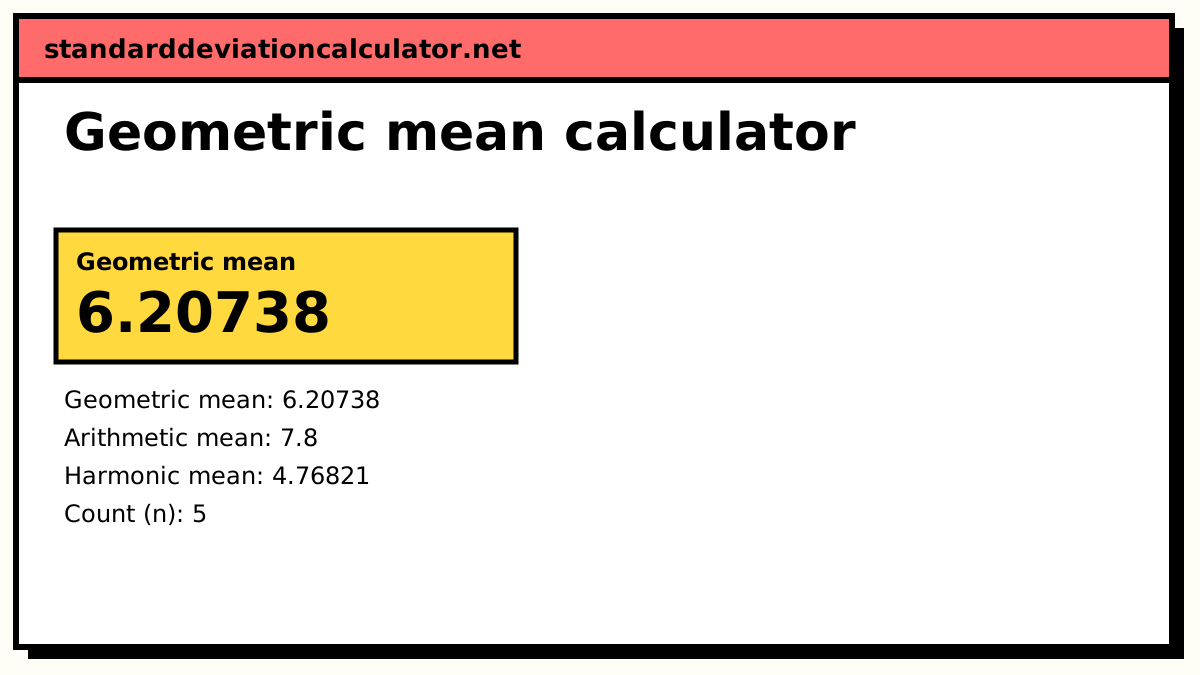
For positive values the means always fall in the order harmonic ≤ geometric ≤ arithmetic: 4.7682 ≤ 6.2074 ≤ 7.8. They are equal only when every value is the same.
The formula
GM = (x₁ × x₂ × … × xₙ)^(1/n) = exp( Σ ln xᵢ ÷ n )
Multiply the n values and take the nth root. The second form is the same number worked through logarithms: average the logs, then undo the log. Calculators use it because a long product overflows, while a sum of logs does not.
A worked example
The calculator's default data is 4, 8, 16, 2, 9.
- Product: 4 × 8 × 16 × 2 × 9 = 9,216.
- n = 5, so take the fifth root: 9,216^(1/5) = 6.2074.
- Check with logs: Σ ln x = 9.1287; 9.1287 ÷ 5 = 1.8257; e^1.8257 = 6.2074.
The arithmetic mean of the same values is 7.8. The geometric mean is lower, as it always is for positive data that is not all the same.
Average growth rate
An investment returns +20%, −10% and +15% over three years. The growth factors are 1.20, 0.90 and 1.15; their product is 1.242, so the money grew 24.2% in total. The geometric mean of the factors is 1.242^(1/3) = 1.0749, an average of 7.49% a year. The arithmetic average of the three rates is 8.33%, which compounded for three years would give 27.1%, more than the investment actually earned.
Geometric, arithmetic and harmonic means
| Mean | Formula | Use it for |
|---|---|---|
| Arithmetic | Σx ÷ n | Quantities that add: heights, marks, costs |
| Geometric | (Πx)^(1/n) | Quantities that multiply: growth, returns, ratios |
| Harmonic | n ÷ Σ(1/x) | Rates over a fixed amount: speeds over equal distances |
Common questions
What is the geometric mean?
The nth root of the product of n values: GM = (x₁ × x₂ × … × xₙ)^(1/n). It is
the single value which, multiplied by itself n times, gives the same product as the data.
For 4, 8, 16, 2 and 9 the product is 9,216, and its fifth root is 6.2074.
When should I use the geometric mean instead of the arithmetic mean?
When the numbers multiply rather than add: growth rates, investment returns, ratios, index numbers and anything spread over several orders of magnitude, such as bacterial counts. Averaging returns of +50% and −50% arithmetically gives 0%, but the money has fallen to 75% of where it started. The geometric mean gives −13.4% a period, which is what actually happened.
Can the geometric mean be calculated with zero or negative numbers?
No. A single zero makes the product zero whatever the other values are, and a negative value has no real logarithm (and no real even root). For returns, convert each rate into a growth factor first: −20% becomes 0.8, which is positive. Choose “Growth rates in %” above and the calculator does that conversion for you.
How do I calculate the geometric mean in Excel?
=GEOMEAN(A2:A10). For growth rates stored as percentages in A2:A10, use
=GEOMEAN(1+A2:A10)-1 (entered as an array formula in older versions of Excel).
Google Sheets has the same GEOMEAN function.
Why is the geometric mean always smaller than the arithmetic mean?
For positive numbers, harmonic mean ≤ geometric mean ≤ arithmetic mean, with equality only when every value is the same. The gap widens as the values spread out, which is why an arithmetic average of volatile returns overstates the growth an investor actually got.
Related calculators
-
Harmonic mean
The average for rates such as speeds and prices per unit.
-
Mean (average)
The ordinary arithmetic mean, with the sum and count shown.
-
Weighted mean
An average in which some values count for more.
-
Compound interest
Growth at a fixed rate, compounded over time.