Arithmetic mean calculator
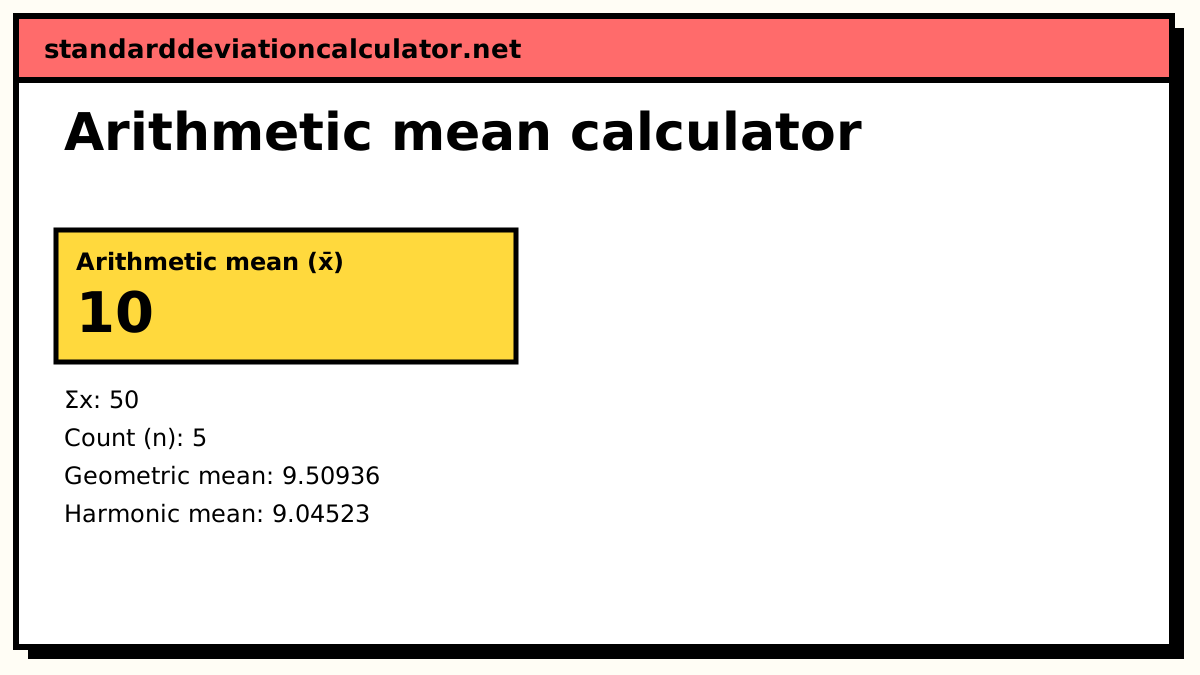
Enter a list of numbers or a frequency table and get the arithmetic mean with the sum Σx, the count n and each step. The calculator also gives the geometric and harmonic means of the same data, so you can see how far apart the three averages are and check which one your problem needs.
Separate with commas, spaces or new lines.
Leave blank to use the middle value or class midpoint.
Leave blank for the class width, or the largest number dividing every deviation.
| Mean | Formula | Value |
|---|---|---|
| Arithmetic (AM) | Σx ÷ n | 10 |
| Geometric (GM) | exp(Σ ln x ÷ n) | 9.50936 |
| Harmonic (HM) | n ÷ Σ(1/x) | 9.04523 |
Show the working, step by step
Count the values.
n = 5
Add the values.
6 + 8 + 12 + 15 + 9 = 50
Divide the sum by the count.
x̄ = Σx ÷ n = 50 ÷ 5 = 10
For comparison, the geometric and harmonic means of the same data.
GM = exp(11.2614 ÷ 5) = 9.50936 HM = 5 ÷ 0.552778 = 9.04523
AM ≥ GM ≥ HM for positive data: 10 ≥ 9.5094 ≥ 9.0452. The wider the spread of the values, the further apart the three means sit.
The formula
List: x̄ = Σx ÷ n Frequency table: x̄ = Σfx ÷ N, N = Σf
For a list, add the values and divide by how many there are. For a frequency table each value x counts f times, so multiply before adding and divide by the total frequency N, not by the number of rows. For class intervals, x is the midpoint of each class.
Worked example (the default numbers)
Take 6, 8, 12, 15 and 9. The sum is Σx = 6 + 8 + 12 + 15 + 9 = 50, and n = 5, so x̄ = 50 ÷ 5 = 10.
For the same five numbers:
| Mean | Working | Value |
|---|---|---|
| Arithmetic | 50 ÷ 5 | 10 |
| Geometric | (6 × 8 × 12 × 15 × 9)1/5 = 77,7601/5 | 9.509 |
| Harmonic | 5 ÷ (1/6 + 1/8 + 1/12 + 1/15 + 1/9) = 5 ÷ 0.55278 | 9.045 |
So 10 ≥ 9.509 ≥ 9.045, as AM ≥ GM ≥ HM says it must be for positive data. The three values are close here because the numbers are not very spread out. Try 1, 10 and 100: the arithmetic mean is 37, the geometric mean 10 and the harmonic mean about 2.7.
The geometric and harmonic means only exist when every value is above zero. Enter −3, 5, 10 and the arithmetic mean is still 4, but the calculator reports the other two as undefined: ln 0 and 1 ÷ 0 have no value, and with negative numbers the formulas give nonsense.
The assumed-mean and step-deviation short-cuts
Assumed mean: x̄ = A + Σfd ÷ N, d = x − A Step deviation: x̄ = A + (Σfu ÷ N) × h, u = (x − A) ÷ h
Both give exactly the same answer as Σfx ÷ N. They exist to make hand arithmetic easier with grouped data. For the default list with A = 9, the deviations are −3, −1, 3, 6 and 0, which add to 5, and x̄ = 9 + 5 ÷ 5 = 10.
Switch the calculator to class intervals to see the grouped version. With classes 0–10, 10–20, 20–30, 30–40 and 40–50 and frequencies 5, 8, 15, 16 and 6, the midpoints are 5, 15, 25, 35 and 45. With A = 25 and h = 10 (the class width), u runs −2, −1, 0, 1, 2 and Σfu = −10 − 8 + 0 + 16 + 12 = 10. Then x̄ = 25 + (10 ÷ 50) × 10 = 27, the same as Σfx ÷ N = 1,350 ÷ 50.
When the arithmetic mean is the wrong average
The arithmetic mean answers one question: what equal share would each observation get if the total were split evenly? When the total is not what matters, it misleads.
Growth factors multiply rather than add. An investment that rises 50% and then falls 50% ends at 1.5 × 0.5 = 0.75 of where it started. The arithmetic mean of the two rates is 0%, which suggests no change. The geometric mean of the factors, √0.75 = 0.866, correctly gives an average loss of about 13.4% a period. Use the geometric mean calculator for returns, population growth and index ratios.
Rates over a fixed amount need the harmonic mean. Drive a distance at 60 km/h and the same distance back at 40 km/h and your average speed is 2 ÷ (1/60 + 1/40) = 48 km/h, not 50, because you spend longer at the slower speed. The harmonic mean calculator handles this and the weighted version.
Skewed data drag the mean towards the long tail. Seven salaries of 30, 32, 35, 38, 40, 45 and 300 thousand have a mean of about 74.3 thousand, higher than six of the seven people earn. The median, 38, describes the typical salary better. Report both when the data are skewed.
Common mistakes
- Dividing Σfx by the number of rows in a frequency table instead of by N = Σf.
- Using the lower class limit instead of the midpoint for class intervals.
- Averaging percentages or rates that apply to different bases without weighting them. Use the weighted mean instead.
- Forgetting to multiply by h at the end of the step-deviation method.
Common questions
What is the arithmetic mean?
The sum of the values divided by how many there are: x̄ = Σx ÷ n. It is what most people mean by “the average”. For 6, 8, 12, 15 and 9 the sum is 50 and there are 5 values, so the arithmetic mean is 10.
Is the arithmetic mean the same as the average?
In everyday use, yes. Strictly, “average” covers any measure of centre, including the median, the mode, and the geometric and harmonic means. When a question says “average” without qualification it almost always wants the arithmetic mean.
Why is the arithmetic mean always at least as large as the geometric and harmonic means?
For positive numbers, AM ≥ GM ≥ HM is a theorem (the inequality of arithmetic and geometric means, extended to the harmonic mean). Taking logs or reciprocals before averaging pulls large values in more than small ones, so the GM and HM lean towards the smaller values. The three are equal only when every value is the same.
Can the arithmetic mean be negative or zero?
Yes. It works for any real numbers: the mean of −3, 5 and 10 is 12 ÷ 3 = 4, and the mean of −2 and 2 is 0. The geometric and harmonic means are different: they need every value to be positive, and the calculator marks them as undefined otherwise.
Does the assumed mean A have to be one of the data values?
No. Any number gives the same final answer, because x̄ = A + Σd ÷ n adds back exactly what was subtracted. A value near the middle keeps the deviations small, which is the whole point of the short-cut.
Related calculators
-
Geometric mean
The right average for growth rates and ratios.
-
Harmonic mean
The right average for speeds and other rates over a fixed amount.
-
Mean of a series
Direct, short-cut and step-deviation working for textbook series.