Statistics
Missing value and missing frequency calculator
Work backwards from a known mean. Type a letter where the missing value or frequency goes, enter the mean, and the calculator sets up the equation, solves it and checks the answer.
For example: 12, 15, x, 20. Exactly one letter (or ?) marks the missing value.
Solid bar: the frequency just found. With it in place the bars balance at the red line, the known mean.
| Class | Mid-value x | f | fx |
|---|---|---|---|
| 11–13 | 12 | 7 | 84 |
| 13–15 | 14 | 6 | 84 |
| 15–17 | 16 | 9 | 144 |
| 17–19 | 18 | 13 | 234 |
| 19–21 | 20 | f = 20 | 20f |
| 21–23 | 22 | 5 | 110 |
| 23–25 | 24 | 4 | 96 |
| Σ | 44 + f | 752 + 20f |
Show the working, step by step
Find the mid-value x of each class and multiply by f. The unknown row contributes f to Σf and 20f to Σfx.
Σf = 44 + f Σfx = 752 + 20f
Set the mean formula equal to the known mean.
18 = (752 + 20f) ÷ (44 + f)
Cross-multiply and collect the terms in f.
18 × 44 + 18f = 752 + 20f 792 − 752 = (20 − 18)f 40 = 2f
Solve.
f = 40 ÷ 2 = 20
Check.
x̄ = 1152 ÷ 64 = 18
The formulas
Missing observation: x = n × x̄ − Σ(known values) Missing frequency f at x₀: x̄ = (Σfx + f·x₀) ÷ (Σf + f) ⇒ f = (x̄ × Σf − Σfx) ÷ (x₀ − x̄)
In the second formula Σf and Σfx are over the known rows only, and x₀ is the value (or class mid-value) of the row with the missing frequency.
A worked example (the default data)
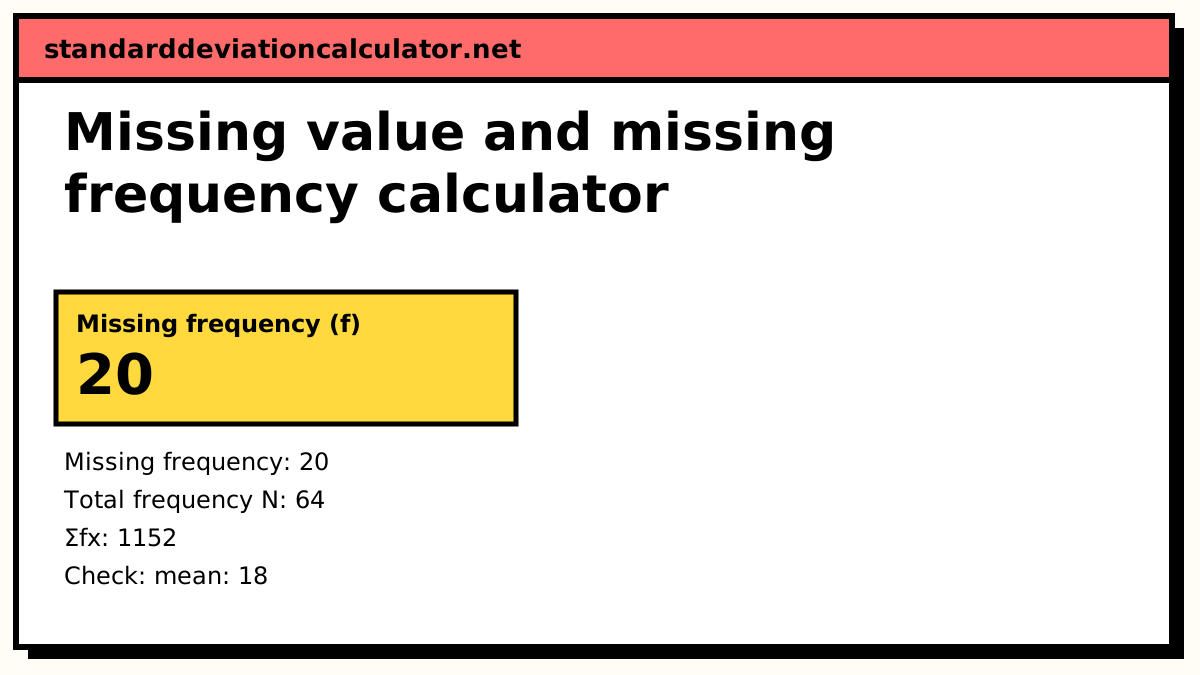
This is the pocket-allowance question from NCERT Class 10 maths: the mean daily pocket allowance of the children is ₹18; find the missing frequency f.
| Allowance (₹) | Mid-value x | Children f | fx |
|---|---|---|---|
| 11–13 | 12 | 7 | 84 |
| 13–15 | 14 | 6 | 84 |
| 15–17 | 16 | 9 | 144 |
| 17–19 | 18 | 13 | 234 |
| 19–21 | 20 | f | 20f |
| 21–23 | 22 | 5 | 110 |
| 23–25 | 24 | 4 | 96 |
| Total | 44 + f | 752 + 20f |
- Set the mean equal to 18: 18 = (752 + 20f) ÷ (44 + f).
- Cross-multiply: 792 + 18f = 752 + 20f.
- Collect terms: 40 = 2f, so f = 20.
- Check: N = 64, Σfx = 1,152, and 1,152 ÷ 64 = 18.
A missing observation
Switch to “Individual series”: the mean of 12, 15, x, 20, 18 and 24 is 18. Six observations with mean 18 must add to 108. The five known values add to 89, so x = 108 − 89 = 19.
Two missing frequencies
A typical exam version: the mean of the distribution 0–20 (17), 20–40 (p), 40–60 (32), 60–80 (q), 80–100 (19) is 50 and the total frequency is 120. The mid-values are 10, 30, 50, 70 and 90.
- From N: 17 + p + 32 + q + 19 = 120, so p + q = 52.
- From the mean: 170 + 30p + 1,600 + 70q + 1,710 = 120 × 50 = 6,000, so 30p + 70q = 2,520.
- Substitute q = 52 − p: 30p + 3,640 − 70p = 2,520, so 40p = 1,120 and p = 28, q = 24.
Enter those rows with p and q as the frequencies, set the mean to 50 and N to 120, and the calculator gives the same pair.
Common mistakes
- Forgetting that the unknown frequency also belongs in N: the denominator is 44 + f, not 44.
- Counting n without the missing observation. If six numbers are listed including x, n is 6.
- Using class limits instead of mid-values in Σfx.
- Leaving the answer as a fraction without checking it: a frequency of 7.5 children means something in the question was copied wrongly.
Common questions
How do I find a missing observation when the mean is given?
The mean times the number of observations gives their total, so the missing value is that
total minus the sum of the known values: x = n × x̄ − Σ(known). For 12, 15, x, 20,
18, 24 with mean 18, n = 6, the total must be 108, the known values add to 89, and x = 19.
How do I find a missing frequency when the mean is given?
Write Σf and Σfx with the unknown f in them, set Σfx ÷ Σf equal to the mean, and solve the linear equation. For the pocket-allowance table on this page, 18 = (752 + 20f) ÷ (44 + f), so 792 + 18f = 752 + 20f and f = 20.
What if two frequencies are missing?
You need a second fact, almost always the total frequency N. Then Σf = N gives one equation and Σfx = N × mean gives another, and the two are solved together. Mark both unknowns with letters (for example p and q) and enter N in the calculator.
Why does the calculator say no frequency works?
Adding observations at one value pulls the mean towards that value and never past it. If the known rows already have a mean of 17 and the unknown row sits at 20, no number of extra observations can make the mean 30. Such a question has a typo, or the mean belongs to a different table.
What if the answer is not a whole number?
A frequency counts people or items, so it should be whole. A fractional answer usually means the mean was rounded in the question, or a value was copied wrongly. The calculator shows the exact solution and flags it.
Related calculators
-
Mean of a series
The forward problem: the mean of a list, discrete or continuous series.
-
Median and mode
Median and mode for the same kinds of tables.
-
Average calculator
The mean of a plain list of numbers.
-
Linear equation solver
Solve the equation in f step by step on its own.