Math
Linear equation calculator
Type a single linear equation and get each step from expanding the brackets to checking the answer, or switch to a 2 × 2 or 3 × 3 system and solve it by elimination or Cramer's rule. The calculator also tells you when there is no solution or infinitely many.
Brackets, fractions such as x/2 and implicit multiplication (2x) are fine. Any single letter can be the unknown.
━ left side: y = 3(x − 2) + 4 ━ right side: y = 2x + 7
Show the working, step by step
Start from the equation as typed.
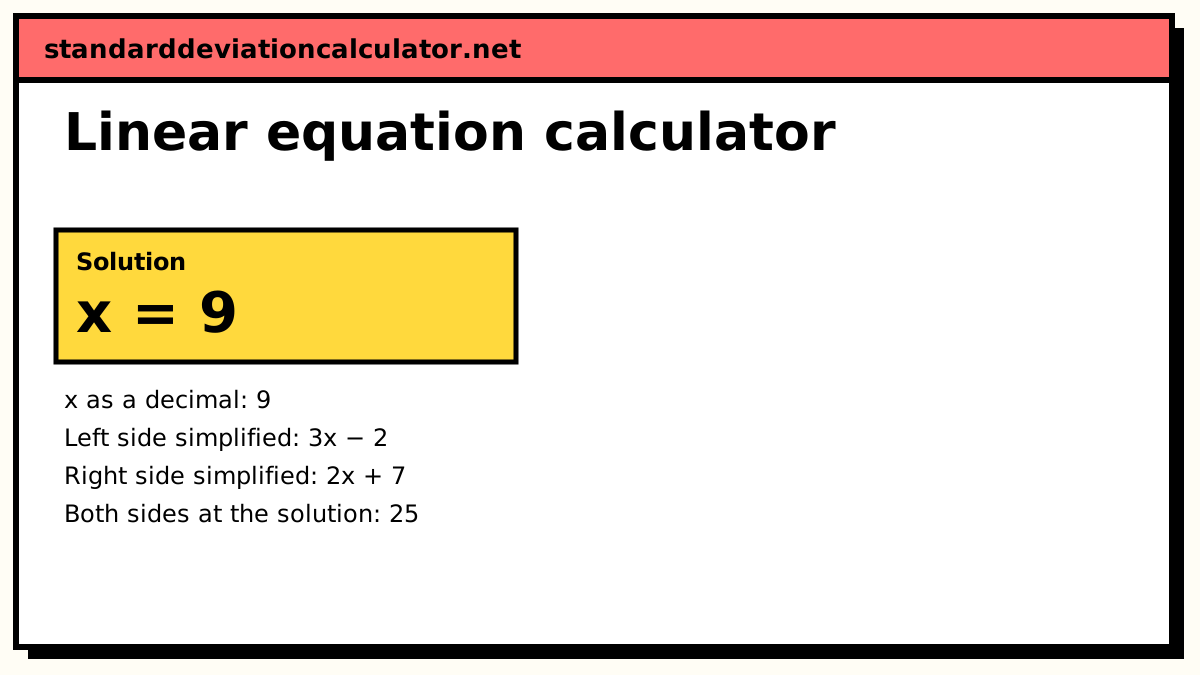
3(x − 2) + 4 = 2x + 7
Expand brackets and collect like terms on each side.
3x − 2 = 2x + 7
On both sides, subtract 2x and add 2, so the x terms are on the left and the numbers on the right.
3x − 2x = 7 − (−2) x = 9
Check by substituting x = 9 into the original equation.
Left: 3(x − 2) + 4 = 25 Right: 2x + 7 = 25
What makes an equation linear
A linear equation has every unknown to the first power only: no x², no √x, no 1/x and no products such as xy. Any linear equation in one unknown can be rearranged to
ax = b ⇒ x = b / a (a ≠ 0)
Brackets and fractions are allowed as long as the unknown is not in a denominator. The equation x/2 + 1/3 = 5 is linear (its solution is x = 28/3); 1/x = 4 is not, until you multiply through by x.
A worked example
The calculator's default is 3(x − 2) + 4 = 2x + 7.
- Expand and collect: 3x − 6 + 4 = 3x − 2, so the equation is 3x − 2 = 2x + 7.
- Subtract 2x from both sides and add 2 to both sides: 3x − 2x = 7 + 2.
- Collect: x = 9.
- Check: 3(9 − 2) + 4 = 25 and 2 × 9 + 7 = 25. Both sides agree.
Systems of equations
Choose a 2 × 2 or 3 × 3 system and enter the coefficients row by row, with 0 for a missing variable. The 2 × 2 default is 2x + 3y = 13 and x − y = −1.
- Elimination: R₂ → R₂ − (1/2)R₁ removes x and leaves −(5/2)y = −15/2, so y = 3. Back-substituting, 2x + 9 = 13 gives x = 2.
- Cramer's rule: D = 2 × (−1) − 3 × 1 = −5, Dx = 13 × (−1) − 3 × (−1) = −10 and Dy = 2 × (−1) − 13 × 1 = −15, so x = −10/−5 = 2 and y = −15/−5 = 3.
The 3 × 3 default (x + y + z = 6, 2x − y + z = 3, x + 2y − z = 2) has D = 7, Dx = 7, Dy = 14 and Dz = 21, so x = 1, y = 2 and z = 3.
How many solutions?
| After elimination | Determinant | Solutions | 2 × 2 picture |
|---|---|---|---|
| Every unknown has a pivot | D ≠ 0 | Exactly one | Lines cross once |
| A row reads 0 = (non-zero) | D = 0 | None | Parallel lines |
| A row reads 0 = 0 | D = 0 | Infinitely many | The same line twice |
For infinitely many solutions the calculator gives the general solution in terms of a free parameter t. For x + 2y = 3 and 2x + 4y = 6 that is x = 3 − 2t, y = t.
Common mistakes
- Expanding only the first term of a bracket. 3(x − 2) is 3x − 6, not 3x − 2.
- Changing the sign on only one side. Whatever you add or subtract, do it to both sides.
- Dividing by a negative and losing the sign. −4x = 8 gives x = −2.
- Misaligned columns in a system. Keep x, y and z in the same order in every equation, and use 0 for a missing term.
Common questions
How do you solve a linear equation step by step?
Expand any brackets, collect like terms on each side, move every term containing the unknown to one side and every number to the other, then divide by the coefficient of the unknown. For 3(x − 2) + 4 = 2x + 7: 3x − 2 = 2x + 7, so 3x − 2x = 7 + 2, and x = 9. Substituting back gives 25 on both sides.
When does a linear equation have no solution or infinitely many?
When the unknown cancels out. If what remains is true, such as 2 = 2 from 2(y + 1) = 2y + 2, the equation is an identity and every value works. If what remains is false, such as 0 = 1 from 2x = 2x + 1, it is a contradiction and no value works.
What is Cramer’s rule?
For a square system with a non-zero coefficient determinant D, each unknown equals a ratio of determinants: x = Dx/D, where Dx is D with the x column replaced by the constants. For 2x + 3y = 13 and x − y = −1, D = −5, Dx = −10 and Dy = −15, so x = 2 and y = 3. When D = 0 the rule gives no answer, and elimination has to decide between no solution and infinitely many.
Is elimination or Cramer’s rule better?
Elimination is less work by hand for three or more unknowns and handles the D = 0 cases directly. Cramer’s rule is tidy for 2 × 2 systems and gives each unknown independently, which is handy when you only need one of them. Both give identical answers when the solution is unique.
What does a 2 × 2 system look like on a graph?
Each equation is a straight line. One crossing point means one solution; parallel lines (same slope, different intercept) mean no solution; the same line twice means infinitely many. The graph under the calculator draws both lines and marks the intersection.
Related calculators
-
Quadratic equation calculator
Equations with an x² term, solved by the quadratic formula.
-
Determinant calculator
The determinants that Cramer’s rule is built on.
-
Matrix calculator
Inverses, products and row reduction for larger systems.
-
Straight line equation
The line through two points, in every standard form.
-
Simplify expressions
Expand and collect like terms in any expression.