Math
Sequence and series calculator
Choose the type of sequence and what you know about it: the first term with the common difference or ratio, or any two terms. The calculator gives the nth term, the sum of the first n terms, the sum to infinity where it exists, and lists the terms.
E.g. 1/2, 1/5, … has first term 1/2 and second term 1/5.
The term to find, and how many terms to add.
| n | Term | Running sum |
|---|---|---|
| 1 | 3 | 3 |
| 2 | 7 | 10 |
| 3 | 11 | 21 |
| 4 | 15 | 36 |
| 5 | 19 | 55 |
| 6 | 23 | 78 |
| 7 | 27 | 105 |
| 8 | 31 | 136 |
| 9 | 35 | 171 |
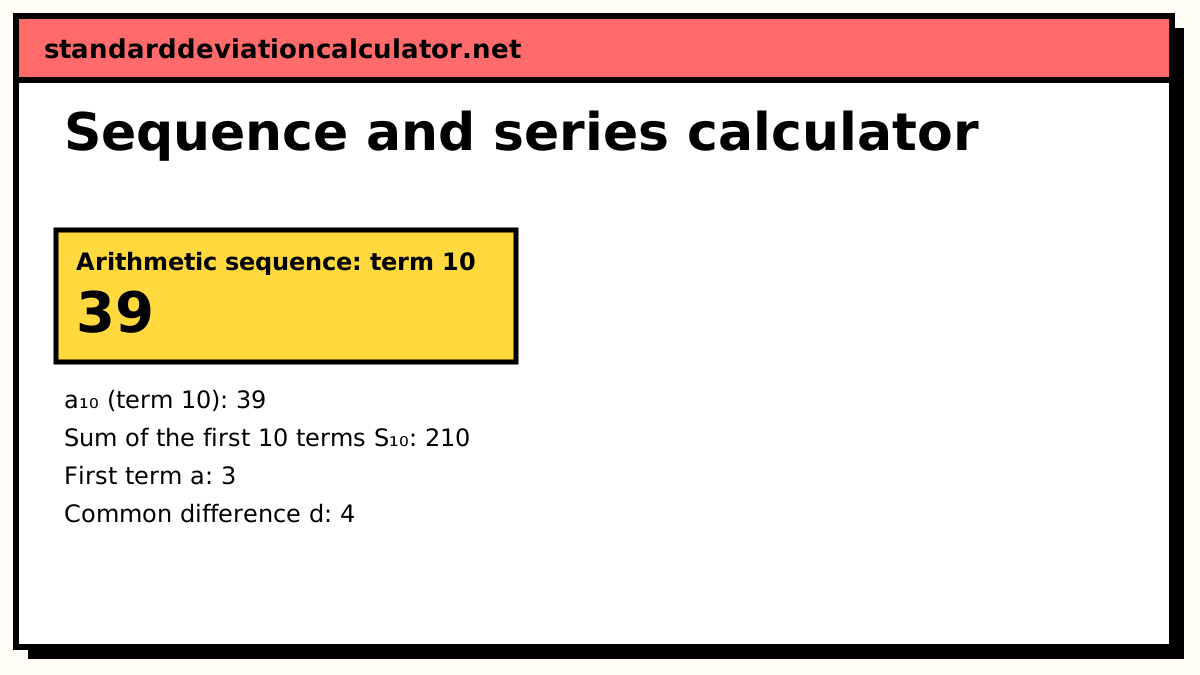
| 10 | 39 | 210 |
Show the working, step by step
Use the nth-term formula aₙ = a + (n − 1)d.
a₁₀ = 3 + (10 − 1) × 4 = 3 + 36 = 39
Sum of n terms: Sₙ = n/2 × (2a + (n − 1)d), which is n times the average of the first and last terms.
S₁₀ = 10/2 × (2 × 3 + 9 × 4) = 5 × 42 = 210 Check: n × (first + last)/2 = 10 × (3 + 39)/2 = 210
An arithmetic series has no sum to infinity (unless every term is 0): its terms do not shrink towards 0.
The formulas
| Sequence | nth term | Sum of n terms | Sum to infinity |
|---|---|---|---|
| Arithmetic | a + (n − 1)d | n/2 × (2a + (n − 1)d) | none (unless all terms are 0) |
| Geometric | a × rⁿ⁻¹ | a(1 − rⁿ)/(1 − r), r ≠ 1 | a/(1 − r), only if |r| < 1 |
| Harmonic | 1 / (1/a + (n − 1)D) | no closed form | none (it diverges) |
A sequence is the list of terms; a series is their sum. In a geometric series with r = 1 every term equals a, and the sum is simply n × a.
A worked example
The default is the arithmetic sequence with a = 3, d = 4 and n = 10: 3, 7, 11, 15, …
- 10th term: a₁₀ = 3 + (10 − 1) × 4 = 3 + 36 = 39.
- Sum: S₁₀ = 10/2 × (2 × 3 + 9 × 4) = 5 × 42 = 210.
- Check: 10 × (3 + 39)/2 = 210, the count times the average of the first and last terms.
- General term: aₙ = 3 + 4(n − 1) = 4n − 1.
Switch to geometric with a = 3 and r = 1/2 and the 10th term is 3 × (1/2)⁹ = 3/512, the sum of ten terms is 3069/512 ≈ 5.994, and the sum to infinity is 3/(1 − 1/2) = 6. The partial sums creep up towards 6 without reaching it.
Where these come up
Arithmetic sequences model anything that changes by a fixed amount: seats per row in a theatre, a salary with a fixed yearly rise, simple interest. Geometric sequences model a fixed percentage change: compound interest, depreciation, population growth and the fading bounce of a ball. Harmonic sequences appear in music (string lengths giving overtones) and in averaging rates.
Common mistakes
- Using n instead of n − 1. The first term has no difference added, so the 10th term adds 9 differences, not 10.
- Using the sum to infinity when |r| ≥ 1. 1 + 2 + 4 + … has no finite sum; plugging r = 2 into a/(1 − r) gives a meaningless −1.
- Ignoring the negative ratio. If two known terms are an even number of places apart, r and −r both fit. The calculator uses the positive one and reports the other.
- Averaging a harmonic sequence's terms. Work with the reciprocals, which are arithmetic.
Common questions
How do I find the nth term of an arithmetic sequence?
aₙ = a + (n − 1)d, where a is the first term and d the common difference. For 3, 7, 11, … (a = 3, d = 4) the 10th term is 3 + 9 × 4 = 39, and the general term simplifies to aₙ = 4n − 1.
What is the sum of an arithmetic series?
Sₙ = n/2 × (2a + (n − 1)d), which is the number of terms times the average of the first and last terms. For the first 10 terms of 3, 7, 11, … that is 10 × (3 + 39)/2 = 210.
When does a geometric series have a sum to infinity?
Only when the common ratio satisfies |r| < 1, so the terms shrink towards zero. Then S∞ = a/(1 − r). For 3, 3/2, 3/4, … (r = 1/2), S∞ = 3/(1 − 1/2) = 6. With |r| ≥ 1 the terms do not shrink and the series has no finite sum.
How do I find a sequence from two of its terms?
For an arithmetic sequence the gap between terms p and q is (q − p) steps, so d = (a_q − a_p)/(q − p). For a geometric one, r^(q − p) = a_q/a_p. If the 3rd term is 12 and the 7th is 192, a geometric sequence has r⁴ = 16, so r = 2 (or −2) and the first term is 12 ÷ 2² = 3.
What is a harmonic sequence?
One whose reciprocals form an arithmetic sequence, such as 1/2, 1/5, 1/8, … (the reciprocals 2, 5, 8 go up by 3). Find the nth term by working with the reciprocals and flipping at the end: the 10th reciprocal is 2 + 9 × 3 = 29, so the 10th term is 1/29. There is no closed formula for the sum, so it is added term by term.
Related calculators
-
Infinite series calculator
Convergence tests and sums of infinite series.
-
Compound interest
A geometric sequence in money: growth at a fixed rate.
-
Binomial theorem
Coefficients from Pascal’s triangle and the general term.
-
Harmonic mean
The average built from reciprocals, like a harmonic sequence.
-
Geometric mean
The middle term of three in geometric progression.