Math
Function calculator
Type a function f(x) to evaluate it at a point, tabulate it, find its domain and inverse, and compose it with a second function g(x). The graph shows f, its inverse and the mirror line y = x.
Powers with ^, roots with sqrt(), ln and log (base 10), sin, cos, tan, e and pi.
Optional. Leave blank to skip f(g(x)).
━ f(x) = (2x + 3)/(x − 1) ━ f⁻¹(x) = (x + 3)/(x − 2) ┄ y = x
| x | f(x) | g(x) | f(g(x)) |
|---|---|---|---|
| −3 | 3/4 | 9 | 21/8 |
| −2 | 1/3 | 4 | 11/3 |
| −1 | −1/2 | 1 | undefined |
| 0 | −3 | 0 | −3 |
| 1 | undefined | 1 | undefined |
| 2 | 7 | 4 | 11/3 |
| 3 | 9/2 | 9 | 21/8 |
Show the working, step by step
Substitute x = 4 into f.
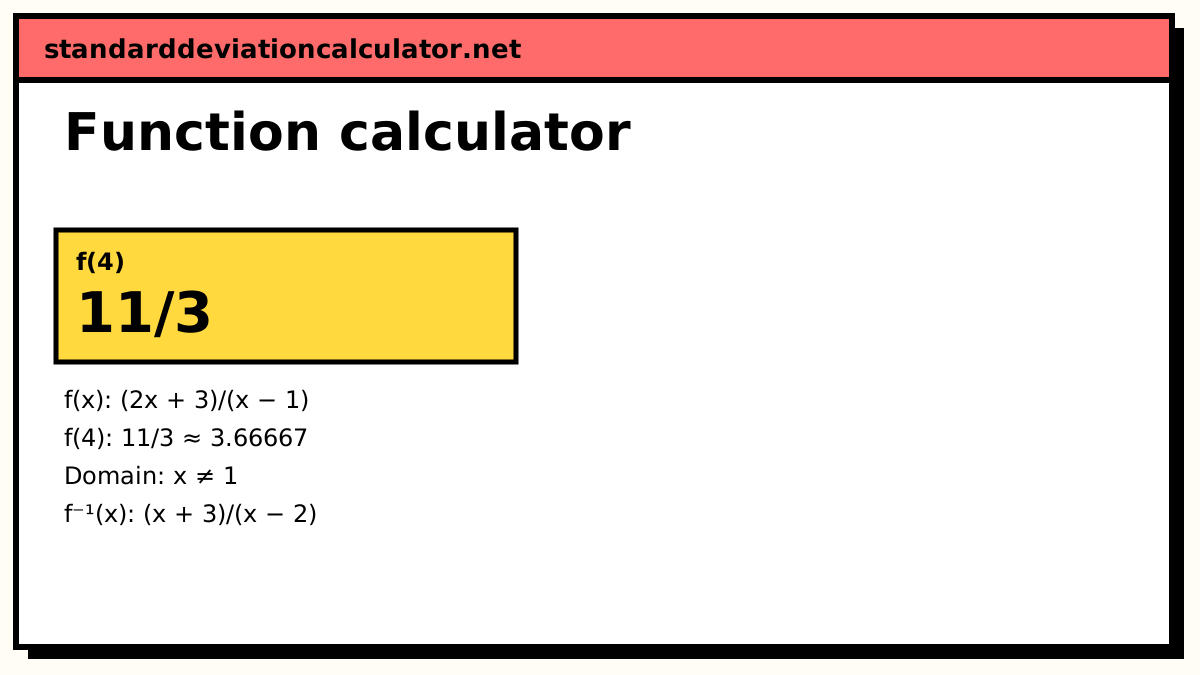
f(4) = (2·4 + 3)/(4 − 1) = 11/3
Find the domain: look for division by zero, even roots of negatives and logarithms of non-positive numbers.
Division: x − 1 ≠ 0, so x ≠ 1
Find the inverse: write y = f(x), undo each operation in reverse order to get x in terms of y, then swap the letters.
f⁻¹(x) = (x + 3)/(x − 2) Check: f(f⁻¹(x)) = x at test points.
Compose: replace every x in f with g(x), and the other way round.
f(g(x)) = (2x² + 3)/(x² − 1) g(f(x)) = ((2x + 3)/(x − 1))²
Functions, briefly
f : x ↦ f(x) (f ∘ g)(x) = f(g(x)) f(f⁻¹(x)) = x
A function assigns exactly one output to each input in its domain. The notation f(4) means “the output when the input is 4”. Composition chains two functions, and an inverse undoes a function, which is only possible when no two inputs share an output (the function is one-to-one).
A worked example
The defaults are f(x) = (2x + 3)/(x − 1), g(x) = x² and x = 4.
- Evaluate: f(4) = (8 + 3)/(4 − 1) = 11/3 ≈ 3.66667.
- Domain: the denominator x − 1 is zero at x = 1, so the domain is every real x except 1.
- Inverse: solving y = (2x + 3)/(x − 1) for x gives f⁻¹(x) = (x + 3)/(x − 2). Check: f⁻¹(11/3) = (11/3 + 3)/(11/3 − 2) = (20/3)/(5/3) = 4.
- Composition: f(g(x)) = (2x² + 3)/(x² − 1), so f(g(4)) = 35/15 = 7/3.
- y-intercept: f(0) = 3/(−1) = −3.
The table of values
From x = −3 to 3 in steps of 1, the default gives:
| x | f(x) | g(x) | f(g(x)) |
|---|---|---|---|
| −3 | 3/4 | 9 | 21/8 |
| −2 | 1/3 | 4 | 11/3 |
| −1 | −1/2 | 1 | undefined |
| 0 | −3 | 0 | −3 |
| 1 | undefined | 1 | undefined |
| 2 | 7 | 4 | 11/3 |
| 3 | 9/2 | 9 | 21/8 |
f(g(x)) is undefined at x = ±1 because g sends both to 1, the one input f cannot take. A composition's domain is the set of x in g's domain whose output g(x) is in f's domain.
Domain rules
| Feature | Condition | Example |
|---|---|---|
| Fraction | denominator ≠ 0 | 1/(x + 2): x ≠ −2 |
| Square (even) root | radicand ≥ 0 | √(x − 2): x ≥ 2 |
| Logarithm | argument > 0 | ln(x² − 1): x < −1 or x > 1 |
| tan x | cos x ≠ 0 | x ≠ π/2 + kπ |
Common mistakes
- Reading f⁻¹(x) as 1/f(x). The inverse undoes f; the reciprocal divides 1 by it. For f(x) = 2x, f⁻¹(x) = x/2 but 1/f(x) = 1/(2x).
- Composing in the wrong order. f(g(x)) applies g first.
- Missing brackets when substituting. f(x) = x² at x = −3 is (−3)² = 9, not −9.
- Inverting a function that is not one-to-one. Restrict the domain first, as with x² on x ≥ 0.
Common questions
How do I evaluate a function at a value?
Replace every x in the formula with the value, in brackets, and work it out. For f(x) = (2x + 3)/(x − 1) at x = 4: f(4) = (2·4 + 3)/(4 − 1) = 11/3 ≈ 3.667. Brackets matter with negative inputs: f(−3) = (2(−3) + 3)/(−3 − 1) = −3/−4 = 3/4.
How do you find the domain of a function?
Start with all real numbers and remove the values that break a rule: a denominator cannot be zero, an even root needs a non-negative radicand, and a logarithm needs a positive argument. For (2x + 3)/(x − 1) only x = 1 is excluded. For √(4 − x²) you need 4 − x² ≥ 0, so the domain is [−2, 2].
How do you find the inverse of a function?
Write y = f(x), solve for x, then swap x and y. From y = (2x + 3)/(x − 1): y(x − 1) = 2x + 3, so xy − 2x = y + 3, x(y − 2) = y + 3 and x = (y + 3)/(y − 2). The inverse is f⁻¹(x) = (x + 3)/(x − 2). Only one-to-one functions have an inverse; for x² the calculator gives √x and notes that it inverts the branch x ≥ 0.
What is function composition?
f(g(x)) means apply g first, then f to the result: substitute the whole of g(x) for x in f. With f(x) = (2x + 3)/(x − 1) and g(x) = x², f(g(x)) = (2x² + 3)/(x² − 1). Order matters: g(f(x)) = ((2x + 3)/(x − 1))², a different function.
Why does the graph of the inverse look like a reflection?
If (a, b) is on the graph of f then (b, a) is on the graph of f⁻¹, and swapping the coordinates of a point reflects it in the line y = x. The calculator draws f, its inverse and y = x together so the symmetry is visible.
Related calculators
-
Graphing calculator
Plot several functions on the same axes.
-
Quadratic equation calculator
Roots and vertex of ax² + bx + c.
-
Polynomial calculator
Evaluate, divide and find the roots of polynomials.
-
Derivative calculator
The rate of change of a function, with the rules used.
-
Simplify expressions
Tidy up a composition or an inverse by hand.