Constant of proportionality calculator
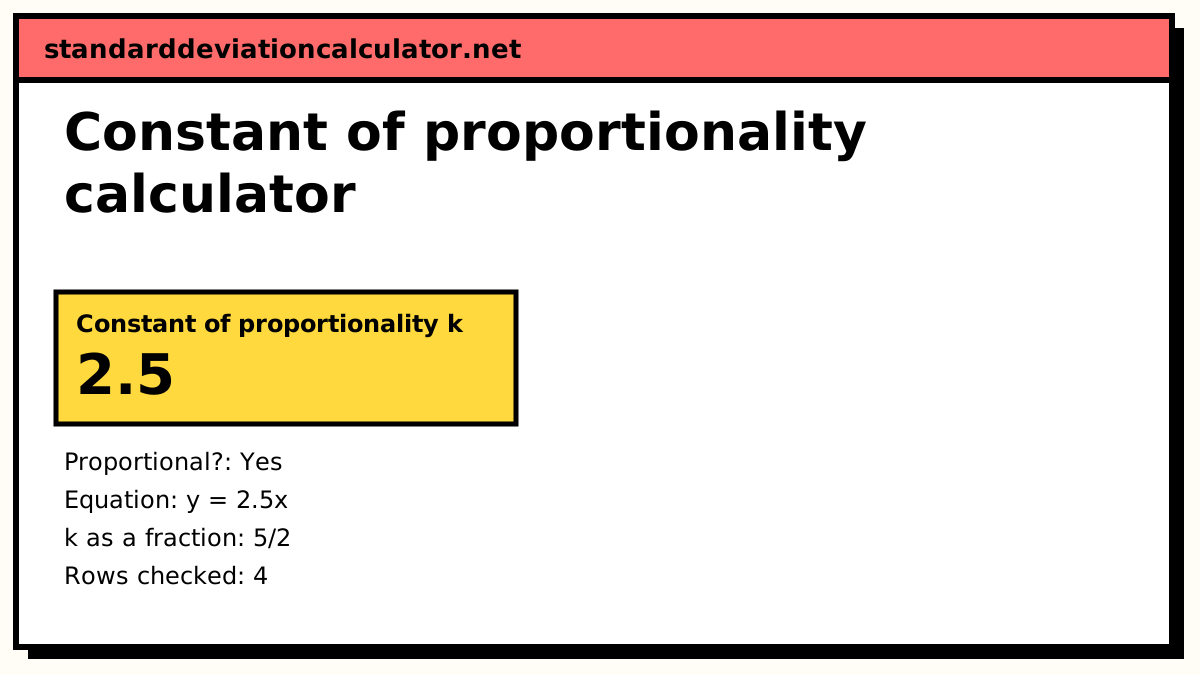
Enter a table of x and y values, or a single pair. The calculator divides y by x in every row, tells you whether the relationship is proportional, and writes the equation y = kx.
| x | y | y ÷ x |
|---|---|---|
| 2 | 5 | 2.5 |
| 4 | 10 | 2.5 |
| 6 | 15 | 2.5 |
| 8 | 20 | 2.5 |
┄ y = 2.5x
Show the working, step by step
Work out y ÷ x for every row.
row 1: 5 ÷ 2 = 2.5 row 2: 10 ÷ 4 = 2.5 row 3: 15 ÷ 6 = 2.5 row 4: 20 ÷ 8 = 2.5
Every row gives the same value, so the relationship is proportional and that value is k.
k = 5/2 equation: y = 2.5x
A proportional relationship graphs as a straight line through the origin. A straight line that misses the origin (y = mx + b with b ≠ 0) is linear but not proportional.
The formula
y = kx so k = y ÷ x (x ≠ 0)
Two quantities are proportional when their ratio never changes. Double x and y doubles; halve x and y halves. The fixed ratio is k. For inverse proportion the rule is y = k ÷ x, so the product x × y is the constant instead.
A worked example from a table
The default table could be the cost in dollars (y) of x kilograms of apples:
| x | y | y ÷ x |
|---|---|---|
| 2 | 5 | 2.5 |
| 4 | 10 | 2.5 |
| 6 | 15 | 2.5 |
| 8 | 20 | 2.5 |
Every ratio is 2.5, so the table is proportional with k = 2.5 (or 5/2), and the equation is y = 2.5x. In words: apples cost $2.50 per kilogram. The unit rate and the constant of proportionality are the same number.
With a single pair, x = 4 and y = 10, the calculator gives the same k = 10 ÷ 4 = 2.5. One point is enough to find k if you already know the relationship is proportional, but not to prove it. Any single point gives some ratio.
Reading the graph
A proportional relationship plots as a straight line through the origin, and k is its slope. The chart under the result draws the points and the line y = kx. If the points sit on a straight line that misses (0, 0), the relationship is linear but not proportional. If they curve, it is neither. For an inverse relationship the points follow a curve that falls as x grows, and x × y is the same at every point.
Where the constant shows up
Once you know k, any missing value follows. At k = 2.5, 7 kg of apples cost 2.5 × 7 = $17.50, and $30 buys 30 ÷ 2.5 = 12 kg. The same idea appears as a unit price, a speed (distance = speed × time), a recipe scaled up (flour = k × servings), a currency exchange rate, and a map scale. In each case the question "is this proportional?" is the question "is the rate the same everywhere?"
Common mistakes
- Dividing x by y. That gives 1/k, which is the constant for x in terms of y (0.4 kg per dollar here), not the usual k.
- Checking only the first two rows. A table can match for two rows and break on the third.
- Calling any straight line proportional. y = 2x + 1 is a line, but y ÷ x changes from row to row, so it is not proportional.
- Including a row with x = 0 and y ≠ 0. That point alone rules out proportionality.
Common questions
What is the constant of proportionality?
When y is proportional to x, y = kx for a fixed number k. That k is the constant of proportionality. It is the value of y when x = 1, which is why it is also called the unit rate, and it is the slope of the line through the origin.
How do I find k from a table?
Divide each y by its x. If every row gives the same answer, the table is proportional and that answer is k. In the default table 5/2, 10/4, 15/6 and 20/8 all equal 2.5, so k = 2.5 and y = 2.5x.
How can I tell if a table is not proportional?
At least one row gives a different y ÷ x. The table x = 1, 2, 3 with y = 3, 5, 7 gives 3, 2.5 and 2.333, so it is not proportional, even though it is a straight line (y = 2x + 1). A proportional line must pass through (0, 0).
What about inverse proportion?
If y = k/x, then x × y is constant, and that product is k. For x = 1, 2, 4 and y = 12, 6, 3 every product is 12, so y = 12/x. Pick the inverse option in the calculator to check a table this way.
Can k be negative or a fraction?
Yes. y = −3x and y = (2/3)x are both proportional relationships. The calculator shows k as a decimal and, when it is a simple fraction, as a fraction too.
Related calculators
-
Ratio and proportion calculator
Solve a : b = c : x and simplify ratios.
-
Linear equation calculator
Solve and graph equations of the form ax + b = c.
-
Straight line equation calculator
Slope and intercept of the line through two points.