Algebra calculators
Solvers for linear, quadratic and polynomial equations, plus tools for simplifying expressions, working with functions and summing sequences. Every step is shown, from the discriminant to the elimination, so the method is as clear as the answer.
Which calculator do I need?
| You have or want | Use |
|---|---|
| Solve ax² + bx + c = 0, including complex roots | Quadratic equation calculator |
| Solve 3x − 7 = 2x + 5, or two or three simultaneous equations | Linear equation calculator |
| Roots of a cubic or higher-degree polynomial, or polynomial long division | Polynomial calculator |
| Expand, factor or simplify an expression | Simplify expression calculator |
| The domain, inverse or composition of a function | Function calculator |
| The nth term or the sum of an arithmetic or geometric sequence | Sequence and series calculator |
| Expand (2x + 3)⁵ or find one coefficient | Binomial theorem calculator |
Solving equations
Find the values of x that make an equation true, from one linear equation to a full polynomial.
-
Linear equation calculator
One linear equation step by step, or 2 × 2 and 3 × 3 systems by elimination or Cramer’s rule.
-
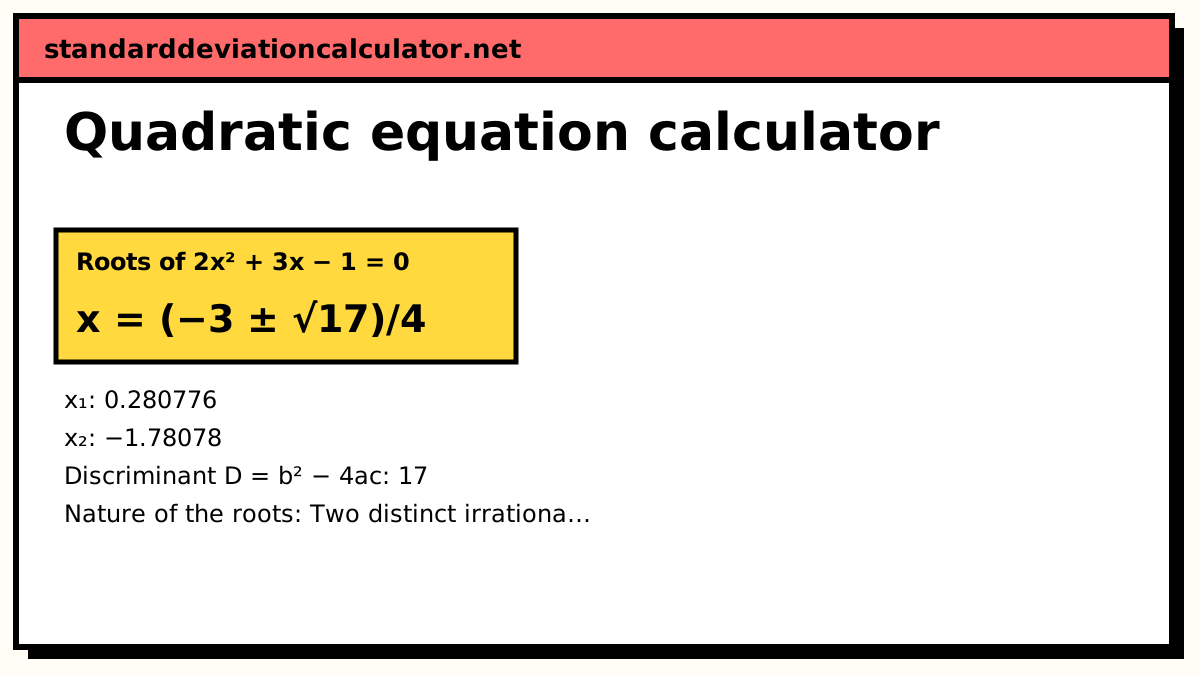
Quadratic equation calculator
Roots of ax² + bx + c = 0 in exact surd or complex form, with the vertex and a graph.
-
Polynomial calculator
Add, multiply and long-divide polynomials, evaluate them, and find every real and complex root.
Expressions and functions
Rewrite expressions in simpler forms and study how a function behaves.
-
Simplify expression calculator
Simplified, expanded and factored forms of an algebraic expression, with fractions combined.
-
Function calculator
Evaluate f(x), tabulate it, and find its domain, inverse and compositions, with a graph.
-
Graphing calculator
Plot up to four functions of x and find their zeros and intersections.
-
Constant of proportionality calculator
k = y/x from a pair or a table, with a check that the table is proportional.
Sequences and expansions
Patterns in lists of numbers and in powers of a binomial.
-
Sequence and series calculator
nth term, sum of n terms and sum to infinity for arithmetic, geometric and harmonic sequences.
-
Binomial theorem calculator
Expand (ax + b)ⁿ, find any term or the coefficient of xᵏ, with Pascal’s triangle.
Which solver for which equation
The highest power of x decides the tool. A first-degree equation, or a system of them, goes to the linear equation calculator. A second-degree equation goes to the quadratic calculator, which gives exact surd or complex roots and the vertex. Anything of degree three or more goes to the polynomial calculator, which finds every real and complex root and also does long division.
The quadratic formula works for every quadratic, and the discriminant b² − 4ac tells you what kind of roots to expect before you finish. For x² − 5x + 6 = 0 it is 25 − 24 = 1, which is positive, so there are two real roots, x = 2 and x = 3. For x² + 2x + 5 = 0 it is 4 − 20 = −16, which is negative, so the roots are complex: x = −1 ± 2i.
Worked comparison: arithmetic versus geometric
Take the first ten terms of two sequences that both start at 3. The arithmetic sequence 3, 7, 11, … adds 4 each time. Its nth term is 4n − 1, the tenth term is 39, and the sum is 10 × (3 + 39) ÷ 2 = 210. The geometric sequence 3, 6, 12, … doubles each time. Its tenth term is 3 × 2⁹ = 1536, and the sum is 3 × (2¹⁰ − 1) = 3069. The sequence and series calculator handles both, and can rebuild a sequence from any two known terms. It also tells you when a geometric series has a sum to infinity, which happens only when the ratio lies between −1 and 1.
Common mix-ups
- Simplify versus solve. An expression such as 2(x + 3) − x has no = sign and simplifies to x + 6. An equation such as 2(x + 3) − x = 10 has a solution, x = 4. Use the simplifier for the first and a solver for the second.
- (a + b)² is not a² + b². It is a² + 2ab + b². The binomial theorem calculator shows where the middle terms come from. For example, the x² coefficient of (x + 2)⁴ is C(4, 2) × 2² = 24.
- An inverse function is not a reciprocal. The inverse of f(x) = 2x + 1 is f⁻¹(x) = (x − 1)/2, not 1/(2x + 1).
Guides to read alongside
-
Standard deviation formula
A worked reading of a formula with sums, squares and roots, symbol by symbol.
-
Statistics formulas
The algebraic formulas behind the site’s statistics calculators.
-
Methodology
How exact and decimal results are produced and rounded.