Math
Binomial theorem calculator
Expand a binomial power such as (2x + 3)⁵ in one step, then pick out any term, the coefficient of a given power of x, or the term independent of x. Coefficients are exact whole numbers or fractions, however large they get.
Expanding (a·xᵖ + b·x^q)ⁿ. Whole numbers, fractions (1/2) and decimals.
Use a negative b for (ax − b)ⁿ.
0 for a constant; −1 for (x + 1/x)ⁿ.
k = 0 gives the term independent of x.
| r | Term | C(n, r) | Coefficient | Power of x |
|---|---|---|---|---|
| 0 | T₁ | 1 | 32 | 5 |
| 1 | T₂ | 5 | 240 | 4 |
| 2 | T₃ | 10 | 720 | 3 |
| 3 | T₄ | 10 | 1,080 | 2 |
| 4 | T₅ | 5 | 810 | 1 |
| 5 | T₆ | 1 | 243 | 0 |
| n | Row of Pascal’s triangle |
|---|---|
| 0 | 1 |
| 1 | 1 1 |
| 2 | 1 2 1 |
| 3 | 1 3 3 1 |
| 4 | 1 4 6 4 1 |
| 5 | 1 5 10 10 5 1 |
Show the working, step by step
The binomial theorem gives each term of (A + B)ⁿ as C(n, r) A^(n−r) B^r, for r = 0, 1, …, n.
A = 2x, B = 3, n = 5
General term:
Tᵣ₊₁ = C(5, r) · (2x)^(5 − r) · (3)^r = C(5, r) · 2^(5 − r) · 3^r · x^(1(5 − r) + 0r)
For term 3, r = 2.
C(5, 2) = 10 2^3 = 8 3^2 = 9 power of x = 1 × 3 + 0 × 2 = 3 T₃ = 10 × 8 × 9 · x³ = 720x³
Write out every term and add them.
r = 0: C(5, 0) × 2^5 × 3^0 = 1 × 32 × 1 → 32x⁵ r = 1: C(5, 1) × 2^4 × 3^1 = 5 × 16 × 3 → 240x⁴ r = 2: C(5, 2) × 2^3 × 3^2 = 10 × 8 × 9 → 720x³ r = 3: C(5, 3) × 2^2 × 3^3 = 10 × 4 × 27 → 1,080x² r = 4: C(5, 4) × 2^1 × 3^4 = 5 × 2 × 81 → 810x r = 5: C(5, 5) × 2^0 × 3^5 = 1 × 1 × 243 → 243 (2x + 3)⁵ = 32x⁵ + 240x⁴ + 720x³ + 1,080x² + 810x + 243
Each coefficient C(n, r) is the entry in row n of Pascal’s triangle; every entry is the sum of the two above it.
The binomial theorem
(A + B)ⁿ = Σ C(n, r) · A^(n−r) · B^r, r = 0, 1, …, n T(r+1) = C(n, r) · A^(n−r) · B^r, C(n, r) = n! / (r! (n − r)!)
Each term takes A from n − r of the brackets and B from the other r, and C(n, r) counts how many ways that choice can be made. The calculator lets A = a·xᵖ and B = b·x^q, which covers (2x + 3)ⁿ, (x − 1)ⁿ, (x² + 1/x)ⁿ and the like. n must be a whole number from 0 to 30.
A worked example
The default expands (2x + 3)⁵, so A = 2x, B = 3 and n = 5.
| r | C(5, r) | 2^(5−r) | 3^r | Term |
|---|---|---|---|---|
| 0 | 1 | 32 | 1 | 32x⁵ |
| 1 | 5 | 16 | 3 | 240x⁴ |
| 2 | 10 | 8 | 9 | 720x³ |
| 3 | 10 | 4 | 27 | 1,080x² |
| 4 | 5 | 2 | 81 | 810x |
| 5 | 1 | 1 | 243 | 243 |
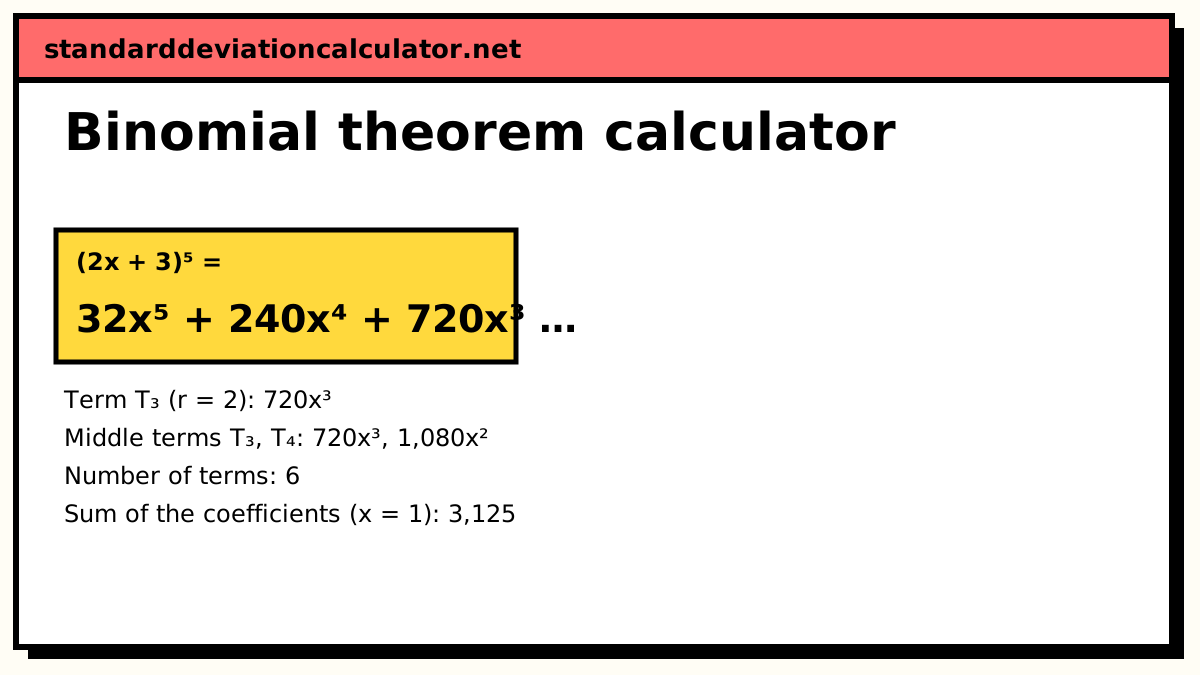
So (2x + 3)⁵ = 32x⁵ + 240x⁴ + 720x³ + 1,080x² + 810x + 243. The 3rd term (r = 2) is 720x³, which is also the coefficient of x³ asked for by default. As a check, the coefficients sum to 5⁵ = 3,125.
Pascal's triangle
Row n of Pascal's triangle lists C(n, 0), C(n, 1), …, C(n, n). Each entry is the sum of the two above it, which is the identity C(n, r) = C(n − 1, r − 1) + C(n − 1, r). Rows 0 to 5 are 1; 1 1; 1 2 1; 1 3 3 1; 1 4 6 4 1; 1 5 10 10 5 1. The calculator prints the rows up to your n (up to row 20).
Common mistakes
- Forgetting to raise the coefficient. (2x)³ is 8x³, not 2x³.
- Losing the sign of b. In (x − 2)ⁿ, B = −2, so the terms alternate in sign.
- Off-by-one term numbers. The kth term uses r = k − 1, because counting starts at r = 0.
- Assuming a term independent of x always exists. In (x + 1/x)⁵ the powers are 5, 3, 1, −1, −3, −5, so there is no constant term.
Common questions
What is the binomial theorem?
It expands a power of a sum without multiplying out bracket by bracket: (A + B)ⁿ = Σ C(n, r) A^(n−r) B^r, for r = 0 to n. The coefficients C(n, r) = n!/(r!(n − r)!) are the numbers in row n of Pascal's triangle. For (2x + 3)⁵ this gives 32x⁵ + 240x⁴ + 720x³ + 1,080x² + 810x + 243.
How do I find a specific term?
Use the general term T(r+1) = C(n, r) A^(n−r) B^r; the kth term has r = k − 1. The 3rd term of (2x + 3)⁵ has r = 2: C(5, 2) × (2x)³ × 3² = 10 × 8x³ × 9 = 720x³.
How do I find the term independent of x?
Write the power of x in the general term and set it to zero. In (x² − 2/x)⁹ the power is 2(9 − r) − r = 18 − 3r, which is 0 when r = 6, so the term is C(9, 6) × (−2)⁶ = 84 × 64 = 5,376. Enter this as a = 1, p = 2, b = −2, q = −1, n = 9 and ask for the coefficient of x⁰. If the r you get is not a whole number from 0 to n, no such term exists.
What are the middle terms?
There are n + 1 terms. When n is even there is one middle term, T(n/2 + 1); when n is odd there are two, T((n + 1)/2) and T((n + 3)/2). (2x + 3)⁵ has six terms, so its middle terms are the 3rd and 4th: 720x³ and 1,080x².
How do I get the sum of the coefficients?
Put x = 1. The coefficients of (2x + 3)⁵ add up to (2 + 3)⁵ = 3,125. Putting x = −1 instead gives the alternating sum, and for (1 + x)ⁿ the coefficients always sum to 2ⁿ.
Related calculators
-
Permutations and combinations
C(n, r) and P(n, r), the counting behind the coefficients.
-
Binomial distribution
The same coefficients as probabilities of k successes.
-
Polynomial calculator
Multiply and divide the expanded polynomials.
-
Simplify expressions
Expand any product of brackets, not only powers of a sum.
-
Sequences and series
Arithmetic, geometric and harmonic sequences.