Math
Simplify expression calculator
Type an algebraic expression to see it simplified, expanded and factored. Fractions are combined over a common denominator and shared factors cancelled, and the calculator shows how it read your input so there is no doubt about what was simplified.
Use ^ for powers, and any letters as variables (2xy is 2·x·y). sqrt(), ln(), sin() and similar functions are allowed.
The marked point is where the original is undefined; the simplified form fills it in.
Show the working, step by step
Read the expression, with every multiplication and power made explicit.
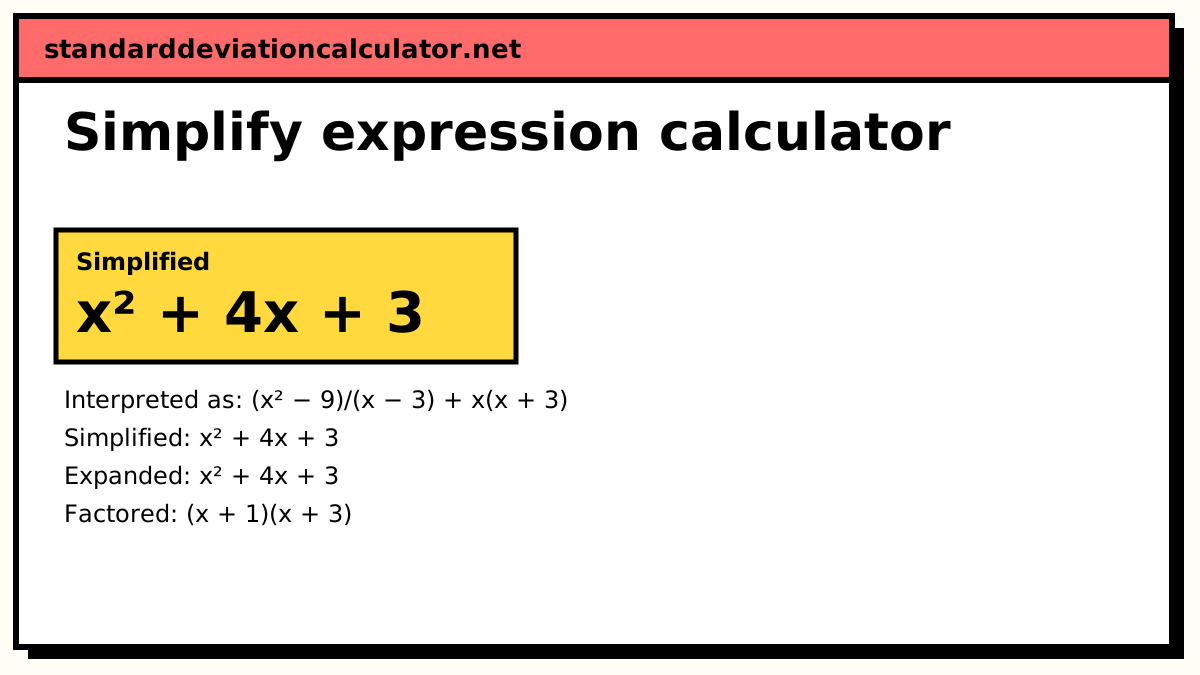
(x² − 9)/(x − 3) + x(x + 3)
Combine everything over a common denominator.
(x³ + x² − 9x − 9)/(x − 3)
Factor the numerator and the denominator.
numerator = (x − 3)(x + 1)(x + 3) denominator = x − 3
Cancel the factors they share, then collect like terms.
x² + 4x + 3
Factor the result.
(x + 1)(x + 3)
Check numerically that the forms agree.
At x = 1.7: original = 12.69, simplified = 12.69 At x = −2.3: original = −0.91, simplified = −0.91
The original expression is undefined where a denominator is zero (x ≠ 3). The simplified form agrees with it everywhere else, so the equality holds with those values excluded.
The rules behind simplifying
a(b + c) = ab + ac (a + b)² = a² + 2ab + b² a² − b² = (a − b)(a + b)
Almost all simplification is these identities used forwards (to expand) or backwards (to factor), plus collecting like terms: 2x + 3y − x + y = x + 4y, because only terms with exactly the same variables and powers can be added. Fractions follow the rules of number fractions: put them over a common denominator, then cancel any factor the numerator and denominator share.
A worked example
The default expression is (x² − 9)/(x − 3) + x(x + 3).
- Combine over the common denominator x − 3: (x³ + x² − 9x − 9)/(x − 3).
- Factor the top and bottom: the numerator is (x − 3)(x + 1)(x + 3) and the denominator is x − 3.
- Cancel the shared factor x − 3 and expand: x² + 4x + 3.
- Factor the result: (x + 1)(x + 3).
A quicker route is to notice that x² − 9 = (x − 3)(x + 3), so the first fraction is x + 3, and x + 3 + x² + 3x = x² + 4x + 3. Either way the original is undefined at x = 3, which the simplified form hides.
Examples of each form
| Input | Simplified | Factored |
|---|---|---|
| (x + 1)² − (x − 1)² | 4x | 4x |
| x⁴ − 1 | x⁴ − 1 | (x − 1)(x + 1)(x² + 1) |
| x² + 2xy + y² | x² + 2xy + y² | (x + y)² |
| 1/x + 1/(x + 1) | (2x + 1)/(x(x + 1)) | (2x + 1)/(x(x + 1)) |
| sin(x)² + cos(x)² | 1 | 1 |
Common mistakes
- Cancelling terms instead of factors. (x + 6)/(x + 2) does not simplify to 3 or to 6/2. Only a factor of the whole numerator and the whole denominator can cancel.
- (a + b)² = a² + b². It is a² + 2ab + b²; the middle term is the usual casualty.
- Losing a minus sign across a bracket. −(x − 3) is −x + 3.
- Forgetting the restrictions. A cancelled denominator still rules its zeros out of the domain.
Common questions
What does “simplify” mean for an algebraic expression?
Rewrite it as an equal expression with fewer terms or operations: expand brackets, collect like terms, combine fractions and cancel common factors. There is no single official simplest form, so the calculator shows the simplified, expanded and factored forms side by side and you can use whichever your question asks for.
What is the difference between expanding and factoring?
They are opposites. Expanding multiplies out brackets: (x + 1)(x + 3) becomes x² + 4x + 3. Factoring writes a sum as a product: x² + 4x + 3 becomes (x + 1)(x + 3). Expanded form is easiest to add and compare; factored form shows the roots and makes cancelling in fractions possible.
Why does the calculator say a value is excluded?
Cancelling a factor can hide a hole. (x² − 9)/(x − 3) simplifies to x + 3, but the original is undefined at x = 3, where its denominator is zero, while x + 3 is 6 there. The two are equal for every other x, so the simplification is correct with x ≠ 3 attached.
How do I type expressions?
Use ^ for powers (x^2, or x² directly), * or nothing for multiplication (2x, 3(x + 1), 2xy), / for division and brackets as usual. sqrt(), ln(), log(), sin(), cos(), tan() and exp() are understood, as are π and e. The first line of the result shows how your input was read, so you can check it.
Can it factor any polynomial?
It factors over the rational numbers, which is what textbooks mean by “factorise”. x⁴ − 1 becomes (x − 1)(x + 1)(x² + 1); x² + 1 stays as it is because its roots are not rational. For roots that are irrational or complex, use the polynomial calculator or the quadratic equation calculator.
Related calculators
-
Polynomial calculator
Long division, products and every root of a polynomial.
-
Binomial theorem
Expand (ax + b)ⁿ without multiplying out by hand.
-
Linear equation calculator
Solve an equation once the sides are simplified.
-
Function calculator
Evaluate, compose and invert functions.