Average rating calculator
Enter how many reviews a product has at each star level. The calculator gives the average rating, the share of reviews at each score, and a Bayesian average that is fairer when you rank items with very different numbers of reviews.
Usually 5 stars; 10-point scales work too.
One row per score. Leave a count at 0 if nobody gave that score.
| Score | Count | Share | Score × count |
|---|---|---|---|
| 5 | 120 | 60% | 600 |
| 4 | 45 | 22.5% | 180 |
| 3 | 15 | 7.5% | 45 |
| 2 | 8 | 4% | 16 |
| 1 | 12 | 6% | 12 |
| Total | 200 | 100% | 853 |
Show the working, step by step
Multiply each score by the number of people who gave it, and add the products.
Σ(score × count) = 5 × 120 + 4 × 45 + 3 × 15 + 2 × 8 + 1 × 12 = 853
Add the counts to get the number of ratings.
n = 120 + 45 + 15 + 8 + 12 = 200
Divide.
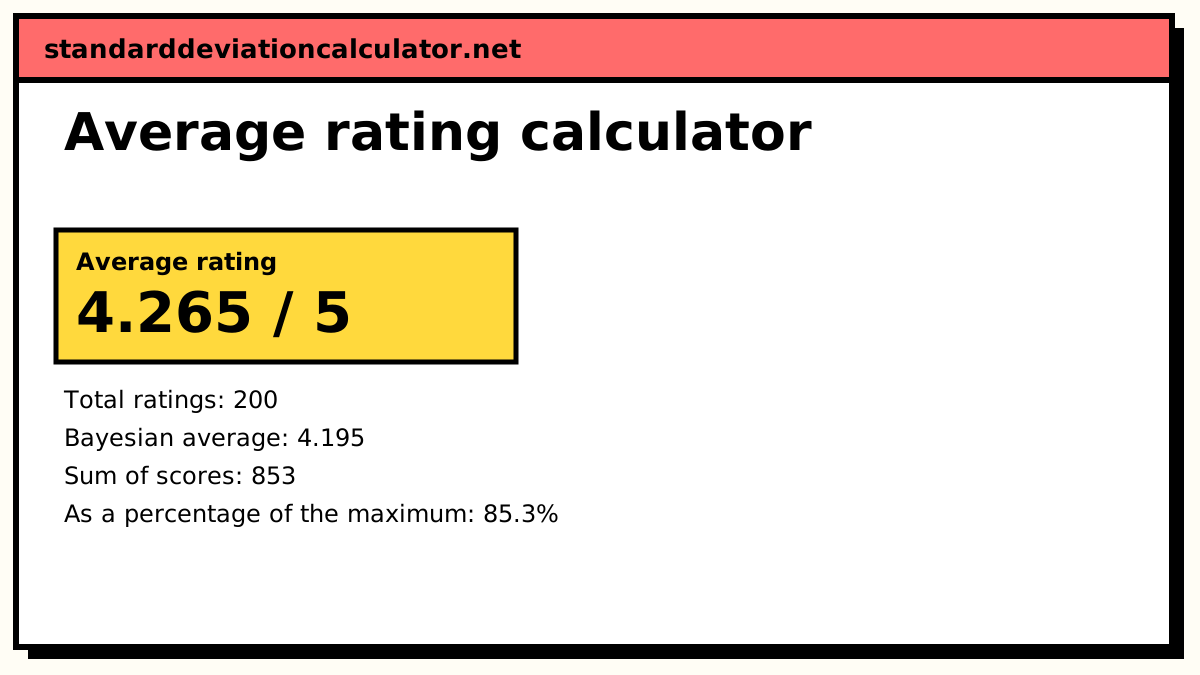
average = 853 ÷ 200 = 4.265
Bayesian average: add C = 20 imaginary ratings at the prior mean m = 3.5 before dividing.
(C × m + Σ) ÷ (C + n) = (20 × 3.5 + 853) ÷ (20 + 200) = 923 ÷ 220 = 4.195
The Bayesian average pulls the raw 4.265 toward 3.5 by an amount that shrinks as ratings pile up. With 200 ratings against a weight of 20, the raw average carries 90.9% of the result.
The formula
average = Σ(score × count) ÷ Σ count Bayesian average = (C × m + Σ(score × count)) ÷ (C + Σ count)
The first line is a weighted mean: each score counts as many times as people gave it. In the second, m is a prior mean (often the average over a whole catalogue) and C is how many reviews' worth of weight that prior gets.
A worked example
The default product has 200 reviews:
| Stars | Reviews | Stars × reviews |
|---|---|---|
| 5 | 120 | 600 |
| 4 | 45 | 180 |
| 3 | 15 | 45 |
| 2 | 8 | 16 |
| 1 | 12 | 12 |
| Total | 200 | 853 |
average = 853 ÷ 200 = 4.265
That is 85.3% of the maximum, and it would display as 4.5 stars if the site rounds to the nearest half star (4.265 is above 4.25), or as 4.3 to one decimal place. Sixty per cent of the reviews are 5-star.
For the Bayesian average, suppose the store's products average m = 3.5 and you give that prior a weight of C = 20 reviews:
(20 × 3.5 + 853) ÷ (20 + 200) = 923 ÷ 220 = 4.195
The raw average supplies 200 ÷ 220 = 90.9% of the result, so the shrinkage is small. A product with only 4 reviews, all 5-star, would drop from 5.0 to (70 + 20) ÷ 24 = 3.75, below this one.
Reading the result
The plain average describes one product. The Bayesian average is for comparing products, because a small number of reviews can produce an extreme average by luck. The standard deviation of the ratings (1.142 here) tells you how much reviewers disagree: two products can both average 4.0 while one has every review at 4 and the other is split between 5s and 1s. The distribution bars show which kind you have.
Common mistakes
- Averaging the star levels instead of the reviews. Every 1-to-5 scale then averages 3.
- Averaging the averages of several products without weighting by their review counts. A product with 10 reviews and one with 1,000 should not count equally.
- Treating a 4.8 from five reviews as better than a 4.6 from five hundred. Use the Bayesian average, or at least show the review count next to the stars.
- Rounding before averaging. Keep the exact counts, and round only the final figure.
Common questions
How do you calculate an average star rating?
Multiply each star level by the number of reviews at that level, add the products, and divide by the total number of reviews. With 120 five-star, 45 four-star, 15 three-star, 8 two-star and 12 one-star reviews the products add to 853 over 200 reviews, so the average is 853 ÷ 200 = 4.265.
Why not just average the five star levels?
Because the levels are not equally common. (5 + 4 + 3 + 2 + 1) ÷ 5 = 3 for every product, whatever its reviews say. The number of reviews at each level is the weight, which is what makes this a weighted mean.
What is a Bayesian average rating?
It adds C imaginary reviews at a prior mean m before averaging: (C × m + Σ) ÷ (C + n). A product with two 5-star reviews then scores below one with 400 reviews averaging 4.8, which is the order most people would trust. As real reviews accumulate, the imaginary ones matter less and the Bayesian average approaches the plain average.
What should I use for m and C?
A common choice is the average rating across all products in the catalogue for m, and the typical (median) number of reviews per product for C. Larger C trusts small samples less. There is no single correct value; choose one and apply it to every item you rank.
Does the calculator work for 10-point or 3-point scales?
Yes. Set the highest score and enter one row per score that appears. Scores need not be whole numbers, so half-star scales work too.
Related calculators
-
Weighted average calculator
The general weighted mean behind a star-rating average.
-
Standard deviation from a frequency table
Spread of the ratings, from the same counts.
-
Median calculator
The middle rating, less affected by a few 1-star reviews.