Statistics
Weighted mean calculator
The weighted arithmetic mean gives each value a say in proportion to its importance. Enter each item's value and weight to get Σwx, Σw and the weighted mean, with the table your statistics textbook sets out.
| Item | x | w | w × x | Share of weight |
|---|---|---|---|---|
| Food | 125 | 40 | 5000 | 40% |
| Fuel and light | 150 | 10 | 1500 | 10% |
| Clothing | 110 | 15 | 1650 | 15% |
| House rent | 140 | 20 | 2800 | 20% |
| Miscellaneous | 120 | 15 | 1800 | 15% |
| Σ | 100 | 12750 | 100% |
Show the working, step by step
Multiply each value by its weight.
Food: 125 × 40 = 5000 Fuel and light: 150 × 10 = 1500 Clothing: 110 × 15 = 1650 House rent: 140 × 20 = 2800 Miscellaneous: 120 × 15 = 1800
Add the products.
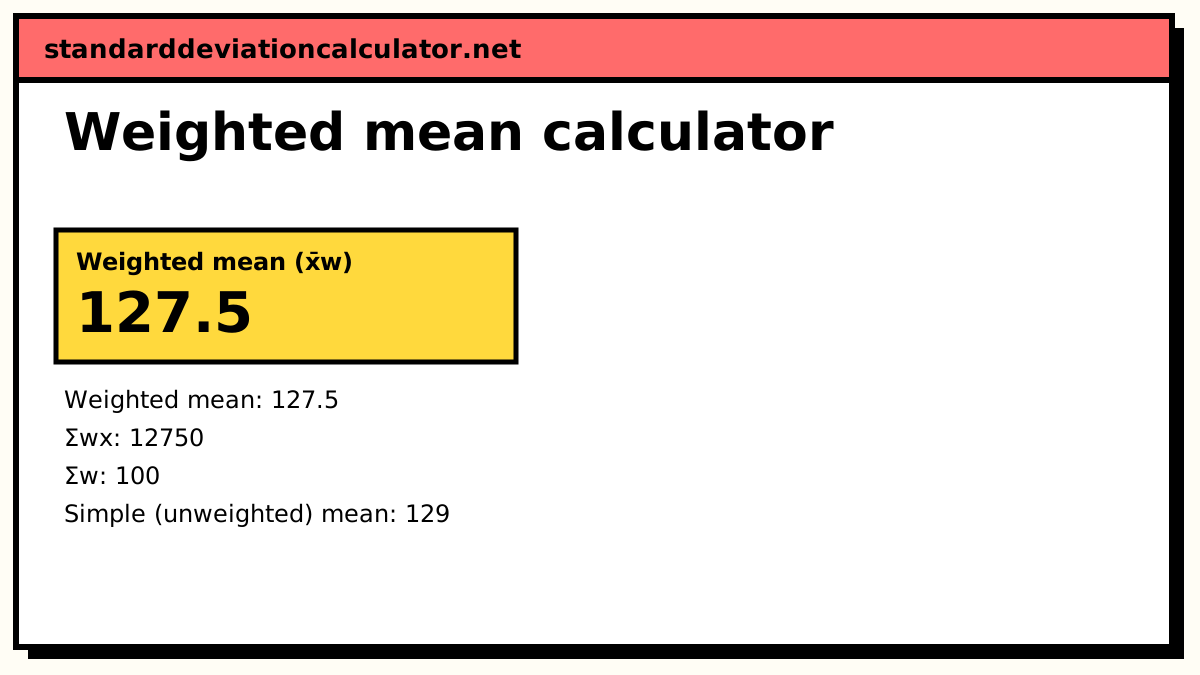
Σwx = 12750
Add the weights.
Σw = 40 + 10 + 15 + 20 + 15 = 100
Divide.
x̄w = Σwx ÷ Σw = 12750 ÷ 100 = 127.5
The simple mean of the values is 129. The weighted mean is lower because the smaller values carry more of the weight.
The formula
x̄w = Σwx ÷ Σw = (w₁x₁ + w₂x₂ + … + wₙxₙ) ÷ (w₁ + w₂ + … + wₙ)
Multiply each value by its weight, add the products, and divide by the total weight. Dividing by Σw rather than by the number of items is what makes the result an average of the values rather than a total.
A worked example: a cost of living index
A family's spending is split into five groups. The group indices for the current year (base year = 100) and the percentage of the budget spent on each group are the calculator's default rows.
| Group | Index x | Weight w | w × x |
|---|---|---|---|
| Food | 125 | 40 | 5,000 |
| Fuel and light | 150 | 10 | 1,500 |
| Clothing | 110 | 15 | 1,650 |
| House rent | 140 | 20 | 2,800 |
| Miscellaneous | 120 | 15 | 1,800 |
| Total | 100 | 12,750 |
Weighted mean = 12,750 ÷ 100 = 127.5. The cost of living has risen 27.5% since the base year. The simple mean of the five indices is 645 ÷ 5 = 129, which overstates the rise: fuel went up the most (to 150), but it takes only 10% of the budget, while food, the largest share, rose less.
Where the weighted arithmetic mean is used
- Index numbers. A price index is the weighted mean of price relatives, with weights from quantities or spending. See the weighted average of price relatives and the Laspeyres index.
- Combined mean of groups. The mean of two classes of 30 and 20 students with means 62 and 70 is (30 × 62 + 20 × 70) ÷ 50 = 65.2: the group means weighted by group size.
- Average price paid. Prices weighted by the quantity bought at each price.
- Grades. Marks weighted by the share of the course each component carries; the weighted average calculator is set up for that.
Weighted mean or simple mean?
Use weights when the items are not equally important, or stand for different numbers of people or units. A simple mean of five price indices treats a 50% rise in the price of salt the same as a 50% rise in rent, which is not how a household experiences it. When the weights are equal the two means coincide, so the simple mean is the weighted mean with all w = 1.
Common mistakes
- Dividing Σwx by the number of items instead of by Σw.
- Swapping values and weights: in a cost of living index the indices are x and the budget shares are w.
- Mixing weight scales, such as percentages for some items and fractions for others.
Common questions
What is the weighted arithmetic mean?
A mean in which each value x counts in proportion to a weight w:
x̄w = Σwx ÷ Σw. The ordinary arithmetic mean is the special case where every
weight is 1. In the default example the weighted mean of the five group indices is 127.5,
while their simple mean is 129.
How is a cost of living index calculated with a weighted mean?
Each expenditure group (food, fuel, clothing, rent, miscellaneous) gets a price index for the current year, with the base year at 100. The weights are the shares of the family budget spent on each group. The weighted mean Σwx ÷ Σw of the group indices is the cost of living index. This is the family budget method taught in CBSE Class 11 economics.
Do the weights have to add up to 100 or 1?
No. Dividing by Σw makes the weights relative, so 40, 10, 15, 20, 15 and 0.4, 0.1, 0.15, 0.2, 0.15 give the same answer. Weights that add to 100 are simply easier to read as percentages.
When is the weighted mean equal to the simple mean?
When all the weights are equal, or more generally when the weights are unrelated to the values so that the heavy and light items balance out. The further the weighted mean moves from the simple mean, the more the weights favour the high or the low values.
Can a weight be zero or negative?
Zero is allowed: that item simply drops out. Negative weights are rejected, since a weight is a share or a count. At least one weight must be positive, otherwise Σw is zero and the mean is undefined.
Related calculators
-
Weighted average (grades)
The same formula framed for course grades and GPA.
-
Weighted price relatives
An index number as the weighted mean of price relatives.
-
Mean of a series
Direct, short-cut and step-deviation methods for frequency tables.
-
Weighted median
The middle of weighted data, where the cumulative weight reaches half.
-
Harmonic mean
A weighted average for rates such as speeds.