Statistics
Laspeyres price index calculator
The Laspeyres index prices the base-year basket at today's prices. Enter each commodity's base-year price and quantity (p₀, q₀) and its current-year price (p₁); the current quantity q₁ is only needed for the quantity index and the time reversal check.
Add a row for each commodity. Prices must be above zero; quantities and weights cannot be negative.
| Commodity | p₀ | q₀ | p₁ | q₁ | p₀q₀ | p₁q₀ |
|---|---|---|---|---|---|---|
| A | 10 | 20 | 15 | 15 | 200 | 300 |
| B | 8 | 15 | 10 | 14 | 120 | 150 |
| C | 5 | 30 | 6 | 36 | 150 | 180 |
| D | 20 | 10 | 24 | 9 | 200 | 240 |
| E | 4 | 25 | 4 | 32 | 100 | 100 |
| Σ | 770 | 970 |
Pale bars: each commodity on its own. Solid bar: the Laspeyres index, which weights them together. The dashed line is the base, 100; above it means prices rose.
Show the working, step by step
Multiply across each row to get p₀q₀, p₁q₀, then add each column.
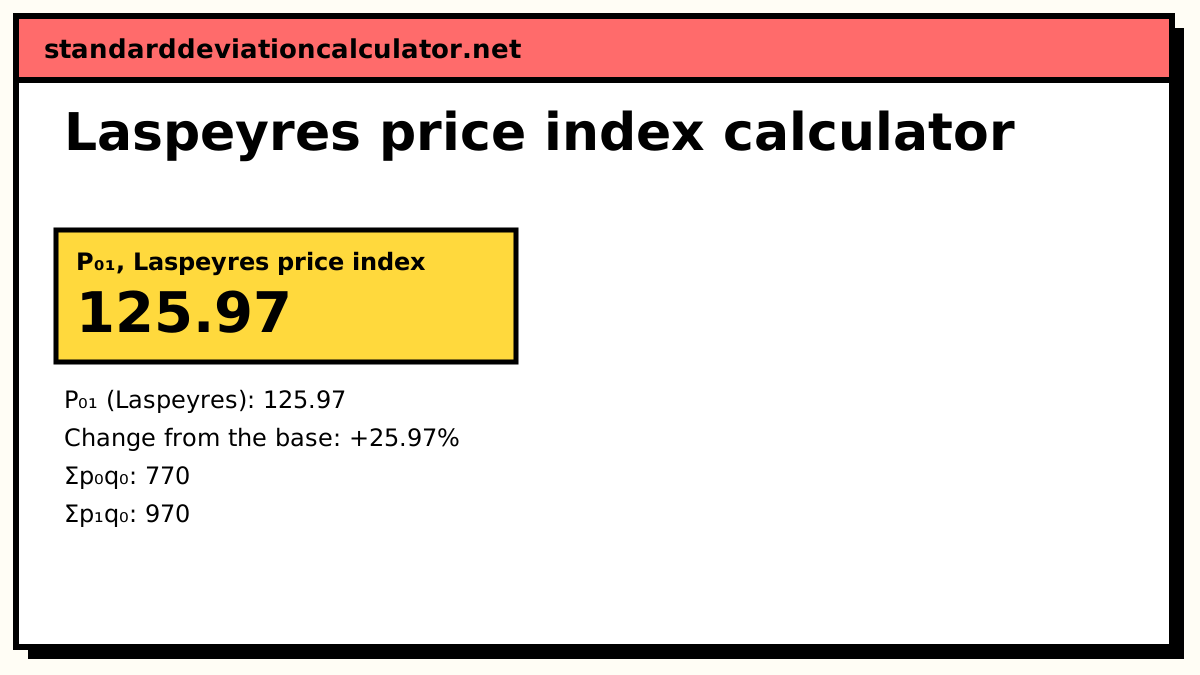
Σp₀q₀ = 770 Σp₁q₀ = 970
Divide and multiply by 100.
P₀₁ (Laspeyres) = Σp₁q₀ / Σp₀q₀ × 100 = 970 / 770 × 100 = 125.97
P₀₁ = 125.97 means prices in the current period are 25.97% higher than in the base period. Time reversal test: P₁₀ = 81.08, and P₀₁ × P₁₀ = 125.97/100 × 81.08/100 = 1.0214, which is not 1, so the test is not met.
The formula
P₀₁ (Laspeyres) = Σp₁q₀ / Σp₀q₀ × 100
The weights are the base-year quantities q₀. Σp₀q₀ is what the base-year basket cost in the base year; Σp₁q₀ is what exactly the same basket costs at current prices. Their ratio says how much more (or less) money the same shopping now takes. It was proposed by Étienne Laspeyres in 1871 and is still the starting point for most consumer price indices.
A worked example
This is the calculator's default data: five commodities, A to E.
| Commodity | p₀ | q₀ | p₁ | p₀q₀ | p₁q₀ |
|---|---|---|---|---|---|
| A | 10 | 20 | 15 | 200 | 300 |
| B | 8 | 15 | 10 | 120 | 150 |
| C | 5 | 30 | 6 | 150 | 180 |
| D | 20 | 10 | 24 | 200 | 240 |
| E | 4 | 25 | 4 | 100 | 100 |
| Σ | 770 | 970 |
- Multiply each base price by its base quantity: Σp₀q₀ = 200 + 120 + 150 + 200 + 100 = 770.
- Multiply each current price by the same base quantity: Σp₁q₀ = 300 + 150 + 180 + 240 + 100 = 970.
- P₀₁ = 970 / 770 × 100 = 125.97.
The base-year basket cost 770 and now costs 970, so on this measure prices have risen by 25.97%. The current quantities (q₁ = 15, 14, 36, 9 and 32) do not enter the price index at all.
Does Laspeyres over- or under-state inflation?
It usually overstates it. Buyers respond to relative prices: in the example, A rose 50% and its quantity fell from 20 to 15, while E did not change in price and its quantity rose from 25 to 32. Laspeyres ignores that switch and prices the old basket, heavy in A and light in E, so it gives the items that became dearer more weight than they now have in spending. The result is an upward substitution bias. Paasche, weighted by the current basket, gives 123.33 on the same data; the truth for a cost-of-living index lies between the two, and Fisher's ideal index (124.65) is the usual estimate of it.
The bias grows with time since the base year, because the basket drifts further from what people buy. That is why statistical offices revise the base and the weights every few years. New products and quality improvements add further upward bias that no choice of formula removes.
When to use it
- Only base-year quantities are known. Laspeyres needs one set of weights, so a monthly series needs new prices only, not a fresh household survey every month.
- Comparable series. Because the weights are fixed, each year's index can be compared directly with every other year on the same base.
- Exams. In CBSE Class 12 and B.Com papers, “weighted aggregative index with base-year quantities as weights” means Laspeyres.
Common mistakes
- Using q₁ in the numerator. Both sums use the base quantity q₀; only the price changes.
- Forgetting the × 100. The ratio 1.2597 is correct but the index is quoted as 125.97.
- Mixing units. Each p and q pair must refer to the same unit (price per kg with quantity in kg). The products p₀q₀ are money values, so different commodities can be added together.
Common questions
What is the formula for the Laspeyres price index?
P₀₁ = Σp₁q₀ / Σp₀q₀ × 100, where p₀ and p₁ are the base-year and
current-year prices and q₀ is the base-year quantity. The numerator is what the base-year
basket costs at today's prices; the denominator is what it cost in the base year. For the
default data, 970 / 770 × 100 = 125.97.
Why does the Laspeyres index overstate inflation?
It keeps buying the base-year basket. When a price rises sharply, people buy less of it and more of the substitutes, but the index still counts the old, larger quantity of the dear item. It therefore overstates the rise in the cost of living. This is called substitution bias. In the example, Laspeyres gives 125.97 while Paasche, which uses the new quantities, gives 123.33.
What is the Laspeyres quantity index?
Swap the roles of price and quantity: Q₀₁ = Σq₁p₀ / Σq₀p₀ × 100. It values
both years' quantities at base-year prices, so price changes do not affect it. For the
default table it is 750 / 770 × 100 = 97.40, so the volume bought fell by about 2.6%.
Choose “Quantity index” above to compute it.
Does the Laspeyres index satisfy the time reversal test?
No. Swap the two years and you get P₁₀ = Σp₀q₁ / Σp₁q₁ × 100 = 750 / 925 × 100 = 81.08. Then P₀₁ × P₁₀ = 1.2597 × 0.8108 = 1.0214, not 1. It fails the factor reversal test too. Of the common formulas, only Fisher's ideal index passes both.
Is the Laspeyres index the same as the weighted average of price relatives?
Yes, when the weights are base-year values W = p₀q₀. Each term RW = (p₁/p₀ × 100) × p₀q₀ = 100 p₁q₀, so ΣRW / ΣW = Σp₁q₀ / Σp₀q₀ × 100. National CPIs are usually computed this way, from price relatives and base-period expenditure weights.
Related calculators
-
Paasche price index
The same idea with current-year quantities, Σp₁q₁ / Σp₀q₁ × 100.
-
Fisher’s ideal index
The geometric mean of Laspeyres and Paasche, with both reversal tests.
-
Weighted aggregative index
All six weighted formulas compared on one table of data.
-
Weighted average of price relatives
ΣRW / ΣW, which equals Laspeyres when W = p₀q₀.
-
Marshall–Edgeworth index
Weights of q₀ + q₁, a compromise between Laspeyres and Paasche.