Statistics
Kelly’s price index calculator
Kelly's index weights prices by a fixed basket that belongs to neither year. Enter the base and current price of each commodity with its fixed quantity q, or switch to using the average of the base and current quantities.
Add a row for each commodity. Prices must be above zero; quantities and weights cannot be negative.
Add a row for each commodity. Prices must be above zero; quantities and weights cannot be negative.
Each bar is a commodity’s price relative (100 = no change); the last bar is the weighted index, which lies between the smallest and largest relative.
| Commodity | p₀ | p₁ | q (fixed) | p₀q | p₁q |
|---|---|---|---|---|---|
| A | 10 | 15 | 18 | 180 | 270 |
| B | 8 | 10 | 15 | 120 | 150 |
| C | 5 | 6 | 32 | 160 | 192 |
| D | 20 | 24 | 10 | 200 | 240 |
| E | 4 | 4 | 28 | 112 | 112 |
| Σ | 772 | 964 |
Show the working, step by step
Multiply each price by its fixed weight q and add each column.
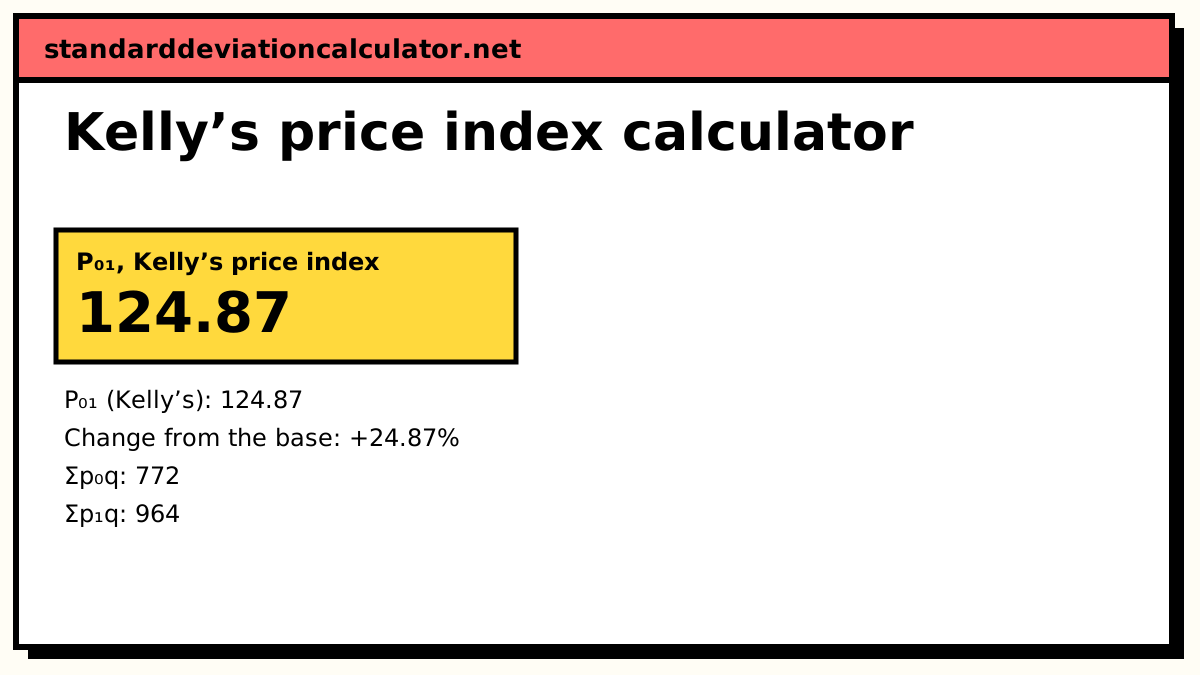
Σp₀q = 772 Σp₁q = 964
Divide and multiply by 100.
P₀₁ (Kelly) = Σp₁q / Σp₀q × 100 = 964 / 772 × 100 = 124.87
P₀₁ = 124.87 means prices in the current period are 24.87% higher than in the base period. Time reversal test: P₁₀ = 80.08, and P₀₁ × P₁₀ = 124.87/100 × 80.08/100 = 1.0000, which equals 1, so the test is met.
The formula
P₀₁ (Kelly) = Σp₁q / Σp₀q × 100
Here q is a set of fixed quantities, one per commodity. Σp₀q is what the fixed basket costs at base-year prices and Σp₁q what it costs now. The formula has the same shape as Laspeyres and Paasche; the difference is only where the basket comes from.
The fixed-weight idea
Laspeyres ties the weights to the base year and Paasche to the current year, so changing the base year means changing the weights, and a Paasche series needs new quantities every period. Kelly separates the two decisions. The basket q is fixed once, typically from the average quantities of a run of “normal” years or from a household survey, and prices from any pair of years are compared using that same basket. Because the weights never move:
- the base year for prices can be shifted without recomputing weights;
- no fresh quantity data are needed each period, only prices;
- indices for different years measure the same basket, so they can be compared with each other directly, and the index passes the time reversal test.
A worked example
The calculator's default data uses fixed quantities q = 18, 15, 32, 10 and 28 (say, the average bought over the last three years):
| Commodity | p₀ | p₁ | q | p₀q | p₁q |
|---|---|---|---|---|---|
| A | 10 | 15 | 18 | 180 | 270 |
| B | 8 | 10 | 15 | 120 | 150 |
| C | 5 | 6 | 32 | 160 | 192 |
| D | 20 | 24 | 10 | 200 | 240 |
| E | 4 | 4 | 28 | 112 | 112 |
| Σ | 772 | 964 |
- Σp₀q = 180 + 120 + 160 + 200 + 112 = 772.
- Σp₁q = 270 + 150 + 192 + 240 + 112 = 964.
- P₀₁ = 964 / 772 × 100 = 124.87.
With the same prices, the base-year quantities (Laspeyres) give 125.97 and the current-year quantities (Paasche) give 123.33. The average of q₀ and q₁ as the fixed basket gives 124.67, the Marshall–Edgeworth figure.
Does it over- or under-state inflation?
That depends entirely on the basket. A fixed basket never responds to price changes, so Kelly's index has the same kind of substitution bias as Laspeyres, measured against whatever year the basket represents. If q comes from years before the base, it overweights goods that have since become relatively dear and overstates inflation, and the bias grows the older the basket gets. If q is an average spanning the base and current periods, it usually lands between Laspeyres and Paasche and the bias is small, as in the example (and with q = (q₀ + q₁)/2 exactly, it always lies between them). The advantage is that the bias is stable and known, rather than changing with every choice of base year.
Common mistakes
- Using q₀ in one sum and q₁ in the other. Kelly uses the same q in the numerator and the denominator; that is what makes it a fixed-weight index.
- Assuming Kelly always equals Marshall–Edgeworth. It does only when q is exactly (q₀ + q₁)/2.
Common questions
What is the formula for Kelly’s price index?
P₀₁ = Σp₁q / Σp₀q × 100, where q is a fixed quantity for each commodity
that is the same in both periods. For the default data, Σp₁q = 964 and Σp₀q = 772, so
P₀₁ = 964 / 772 × 100 = 124.87.
What does “fixed weight” mean in Kelly’s method?
The quantities used as weights do not belong to either the base or the current year. They are chosen once, often as the average quantities over several years, and kept for as long as the index is published. The base period for prices can then be changed without changing the weights.
Is Kelly’s index the same as Marshall–Edgeworth?
Only when q is the average of the two years' quantities, q = (q₀ + q₁)/2. The ½ cancels and the formula becomes Σp₁(q₀ + q₁) / Σp₀(q₀ + q₁) × 100, which is Marshall–Edgeworth. On the default data both give 124.67. Choose “Use the average of q₀ and q₁” above to see this.
Does Kelly’s index satisfy the time reversal test?
Yes. With the same q in both periods, swapping the years just turns Σp₁q/Σp₀q upside down, so P₀₁ × P₁₀ = 1. It does not satisfy the factor reversal test.
Is it Kelly or Kelley?
The method is usually credited to the American statistician Truman L. Kelley. Indian textbooks (and most exam papers) write “Kelly's method”, which is the spelling used here.
Related calculators
-
Marshall–Edgeworth index
Kelly’s index with q = (q₀ + q₁)/2.
-
Laspeyres price index
A fixed basket too, but the base year’s own quantities.
-
Weighted aggregative index
Σp₁w / Σp₀w with six choices of w, compared.
-
Fisher’s ideal index
The index that passes both reversal tests.