Statistics
Dorbish–Bowley price index calculator
The Dorbish–Bowley index splits the difference between Laspeyres and Paasche by taking their arithmetic mean. Enter each commodity's prices and quantities in the base and current years.
Add a row for each commodity. Prices must be above zero; quantities and weights cannot be negative.
Dorbish–Bowley is the arithmetic mean of Laspeyres and Paasche; Fisher is their geometric mean, so it is never larger.
| Commodity | p₀ | q₀ | p₁ | q₁ | p₀q₀ | p₁q₀ | p₀q₁ | p₁q₁ |
|---|---|---|---|---|---|---|---|---|
| A | 10 | 20 | 15 | 15 | 200 | 300 | 150 | 225 |
| B | 8 | 15 | 10 | 14 | 120 | 150 | 112 | 140 |
| C | 5 | 30 | 6 | 36 | 150 | 180 | 180 | 216 |
| D | 20 | 10 | 24 | 9 | 200 | 240 | 180 | 216 |
| E | 4 | 25 | 4 | 32 | 100 | 100 | 128 | 128 |
| Σ | 770 | 970 | 750 | 925 |
Show the working, step by step
Multiply across each row to get p₀q₀, p₁q₀, p₀q₁, p₁q₁, then add each column.
Σp₀q₀ = 770 Σp₁q₀ = 970 Σp₀q₁ = 750 Σp₁q₁ = 925
Laspeyres and Paasche indices:
L = Σp₁q₀ / Σp₀q₀ × 100 = 970 / 770 × 100 = 125.97 P = Σp₁q₁ / Σp₀q₁ × 100 = 925 / 750 × 100 = 123.33
Take their arithmetic mean.
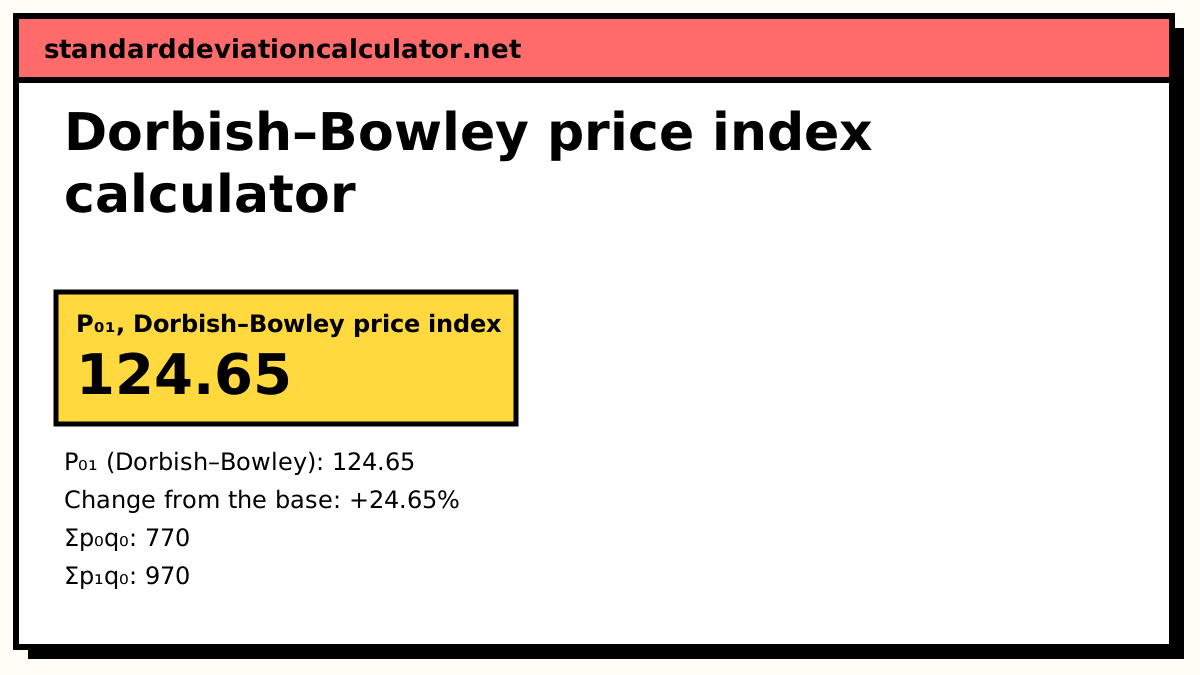
P₀₁ (Dorbish–Bowley) = (125.97 + 123.33) / 2 = 124.65
P₀₁ = 124.65 means prices in the current period are 24.65% higher than in the base period. Time reversal test: P₁₀ = 80.23, and P₀₁ × P₁₀ = 124.65/100 × 80.23/100 = 1.0001, which is not 1, so the test is not met.
The formula
P₀₁ = (L + P) / 2 L = Σp₁q₀ / Σp₀q₀ × 100 P = Σp₁q₁ / Σp₀q₁ × 100
Laspeyres uses the base-year basket and Paasche the current one. Neither is “right”: they answer slightly different questions and are biased in opposite directions. The Dorbish–Bowley index simply averages them.
A worked example
The calculator's default data, with the four product columns summed:
| Commodity | p₀ | q₀ | p₁ | q₁ | p₀q₀ | p₁q₀ | p₀q₁ | p₁q₁ |
|---|---|---|---|---|---|---|---|---|
| A | 10 | 20 | 15 | 15 | 200 | 300 | 150 | 225 |
| B | 8 | 15 | 10 | 14 | 120 | 150 | 112 | 140 |
| C | 5 | 30 | 6 | 36 | 150 | 180 | 180 | 216 |
| D | 20 | 10 | 24 | 9 | 200 | 240 | 180 | 216 |
| E | 4 | 25 | 4 | 32 | 100 | 100 | 128 | 128 |
| Σ | 770 | 970 | 750 | 925 |
- Laspeyres: L = 970 / 770 × 100 = 125.97.
- Paasche: P = 925 / 750 × 100 = 123.33.
- Dorbish–Bowley: (125.97 + 123.33) / 2 = 124.65.
Kept to three decimals the answer is 124.654. Fisher's index on the same data is 124.647, so the two agree to two decimals, as they usually do when L and P are within a few points.
Does it over- or under-state inflation?
Laspeyres tends to overstate the rise in living costs (it keeps the old basket, heavy in goods that have since become dear) and Paasche tends to understate it (its basket has already shifted to goods that became cheap). Averaging the two removes most of both biases, so Dorbish–Bowley lands close to the true change. Because it is an arithmetic mean it sits slightly above Fisher, which gives it a very small upward lean compared with the ideal index. That lean only matters when L and P are far apart, for example over a long gap between base and current year.
How it compares
| Index | Formula | Default data |
|---|---|---|
| Laspeyres | Σp₁q₀ / Σp₀q₀ × 100 | 125.97 |
| Marshall–Edgeworth | Σp₁(q₀ + q₁) / Σp₀(q₀ + q₁) × 100 | 124.67 |
| Dorbish–Bowley | (L + P) / 2 | 124.65 |
| Fisher | √(L × P) | 124.65 |
| Paasche | Σp₁q₁ / Σp₀q₁ × 100 | 123.33 |
Common mistakes
- Rounding L and P heavily before averaging. Keep at least two decimals in each.
- Confusing it with Marshall–Edgeworth, which averages the quantities, not the indices.
Common questions
What is the Dorbish–Bowley price index formula?
P₀₁ = (L + P) / 2 = ½ (Σp₁q₀/Σp₀q₀ + Σp₁q₁/Σp₀q₁) × 100: the simple
arithmetic mean of the Laspeyres and Paasche indices. For the default data,
(125.97 + 123.33) / 2 = 124.65.
What is the difference between Dorbish–Bowley and Fisher’s index?
Dorbish–Bowley takes the arithmetic mean of L and P; Fisher takes the geometric mean √(L × P). Because an arithmetic mean is never below a geometric mean, Dorbish–Bowley is always at least as large as Fisher. The gap is tiny when L and P are close: 124.654 against 124.647 on the default data, which both round to 124.65.
Does the Dorbish–Bowley index satisfy the time reversal test?
No, although it comes close when L and P are near each other. On the default data P₁₀ = 80.23 and P₀₁ × P₁₀ = 1.0001, not exactly 1. It fails the factor reversal test too (1.2014 against V₀₁ = 1.2013). Fisher's index passes both.
Is it spelled Dorbish, Drobisch or Bowley?
The formula is credited to the German mathematician Moritz Drobisch (1871) and to the British statistician Arthur Bowley. Indian textbooks usually write “Dorbish and Bowley”, and international texts “Drobisch”. They are the same index.
When should I use Dorbish–Bowley instead of Fisher?
When you only have a basic calculator: it needs no square root, and in practice it gives almost the same number. When a question asks for an index that passes the reversal tests, or asks for the “ideal” index, use Fisher.
Related calculators
-
Fisher’s ideal index
The geometric mean of L and P, with both reversal tests checked.
-
Laspeyres price index
Σp₁q₀ / Σp₀q₀ × 100, the L in (L + P)/2.
-
Paasche price index
Σp₁q₁ / Σp₀q₁ × 100, the P in (L + P)/2.
-
Marshall–Edgeworth index
Another compromise: weights of q₀ + q₁.
-
Weighted aggregative index
All six weighted methods compared.