Math
Ratio and proportion calculator
Pick what you need to do with a ratio: simplify it, solve a missing value in a proportion, share an amount in it, or scale it. Ratios can have two or more terms, written with colons such as 12:18:30.
Terms separated by colons, e.g. 12:18:30 or 1.5:2.
Term 1: 2 parts Term 2: 3 parts Term 3: 5 parts
Show the working, step by step
Find the greatest common divisor of the terms.
GCD(12, 18, 30) = 6
Divide every term by 6.
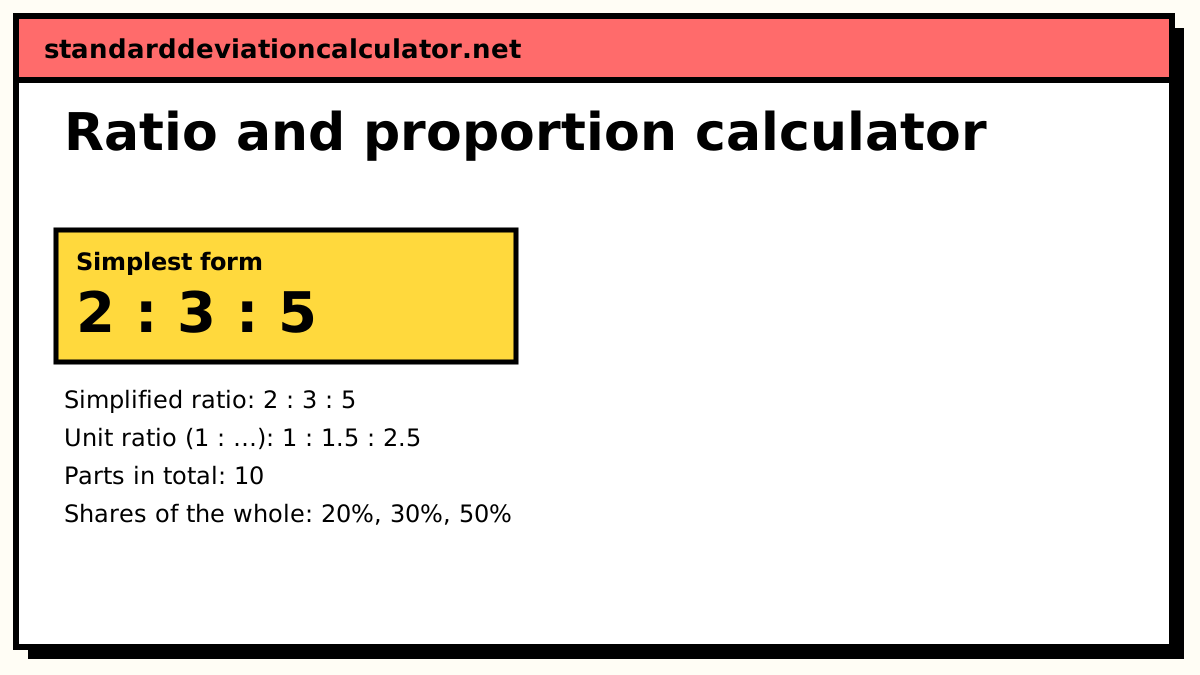
12 ÷ 6 : 18 ÷ 6 : 30 ÷ 6 = 2 : 3 : 5
The key facts
a : b = ka : kb for any k ≠ 0 (equivalent ratios) a : b = c : x ⇔ a·x = b·c ⇔ x = b·c ÷ a share of term i = total × termᵢ ÷ (sum of the terms)
A ratio says how many parts of one thing go with how many parts of another. Multiplying or dividing every term by the same number gives an equivalent ratio, which is all that simplifying and scaling are. A proportion is a statement that two ratios are equal.
A worked example: simplifying 12 : 18 : 30
- Find the greatest common divisor of 12, 18 and 30. It is 6.
- Divide each term by 6: 12 ÷ 6 = 2, 18 ÷ 6 = 3, 30 ÷ 6 = 5.
- The simplest form is 2 : 3 : 5. There are 10 parts in total, so the shares of the whole are 20%, 30% and 50%.
As a unit ratio (first term 1), 2 : 3 : 5 is 1 : 1.5 : 2.5, which is handy for recipes and mixtures where the first ingredient is measured and the rest follow.
Sharing in a ratio
Share 500 in the ratio 12 : 18 : 30. Simplify to 2 : 3 : 5 (the shares do not change), add the parts to get 10, and find one part: 500 ÷ 10 = 50. The shares are 2 × 50 = 100, 3 × 50 = 150 and 5 × 50 = 250, which add back to 500.
Direct and inverse proportion
| Type | Rule | Example |
|---|---|---|
| Direct | y ÷ x stays the same | 3 kg cost $5, so 12 kg cost $20 |
| Inverse | x × y stays the same | 3 workers take 12 days, so 6 workers take 6 days |
The proportion solver handles the direct case, a : b = c : x. For an inverse relationship, multiply instead: x = (a × b) ÷ c.
Common mistakes
- Dividing the total by a single term instead of by the sum of the terms.
- Swapping positions in a proportion, which solves a different problem.
- Simplifying with a common factor that is not the greatest, e.g. dividing 12 : 18 : 30 by 2 to get 6 : 9 : 15, which is equivalent but not simplest.
Common questions
How do you simplify a ratio?
Divide every term by the greatest common divisor of all the terms. For 12 : 18 : 30 the GCD is 6, so the ratio simplifies to 2 : 3 : 5. If the terms are decimals, multiply them all by a power of ten first: 1.5 : 2.25 becomes 150 : 225, and dividing by 75 gives 2 : 3.
How do you solve a proportion such as 3 : 5 = 12 : x?
Write it as two equal fractions, 3/5 = 12/x, and cross-multiply: 3x = 5 × 12 = 60, so x = 20. Another way to see it: 12 is 3 multiplied by 4, so x is 5 multiplied by 4.
How do you divide an amount in a ratio?
Add the parts of the ratio, divide the amount by that total to find one part, then multiply by each term. To share 500 in the ratio 2 : 3 : 5, there are 10 parts of 50 each, so the shares are 100, 150 and 250.
What is the difference between a ratio and a fraction?
A ratio compares parts with each other; a fraction compares a part with the whole. In 2 : 3 : 5 the first share is 2 parts out of 10, so as a fraction of the whole it is 2/10 = 1/5, or 20%. The calculator shows these shares under every simplified ratio.
Does the order of a ratio matter?
Yes. 2 : 3 and 3 : 2 are different. Keep the terms in the order the question gives them (for example boys : girls), and when you solve a proportion make sure the matching quantities are in matching positions on both sides.
Related calculators
-
GCD and LCM
The greatest common divisor used to simplify ratios.
-
Percentage
Shares of a whole per hundred.
-
Division
Exact quotients and fractions.