Arithmetic and number theory calculators
Calculators for the four operations, percentages, ratios, simple averages and the properties of whole numbers. They show column and long-division working for students checking homework, and give exact answers for numbers of any size.
Which calculator do I need?
| You have or want | Use |
|---|---|
| Long division with the remainder and the repeating decimal | Division calculator |
| What percent one number is of another, or a percentage increase | Percentage calculator |
| Share an amount in the ratio 2 : 3, or solve a : b = c : x | Ratio and proportion calculator |
| An average where some values count more than others | Weighted average calculator |
| Whether a number is prime, or the next prime after it | Prime number calculator |
| A factor tree and the full list of divisors | Prime factorization calculator |
| The highest common factor or lowest common multiple | GCD and LCM calculator |
| A number in binary, hex or another base | Number system converter |
The four operations
Exact sums, differences, products and quotients with the written method shown.
-
Addition calculator
Add any list of numbers exactly, with column addition and the carries shown.
-
Subtraction calculator
Subtract with column working that shows every borrow, including across zeros.
-
Multiplication calculator
Exact products of any size, with long multiplication and partial products.
-
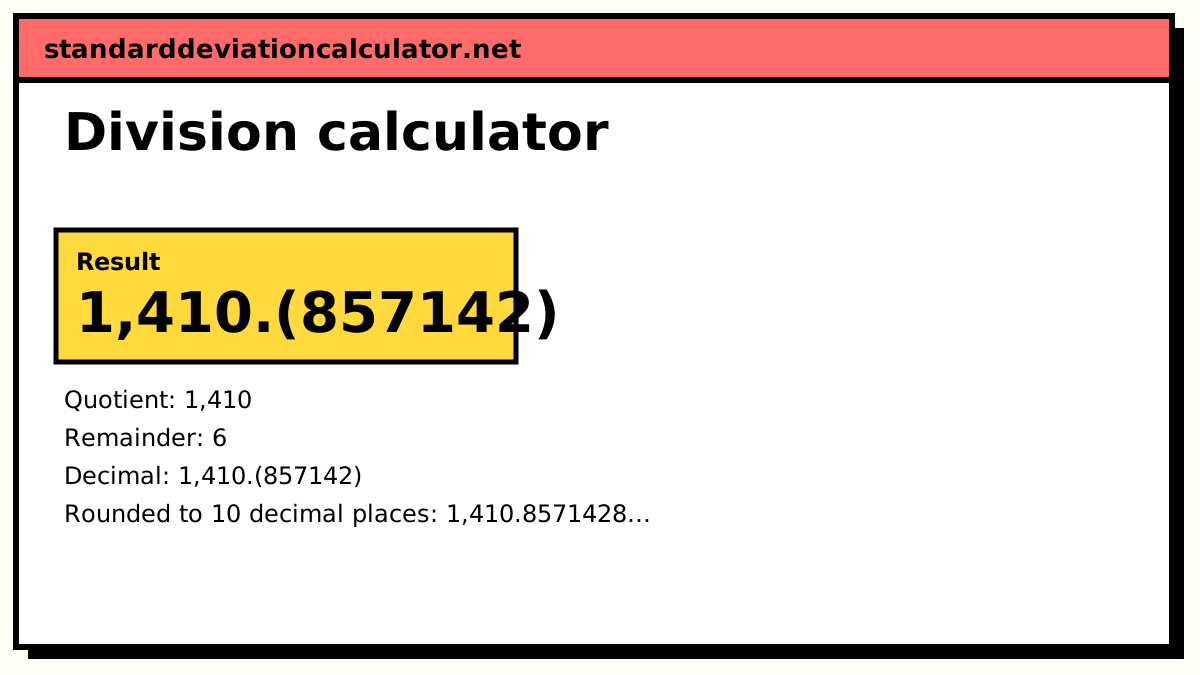
Division calculator
Quotient, remainder, repeating decimal and a step-by-step long division.
Percentages, ratios and averages
Comparing amounts: as a percentage, as a ratio, or as the average of a list.
-
Percentage calculator
Percent of a number, percentage change, increase or decrease, and reverse percentages.
-
Ratio and proportion calculator
Simplify ratios, solve a : b = c : x, and share an amount in a ratio.
-
Average calculator
The arithmetic mean of a list of numbers, with the geometric, harmonic and trimmed means.
-
Weighted average calculator
An average where each value carries its own weight, such as credits, quantities or percentages.
-
Grade average calculator
Average test, quiz and homework scores, with the median and the effect of dropping the lowest.
Primes, factors and divisibility
Breaking whole numbers into their building blocks and finding what they share.
-
Prime number calculator
Test any number for primality, find the next or previous prime, list primes, or the nth prime.
-
Prime factorization calculator
Prime factors with exponents, the division ladder, and every divisor.
-
Divisibility calculator
Test a number against 2 to 12 with each divisibility rule applied to its digits.
-
GCD and LCM calculator
GCD and LCM by the Euclidean algorithm and by prime factors, with Bézout coefficients.
Number theory and number bases
Remainders, special functions of integers, and writing numbers in other bases.
-
Modular arithmetic calculator
a mod n, modular powers, inverses and linear congruences, with the steps.
-
Number theory calculator
Euler’s totient, divisor functions, perfect numbers, digital root and Collatz steps.
-
Number system converter
Convert between binary, octal, decimal, hex and any base from 2 to 36.
How these calculators fit together
The first four pages do one operation each and show the written method taught in school: carries for addition, borrows for subtraction, partial products for multiplication and the bring-down steps of long division. Use them to check working, not only the answer.
Percentages and ratios are two ways of comparing amounts. The percentage calculator compares against 100; the ratio calculator compares parts with each other. The average, weighted average and grade average calculators summarise a list with one number. For the median, mode and range, see the averages hub in statistics.
The prime and factor pages all rest on the same fact: every whole number above 1 is a product of primes in exactly one way. Once you have the prime factorization, the GCD, LCM and divisor count follow.
Worked comparison: GCD and LCM of 12 and 18
| Number | Prime factors |
|---|---|
| 12 | 2² × 3 |
| 18 | 2 × 3² |
| GCD (lowest powers) | 2 × 3 = 6 |
| LCM (highest powers) | 2² × 3² = 36 |
As a check, GCD × LCM = 6 × 36 = 216 = 12 × 18, which holds for any two positive whole numbers. The GCD and LCM calculator also runs the Euclidean algorithm, which is quicker for large numbers: 18 = 1 × 12 + 6, then 12 = 2 × 6 + 0, so the GCD is 6.
Common mix-ups
- Percentage change is not symmetric. Going from 40 to 50 is a 25% rise, but going back from 50 to 40 is a 20% fall, because the base changes.
- Percent versus percentage points. A rate moving from 4% to 5% has risen by one percentage point, which is a 25% increase.
- Remainder versus mod of a negative number. Many programming languages give −7 % 3 = −1, while mathematics gives −7 mod 3 = 2. The modular arithmetic calculator uses the mathematical convention.
Guides to read alongside
-
Statistics formulas
The arithmetic, weighted, geometric and harmonic mean formulas side by side.
-
How to calculate standard deviation
A step-by-step hand calculation that puts averages, squaring and square roots to work.
-
Methodology
How results are rounded and why exact integer arithmetic is used where it matters.