Math
Subtraction calculator
Enter the number you start with and the number to take away. You get the exact difference, the column subtraction with every borrow marked, and a check that adds the answer back.
after borrowing 4 9 9 13 5 0 0 3 − 1 7 6 8 ──────────── 3 2 3 5
| Column | Top | Lent | Borrowed | Bottom | Digit |
|---|---|---|---|---|---|
| Thousands | 5 | −1 | 1 | 3 | |
| Hundreds | 0 | −1 | +10 | 7 | 2 |
| Tens | 0 | −1 | +10 | 6 | 3 |
| Ones | 3 | +10 | 8 | 5 |
Show the working, step by step
Ones: 3 is less than 8, so borrow 1 from the column on the left, worth 10 here.
3 + 10 = 13; 13 − 8 = 5
Tens: this digit has lent 1 to the column on its right, leaving 0 − 1, which is less than 6, so it borrows 10 from the column on its left.
0 − 1 + 10 = 9; 9 − 6 = 3
Hundreds: this digit has lent 1 to the column on its right, leaving 0 − 1, which is less than 7, so it borrows 10 from the column on its left.
0 − 1 + 10 = 9; 9 − 7 = 2
Thousands: this digit lent 1 to the right, leaving 4, which is at least 1.
5 − 1 = 4; 4 − 1 = 3
Result, checked by adding back:
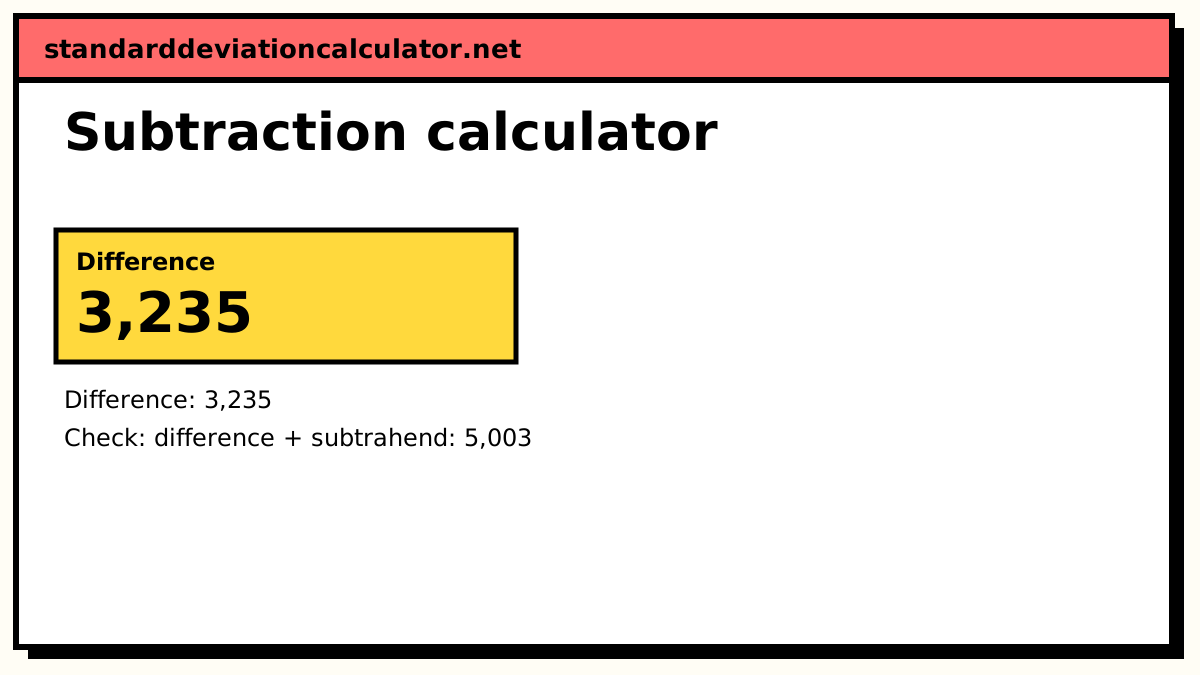
5,003 − 1,768 = 3,235 3,235 + 1,768 = 5,003 ✓
The method
minuend − subtrahend = difference difference + subtrahend = minuend (the check)
Column subtraction works one place value at a time from the right. When a top digit is too small, you regroup: one unit from the next column to the left is exchanged for ten in this column. Nothing is created or lost; 5,003 is still 5,003 when it is written as 4 thousands, 9 hundreds, 9 tens and 13 ones.
A worked example: 5,003 − 1,768
- Ones: 3 is less than 8, so borrow. The tens and hundreds are both 0, so the borrow comes all the way from the thousands.
- After regrouping the top number reads 4 | 9 | 9 | 13.
- Ones: 13 − 8 = 5.
- Tens: 9 − 6 = 3.
- Hundreds: 9 − 7 = 2.
- Thousands: 4 − 1 = 3.
The difference is 3,235, and 3,235 + 1,768 = 5,003 confirms it.
The calculator’s step list describes the same thing column by column: each column that has lent 1 to its right first loses that 1, and borrows 10 from its left if it is then too small. It is the same arithmetic as crossing out and rewriting digits on paper.
Decimals
Line up the decimal points and pad with zeros so both numbers have the same number of decimal places. 12.5 − 7.75 becomes 12.50 − 7.75: the hundredths column is 0 − 5, so it borrows, and the answer is 4.75.
Signs at a glance
| Case | Rewrite as | Example |
|---|---|---|
| a − b, a ≥ b ≥ 0 | Column subtraction | 5,003 − 1,768 = 3,235 |
| a − b, b > a ≥ 0 | −(b − a) | 3 − 10 = −7 |
| a − (−b) | a + b | 3 − (−4) = 7 |
| −a − b | −(a + b) | −3 − 4 = −7 |
| −a − (−b) | b − a | −3 − (−10) = 7 |
Common mistakes
- Subtracting the smaller digit from the larger in every column. 5,003 − 1,768 worked that way gives 4,765, because 8 − 3 is used instead of 13 − 8.
- Forgetting that a lending digit went down by 1. After the tens lend to the ones, the tens digit is one less.
- Misaligning decimals. Always line up the points, not the last digits.
Common questions
How do you subtract with borrowing?
Work from the right. When the top digit in a column is smaller than the bottom digit, take 1 from the column to its left; that 1 is worth 10 in the current column. In 5,003 − 1,768 the ones column is 3 − 8, so borrow: 13 − 8 = 5. The borrowed 1 is then owed by the tens column, and so on.
How do you borrow across zeros?
A zero has nothing to lend, so it must borrow first. In 5,003 the ones need a borrow, but the tens and hundreds are 0. The borrow comes from the thousands: 5 becomes 4, each 0 becomes 9, and the ones digit becomes 13. That is why the regrouped top number reads 4 | 9 | 9 | 13, and 5,003 − 1,768 = 3,235.
What happens when the second number is bigger?
The answer is negative. Subtract the smaller number from the larger and put a minus sign in front: 3 − 10 = −(10 − 3) = −7. Column subtraction itself only works with the larger number on top, which is why the calculator swaps them for the working.
How do I subtract a negative number?
Subtracting a negative is the same as adding its size: 3 − (−4) = 3 + 4 = 7. Taking away a debt leaves you better off. Two negatives, such as −3 − (−10), become 10 − 3 = 7.
How can I check a subtraction?
Add the answer to the number you took away. You should get back the number you started with: 3,235 + 1,768 = 5,003. The calculator shows this check under every result.
Related calculators
-
Addition
Column addition with every carry shown.
-
Percentage change
Turn a difference into a percentage increase or decrease.
-
Division
Long division, remainders and repeating decimals.
-
Range
The largest value minus the smallest.