Calculus calculators
Step-by-step calculators for derivatives, integrals and limits, plus series, differential equations and functions of two variables. Each names the rule or test it applies at every step, for students working through a calculus course.
Which calculator do I need?
| You have or want | Use |
|---|---|
| The derivative of a function, with the chain, product or quotient rule shown | Derivative calculator |
| An antiderivative, or the area under a curve between two limits | Integral calculator |
| The limit of a 0/0 or ∞/∞ expression | Limit calculator |
| Whether an infinite series converges, and its sum | Infinite series calculator |
| A numerical solution of y′ = f(x, y) from a starting value | Differential equation calculator |
| ∂f/∂x, ∂f/∂y and the mixed partials of f(x, y) | Partial derivative calculator |
| The gradient, critical points or a double integral of f(x, y) | Multivariable calculus calculator |
Limits and derivatives
Rates of change of a function of one variable, and the limits they are built on.
-
Limit calculator
Limits at a point or at ±∞, one- or two-sided, with L’Hôpital’s rule and a table of values.
-
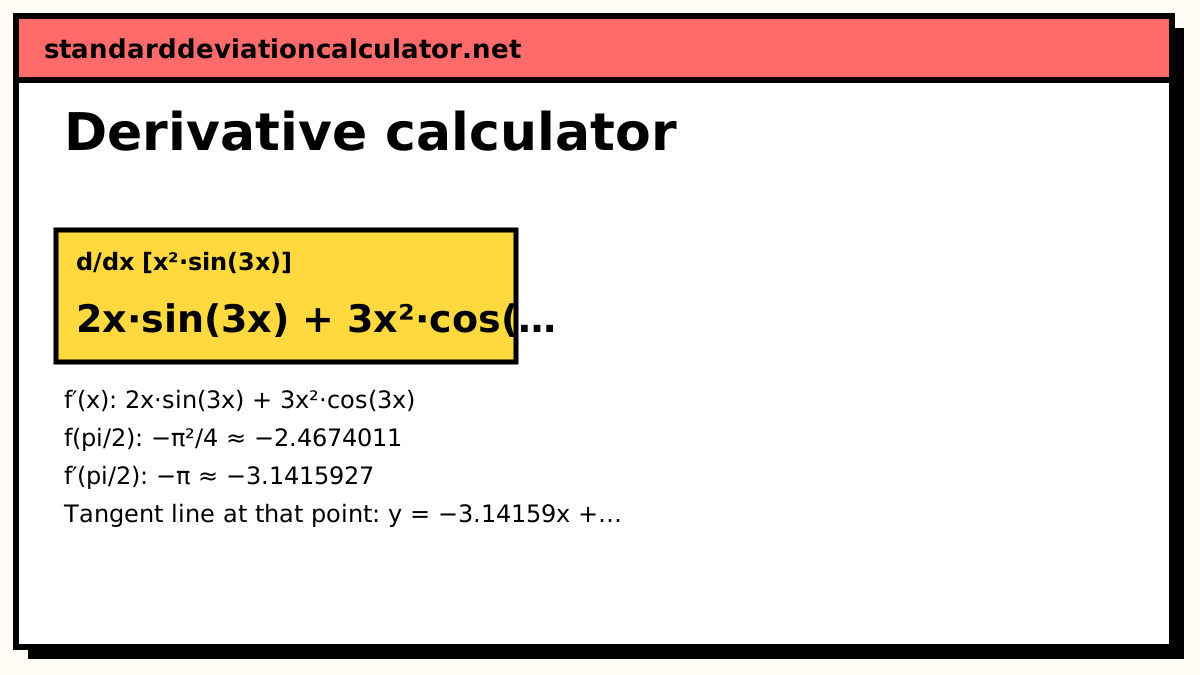
Derivative calculator
Derivatives up to the fourth, with each rule shown as a step, a tangent line and a graph.
Integrals and series
Adding up: areas under curves, and sums of infinitely many terms.
-
Integral calculator
Antiderivatives with the method named, and definite or improper integrals, exact and numerical.
-
Infinite series calculator
Convergence tests with reasoning, partial sums, and the sum of a convergent series.
Differential equations and several variables
Equations involving derivatives, and functions of more than one variable.
-
Differential equation calculator
Solve y′ = f(x, y) numerically with RK4 and Euler, or linear equations exactly.
-
Partial derivative calculator
First and second partial derivatives, mixed partials and Clairaut’s check, at a point.
-
Multivariable calculus calculator
Gradient, directional derivative, Hessian, critical points and double integrals of f(x, y).
How the calculus tools connect
A derivative is a limit, and an integral undoes a derivative, so the first three calculators cover the core of a single-variable course. The limit calculator handles the indeterminate forms that make limits hard. The derivative calculator gives up to the fourth derivative and the tangent line. The integral calculator names the method it used, such as substitution, by parts or partial fractions.
The rest extend these ideas. The series calculator applies convergence tests. The differential equation calculator solves equations where the unknown is a function. The partial derivative and multivariable calculators take everything to functions of two variables.
Worked comparison: one function, three questions
Take f(x) = x³ − 3x. Its derivative is f′(x) = 3x² − 3, which is zero at x = −1 and x = 1. Those are the turning points: a local maximum of 2 at x = −1 and a local minimum of −2 at x = 1. The definite integral from 0 to 2 is [x⁴/4 − 3x²/2] from 0 to 2 = 4 − 6 = −2. The answer is negative because more of the curve lies below the axis on that interval than above it. A signed integral is not the same as the geometric area.
Numerical methods and their accuracy
Solving y′ = y with y(0) = 1 up to x = 1 should give e ≈ 2.718282. With a step of 0.1, Euler’s method gives 1.1¹⁰ ≈ 2.593742, an error of about 5%. The fourth-order Runge–Kutta method (RK4) gives 2.718280 with the same step. The differential equation calculator shows both, so you can see why RK4 is the default.
Common mix-ups
- Terms tending to zero is not enough. The terms of 1 + 1/2 + 1/3 + … shrink to zero, but the harmonic series diverges. By contrast, 1 + 1/4 + 1/9 + … converges to π²/6 ≈ 1.6449.
- Forgetting + C. An indefinite integral is a family of functions, so the constant matters, especially when you solve a differential equation from an initial value.
- Partial versus total derivative. ∂f/∂x holds y fixed. The gradient collects all the partials into one vector.
Guides to read alongside
-
Standard deviation and the normal distribution
Why the bell curve’s inflection points sit exactly one standard deviation from the mean.
-
Standard deviation of a random variable
Expected value and variance of continuous distributions, written as integrals.
-
Methodology
How numerical results are computed and rounded.