Math
Partial derivative calculator
Enter a function of x and y (or x, y and z). The calculator finds every first and second partial derivative, checks that the mixed partials agree, and evaluates them at your point.
Variables x, y and z. Write products as x*y or x y. ln, sqrt, sin, cos, e and pi work.
━ f with y = 2 held fixed ┄ tangent, slope ∂f/∂x = 16
| then ∂/∂x | then ∂/∂y | |
|---|---|---|
| ∂f/∂x | 6xy² | 6x²y + 2 |
| ∂f/∂y | 6x²y + 2 | 2x³ − 6y |
| ∂/∂x | ∂/∂y | |
|---|---|---|
| ∂f/∂x | 24 | 14 |
| ∂f/∂y | 14 | −10 |
Show the working, step by step
To find ∂f/∂x, treat y as constant and differentiate with respect to x alone.
Power rule: bring the power down and reduce it by 1
∂/∂x [x³] = 3x²
Constant multiple rule: the constant y² stays as a factor
∂/∂x [x³y²] = y²·3x² = 3x²y²
Constant multiple rule: the constant y stays as a factor
∂/∂x [2xy] = y·2 = 2y
Sum rule: differentiate term by term
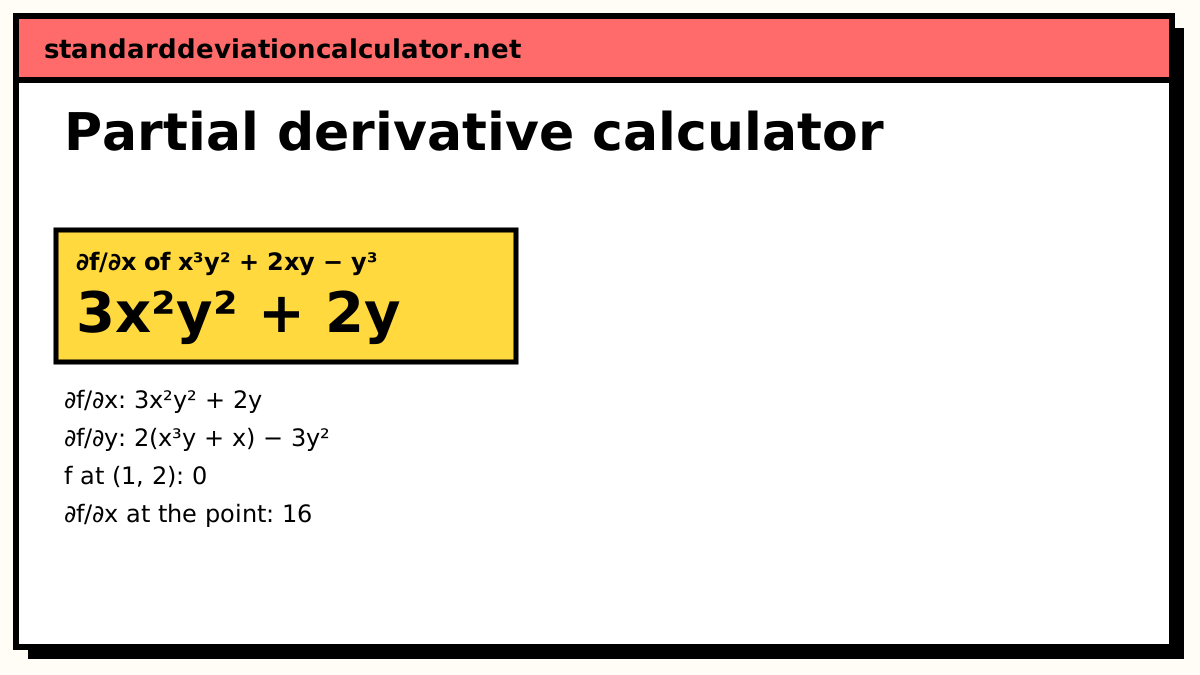
∂/∂x [x³y² + 2xy] = 3x²y² + 2y
Difference rule: differentiate term by term
∂/∂x [x³y² + 2xy − y³] = (3x²y² + 2y) = 3x²y² + 2y
Differentiate ∂f/∂x with respect to x again.
∂²f/∂x² = ∂/∂x [3x²y² + 2y] = 6xy²
Differentiate ∂f/∂x with respect to y.
∂²f/∂y∂x = ∂/∂y [3x²y² + 2y] = 6x²y + 2
Clairaut's theorem: when the mixed partials are continuous, the order does not matter. Here they agree.
fₓᵧ = 6x²y + 2 fᵧₓ = 6x²y + 2
Substitute x = 1, y = 2.
∂f/∂x = 16
Mixed partials are written ∂²f/∂y∂x = f_xy: differentiate by x first, then by y. Equivalent forms of an answer are equally correct.
The definition
∂f/∂x = lim h→0 [f(x + h, y) − f(x, y)] ÷ h
Only x moves; y is held fixed. So every ordinary differentiation rule (power, product, chain) applies unchanged, with the other variables treated as constants. A term containing no x at all has ∂/∂x equal to 0.
A worked example
The default is f(x, y) = x³y² + 2xy − y³ at the point (1, 2).
- ∂f/∂x, holding y constant: 3x²y² + 2y. At (1, 2): 3·1·4 + 4 = 16.
- ∂f/∂y, holding x constant: 2x³y + 2x − 3y². At (1, 2): 4 + 2 − 12 = −6.
- Second partials: f_xx = 6xy² = 24, f_yy = 2x³ − 6y = −10, and f_xy = f_yx = 6x²y + 2 = 14 at (1, 2).
- f(1, 2) = 4 + 4 − 8 = 0, so the point lies on the level curve f = 0.
Notation
| Written | Also written | Meaning |
|---|---|---|
| ∂f/∂x | fₓ, f₁, Dₓf | Rate of change in the x-direction |
| ∂²f/∂x² | fₓₓ | Differentiate by x twice |
| ∂²f/∂y∂x | fₓᵧ | By x first, then by y |
| ∂²f/∂x∂y | fᵧₓ | By y first, then by x |
The order convention is read right to left in the ∂ notation and left to right in the subscript notation. By Clairaut’s theorem the two usually agree anyway.
Where partial derivatives are used
The gradient ∇f = (fₓ, fᵧ) points uphill and gives the directional derivative in any direction. Setting both first partials to zero finds candidate maxima and minima, and the second partials (the Hessian) classify them; the multivariable calculus calculator does both. In economics, ∂Q/∂L is the marginal product of labour; in physics, partial derivatives make up the heat, wave and Laplace equations.
Common mistakes
- Differentiating a term like y³ with respect to x as 3y². It is a constant in x, so its x-partial is 0.
- Dropping the other variable’s factor: ∂/∂x of x²y is 2xy, not 2x.
- Forgetting the chain rule for sin(xy): its x-partial is y·cos(xy).
Common questions
How do you take a partial derivative?
Differentiate with respect to one variable while treating every other variable as a constant. For f = x³y² + 2xy − y³, ∂f/∂x treats y as a number: x³y² becomes 3x²y², 2xy becomes 2y, and −y³ is a constant, so it disappears. The result is 3x²y² + 2y.
What is a mixed partial derivative?
A second derivative taken with respect to two different variables: differentiate by x, then by y. It is written ∂²f/∂y∂x or f_xy. For the default function, f_x = 3x²y² + 2y and f_xy = 6x²y + 2.
What does Clairaut’s theorem say?
If the mixed partials f_xy and f_yx are continuous near a point, they are equal there, so the order of differentiation does not matter. This holds for every function built from polynomials, exponentials and trig functions away from points where they are undefined. The calculator computes both orders separately and reports whether they agree.
What does the partial derivative mean geometrically?
∂f/∂x at (a, b) is the slope of the surface z = f(x, y) in the x-direction: slice the surface with the plane y = b and take the slope of the resulting curve at x = a. At (1, 2) the default surface rises with slope 16 in the x-direction and falls with slope 6 in the y-direction.
How do I enter xy or a function of three variables?
Type x*y, x y (with a space) or just xy; all three mean x times y. Use z as a third variable, and the calculator adds ∂f/∂z and the full 3 × 3 table of second partials.
Related calculators
-
Derivative
Ordinary derivatives of f(x), up to the fourth, with the rules shown.
-
Multivariable calculus
Gradient, directional derivative, Hessian, critical points and double integrals.
-
Vector calculator
Dot and cross products, magnitudes and angles.
-
Differential equations
Solve y′ = f(x, y) and linear equations.