Math
Infinite series calculator
Enter the general term aₙ and where the sum starts. The calculator applies the standard convergence tests in turn, explains what each one shows, and gives the sum when the series converges, exactly when it can and numerically when it cannot.
Use n as the index. ^ for powers, n! for factorials, (-1)^n for alternating signs; ln, sqrt, e and pi work.
━ partial sums Sₙ ┄ sum ≈ 1.64493
| n | aₙ | Partial sum Sₙ | Terms added |
|---|---|---|---|
| 1 | 1 | 1 | 1 |
| 2 | 0.25 | 1.25 | 2 |
| 3 | 0.11111111 | 1.36111111111 | 3 |
| 4 | 0.0625 | 1.42361111111 | 4 |
| 5 | 0.04 | 1.46361111111 | 5 |
| 6 | 0.027777778 | 1.49138888889 | 6 |
| 7 | 0.020408163 | 1.51179705215 | 7 |
| 8 | 0.015625 | 1.52742205215 | 8 |
| 9 | 0.012345679 | 1.53976773117 | 9 |
| 10 | 0.01 | 1.54976773117 | 10 |
| 20 | 0.0025 | 1.59616324391 | 20 |
| 50 | 0.0004 | 1.62513273362 | 50 |
| 100 | 0.0001 | 1.63498390018 | 100 |
| 1000 | 1.0000000e−6 | 1.64393456668 | 1000 |
| 10000 | 1.0000000e−8 | 1.64483407185 | 10000 |
Show the working, step by step
Write out the first terms.
1 + 0.25 + 0.111111 + 0.0625 + 0.04 + …
nth-term (divergence) test: inconclusive. |a_n| appears to tend to 0 (|a_1000000| ≈ 1.000e−12). That is necessary for convergence but does not prove it, so this test says nothing more.
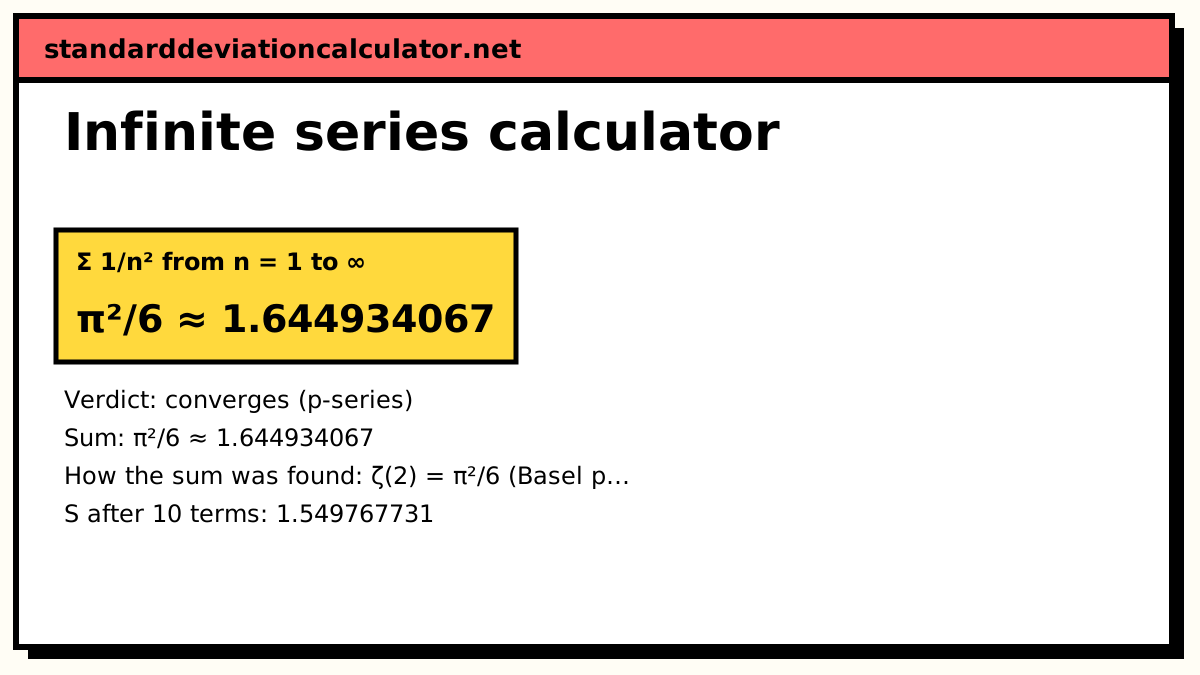
p-series: converges. a_n = 1/n^2 for every n checked. A p-series Σ1/n^p converges exactly when p > 1; here p = 2.
Find the sum: ζ(2) = π²/6 (Basel problem).
Σ = π²/6 ≈ 1.644934067
Tests are applied in order: recognised series (geometric, p-series), the nth-term test, the ratio and root tests, the alternating series test, then a limit comparison with a p-series.
What convergence means
Σ aₙ = lim N→∞ S_N, where S_N = a_k + a_(k+1) + … + a_N
A series converges if its partial sums approach a finite limit, and that limit is its sum. Otherwise it diverges: the sums grow without bound, or keep oscillating.
The tests, in the order the calculator applies them
| Test | Converges if | Diverges if |
|---|---|---|
| Geometric, Σ a·rⁿ | |r| < 1 (sum a/(1 − r)) | |r| ≥ 1 |
| p-series, Σ 1/nᵖ | p > 1 | p ≤ 1 |
| nth-term | never decides convergence | aₙ does not tend to 0 |
| Ratio, L = lim |aₙ₊₁/aₙ| | L < 1 | L > 1 (L = 1: no answer) |
| Root, L = lim |aₙ|^(1/n) | L < 1 | L > 1 (L = 1: no answer) |
| Alternating series | signs alternate and |aₙ| decreases to 0 | does not decide divergence |
| Limit comparison with 1/nᵖ | aₙ behaves like C/nᵖ with p > 1 | … with p ≤ 1 (positive terms) |
The recognised forms are exact. The ratio, root and comparison limits are estimated from terms far out in the series (n in the thousands or more), so for those the verdict is strong numerical evidence rather than a proof. Borderline series, such as Σ1/(n·ln n), which diverges, and Σ1/(n·ln²n), which converges, sit exactly where numerical estimates cannot tell them apart; the calculator says "undecided" rather than guess.
A worked example
The default is Σ 1/n² from n = 1.
- The first terms are 1 + 1/4 + 1/9 + 1/16 + 1/25 + …
- aₙ = 1/n² exactly, a p-series with p = 2 > 1, so the series converges.
- The sum is ζ(2) = π²/6 ≈ 1.644934.
- The partial sums approach it slowly: S₁₀ = 1.549768, S₁₀₀ = 1.634984, S₁₀₀₀ = 1.643935. The remainder after N terms is about 1/N, which is why the chart creeps up rather than jumping to the limit.
Well-known sums
| Series | Sum |
|---|---|
| Σ (1/2)ⁿ from n = 0 | 2 |
| Σ 1/n² from n = 1 | π²/6 |
| Σ 1/n⁴ from n = 1 | π⁴/90 |
| Σ 1/n! from n = 0 | e |
| Σ (−1)ⁿ⁺¹/n from n = 1 | ln 2 |
| Σ (−1)ⁿ/(2n + 1) from n = 0 | π/4 |
| Σ n/2ⁿ from n = 1 | 2 |
| Σ 1/(n(n + 1)) from n = 1 | 1 (telescoping) |
Common mistakes
- Concluding convergence because aₙ → 0. The harmonic series is the standard counterexample.
- Reading a slowly growing partial sum as a limit. Σ1/n reaches only 7.49 after 1,000 terms but has no limit.
- Using the ratio test on a p-series: it always gives L = 1, which decides nothing.
- Forgetting the starting index. Σ(1/2)ⁿ is 2 from n = 0 but 1 from n = 1.
Common questions
Does the harmonic series 1 + 1/2 + 1/3 + … converge?
No. It is the p-series with p = 1, which diverges, even though its terms tend to 0. It grows very slowly: the first 1,000 terms add up to only about 7.49, and it passes 20 only after roughly 270 million terms. That slowness is why partial sums alone can mislead.
If the terms go to zero, does the series converge?
Not necessarily. Terms tending to 0 is necessary for convergence but not sufficient: Σ1/n diverges with terms that go to 0. The nth-term test only works in one direction. If the terms do not go to 0, the series certainly diverges.
What is the sum of 1/n²?
π²/6 ≈ 1.644934. Euler found this in 1734 (the Basel problem). In general Σ1/n^p is the zeta function ζ(p); for even p it is a rational multiple of π^p, such as ζ(4) = π⁴/90, but for odd p no simple closed form is known.
When is the ratio test inconclusive?
When lim |aₙ₊₁/aₙ| = 1. This happens for every p-series, convergent or not: for 1/n² and 1/n alike the ratio tends to 1. Use the p-series test or a comparison instead. The ratio test is at its best with factorials and exponentials, such as n/2ⁿ or 1/n!.
How accurate is the sum when there is no formula?
The calculator speeds up the slow cases: repeated averaging of partial sums for alternating series, and an integral estimate of the remainder for positive terms that fall off like a power of n. These usually give 8 or more correct digits. The result is still a numerical estimate, and the page says so. Recognised series (geometric, p-series) are summed with their exact formulas.
Related calculators
-
Sequences and series
Arithmetic and geometric sequences and their finite sums.
-
Limit
A series converges when its partial sums have a limit.
-
Integral
The integral test compares a series with an improper integral.
-
Derivative
Differentiate step by step; Taylor series coefficients come from derivatives.