Basic probability calculators
The calculators here handle probabilities of single and combined events, counting the ways something can happen, converting probability to odds, and finding the expected value of a bet or game. They suit students working through a probability unit and anyone who needs a quick, checked answer.
Which calculator do I need?
| You have or want | Use |
|---|---|
| P(A), P(B) and want the union, intersection or complement | Probability calculator |
| P(A and B) for dependent or independent events, or from a table of counts | Joint probability calculator |
| Three independent events: at least one, exactly two, none | Probability of 3 events calculator |
| A base rate and a test’s hit and false-alarm rates, and want P(cause | evidence) | Bayes' theorem calculator |
| How many groups of r can be chosen from n, order not mattering | Combination calculator |
| How many ordered arrangements, or rearrangements of the letters in a word | Permutation calculator |
| Bookmaker odds, and want the probability they imply and the margin | Implied probability calculator |
| Only a mean and SD, and want a guaranteed minimum share within k SDs | Chebyshev's theorem calculator |
Events and conditional probability
Combine events with and, or and not, condition on what you already know, and update beliefs with Bayes’ theorem.
-
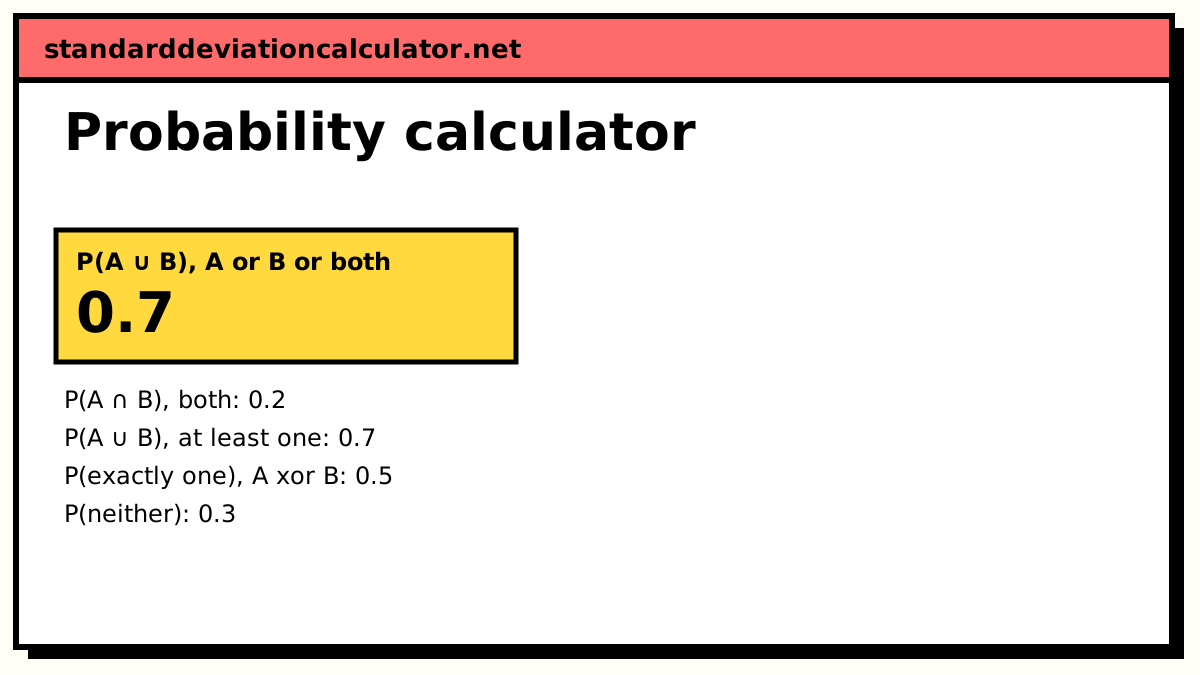
Probability calculator
Union, intersection, complement and conditional probabilities of two events, or P(at least one).
-
Conditional probability calculator
P(A|B) from probabilities or from a 2×2 table of counts.
-
Joint probability calculator
P(A ∩ B) for independent or dependent events, or from a two-way table of counts.
-
Probability of 3 events calculator
At least one, all three, exactly one, exactly two and none, for three independent events.
-
Bayes' theorem calculator
Posterior probability for a medical test, with natural frequencies, or across several hypotheses.
Counting: combinations and permutations
Count the outcomes that make up a probability, from simple selections to passwords and lottery tickets.
-
Combination calculator
nCr with or without repetition, and a list of every combination for small sets.
-
Permutation calculator
nPr, nʳ with repetition, and the distinct arrangements of the letters in a word.
-
Permutation and combination calculator
nPr, nCr, with-repetition counts, letter arrangements and circular permutations, exactly.
-
Password combination calculator
How many passwords a character set and length allow, their entropy, and the time to brute-force them.
-
Lottery calculator
Jackpot and prize-tier odds for any pick-k-from-n lottery with a bonus ball, and the expected value of a ticket.
-
Quiz: Lottery calculator
Random lottery-odds questions to answer, marked instantly with the working shown.
Odds and betting
Move between probabilities and the odds formats used by bookmakers.
-
Odds calculator
Convert between probability, odds for and against, and fractional, decimal and American odds.
-
Implied probability calculator
Implied probabilities from betting odds, the bookmaker’s overround, and fair no-vig probabilities.
Expected value, proportions and bounds
Summarise a random outcome by its average, estimate a proportion from a sample, and bound the tails of any distribution.
-
Expected value calculator
E[X], variance and standard deviation from a table of outcomes and probabilities, with a fair-game check.
-
P-hat calculator
Sample proportion p̂ = x/n with its standard error, margin of error and confidence interval.
-
Chebyshev's theorem calculator
The minimum share of data within k standard deviations of the mean, for any distribution.
From events to counts to expected values
Basic probability starts with events. The probability calculator combines two events with the addition rule, P(A or B) = P(A) + P(B) − P(A and B). The joint probability calculator handles the “and” part, which is P(A) × P(B) only when the events are independent. Conditional probability and Bayes’ theorem answer “given that” questions: Bayes reverses the condition, turning P(evidence | cause) into P(cause | evidence).
When every outcome is equally likely, a probability is a count of favourable outcomes over a count of all outcomes, and the counting calculators supply both. Once outcomes carry payoffs, the expected value calculator weights each payoff by its probability.
Worked comparison: order matters or not
| Question | Rule | Count |
|---|---|---|
| Choose a committee of 3 from 10 people | nCr = 10! / (3! 7!) | 120 |
| Choose a chair, secretary and treasurer from 10 | nPr = 10! / 7! | 720 |
| A 3-digit code from 10 digits, repeats allowed | nʳ = 10³ | 1,000 |
| Pick 6 numbers from 49 (lotto) | C(49, 6) | 13,983,816 |
The permutation count is the combination count times 3! = 6, because each committee can be ordered six ways. The lottery calculator uses the same combination rule, so one 6-from-49 ticket has a 1 in 13,983,816 chance of the jackpot.
Common mix-ups
- Odds against vs probability. A probability of 0.2 is odds of 4 to 1 against, decimal odds of 5.00 and American odds of +400. The odds calculator shows all four.
- Chebyshev vs the empirical rule. Chebyshev’s theorem guarantees at least 75% of any data within 2 SDs; the normal distribution puts 95.45% there. Use Chebyshev when you cannot assume a bell shape.
- Sample proportion vs probability. p̂ from the p-hat calculator is an estimate with a standard error, not the true probability.