Probability of three events calculator
Enter the probabilities of three independent events to find the chance that at least one, all three, exactly one, exactly two or none of them happen.
Decimal, fraction (1/6) or percentage.
| Outcome | Formula | Probability |
|---|---|---|
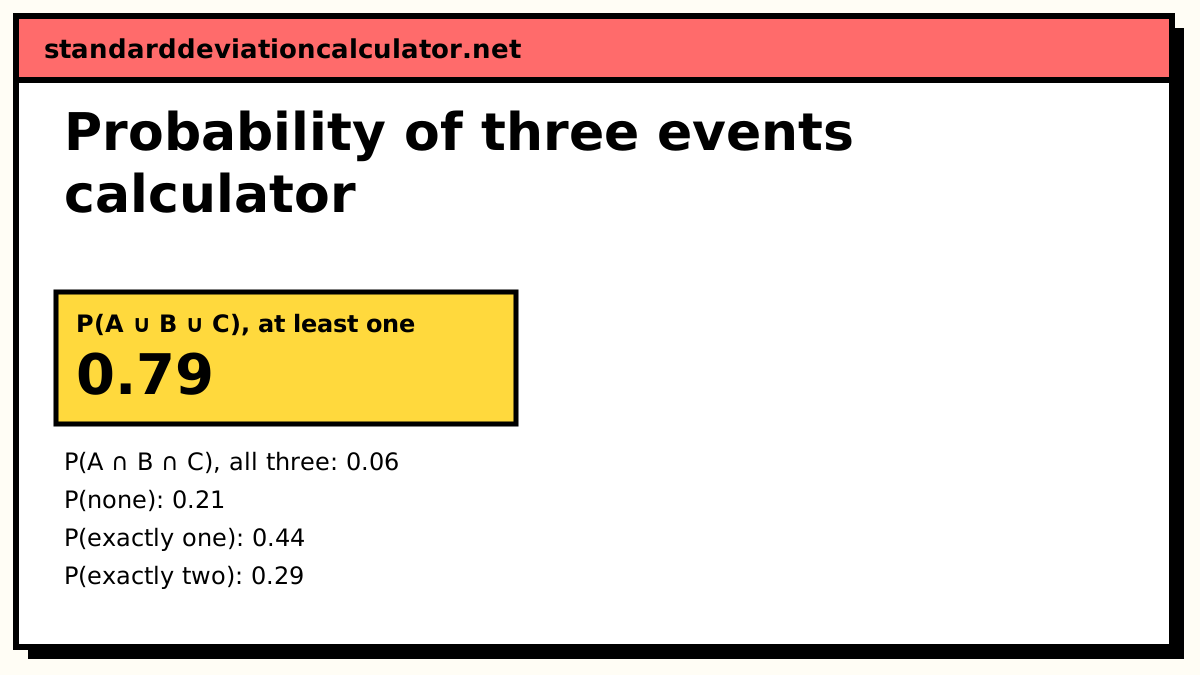
| All three | P(A)P(B)P(C) | 0.06 |
| Exactly two | P(A)P(B)P(C′) + P(A)P(B′)P(C) + P(A′)P(B)P(C) | 0.29 |
| Exactly one | P(A)P(B′)P(C′) + P(A′)P(B)P(C′) + P(A′)P(B′)P(C) | 0.44 |
| None | P(A′)P(B′)P(C′) | 0.21 |
| Total | 1 |
Show the working, step by step
Write down the complements.
P(A′) = 0.5, P(B′) = 0.6, P(C′) = 0.7
None of the three happens:
P(none) = 0.5 × 0.6 × 0.7 = 0.21
At least one is the complement of none:
P(at least one) = 1 − 0.21 = 0.79
Check with inclusion–exclusion:
P(A ∪ B ∪ C) = P(A) + P(B) + P(C) − P(A∩B) − P(A∩C) − P(B∩C) + P(A∩B∩C) = 0.5 + 0.4 + 0.3 − 0.2 − 0.15 − 0.12 + 0.06 = 0.79
All three:
P(A ∩ B ∩ C) = 0.5 × 0.4 × 0.3 = 0.06
Exactly one: one event happens and the other two do not, in three ways.
0.5×0.6×0.7 + 0.5×0.4×0.7 + 0.5×0.6×0.3 = 0.44
Exactly two: two happen and one does not, in three ways.
0.5×0.4×0.7 + 0.5×0.6×0.3 + 0.5×0.4×0.3 = 0.29
These formulas assume A, B and C are independent. For events that affect each other, the pairwise and triple intersections have to be known separately.
The formulas
P(A ∩ B ∩ C) = P(A) P(B) P(C) P(none) = (1 − P(A))(1 − P(B))(1 − P(C)) P(A ∪ B ∪ C) = 1 − P(none)
For exactly one, add the three ways one event happens and the other two do not. For exactly two, add the three ways two happen and one does not. Written with complements (A′ means “not A”):
P(exactly one) = P(A)P(B′)P(C′) + P(A′)P(B)P(C′) + P(A′)P(B′)P(C) P(exactly two) = P(A)P(B)P(C′) + P(A)P(B′)P(C) + P(A′)P(B)P(C)
A worked example
Three students each try a hard puzzle on their own. Ann solves it with probability 0.5, Ben with 0.4 and Cal with 0.3, and they do not help each other. What is the chance the puzzle gets solved?
First the complements: 0.5, 0.6 and 0.7. Then:
P(none) = 0.5 × 0.6 × 0.7 = 0.21 P(at least one) = 1 − 0.21 = 0.79
Inclusion–exclusion gives the same answer:
0.5 + 0.4 + 0.3 − 0.2 − 0.15 − 0.12 + 0.06 = 0.79
The other cases:
- All three solve it: 0.5 × 0.4 × 0.3 = 0.06.
- Exactly one: 0.5 × 0.6 × 0.7 + 0.5 × 0.4 × 0.7 + 0.5 × 0.6 × 0.3 = 0.21 + 0.14 + 0.09 = 0.44.
- Exactly two: 0.5 × 0.4 × 0.7 + 0.5 × 0.6 × 0.3 + 0.5 × 0.4 × 0.3 = 0.14 + 0.09 + 0.06 = 0.29.
Check: 0.21 + 0.44 + 0.29 + 0.06 = 1. The Venn diagram shows each of the seven regions inside the circles, and the 0.21 for “none” outside them.
How to read the result
“At least one” is usually the question people mean by “the chance it happens”, and it is always at least as large as the biggest single probability. Here it is 0.79, well above Ann's 0.5, because each extra solver adds another chance. “Exactly one” is what you want for questions like “only one alarm goes off”, and “at least two” (0.35 here) for majority votes among three.
Why complements are the easy route
“At least one” covers seven of the eight regions of a three-set Venn diagram, while “none” is a single region with a single product. That is why working out P(none) and subtracting it from 1 is quicker and less error-prone than inclusion–exclusion. The same trick scales to any number of independent events: the chance that at least one of n events happens is 1 − (1 − p₁)(1 − p₂)…(1 − pₙ).
Common mistakes
- Adding the three probabilities for “at least one”. 0.5 + 0.4 + 0.3 = 1.2 is not a probability; the overlaps have been counted more than once.
- Forgetting the complements in “exactly one”. P(A) alone includes outcomes where B or C also happen.
- Using this for dependent events. If one event makes another more or less likely, the products are wrong.
- Rounding too early. Keep full precision until the end; the calculator shows six significant figures.
Common questions
How do I find the probability of at least one of three events?
Work out the chance that none of them happens and subtract from 1. For independent events, P(at least one) = 1 − (1 − P(A))(1 − P(B))(1 − P(C)). With 0.5, 0.4 and 0.3 that is 1 − 0.5 × 0.6 × 0.7 = 1 − 0.21 = 0.79.
What is the inclusion–exclusion formula for three events?
P(A ∪ B ∪ C) = P(A) + P(B) + P(C) − P(A∩B) − P(A∩C) − P(B∩C) + P(A∩B∩C). Adding the three probabilities counts the overlaps too often, subtracting the pairs takes away the triple overlap once too many, and the last term puts it back.
Does this work if the events are not independent?
The inclusion–exclusion formula holds for any events, but you then need the actual pairwise and triple intersections; they are no longer products. This calculator assumes independence and computes every intersection by multiplying.
Why do exactly one, exactly two, all three and none add to 1?
Every outcome falls into exactly one of those four cases, so their probabilities must sum to 1. In the default example 0.44 + 0.29 + 0.06 + 0.21 = 1. The calculator shows the sum as a check.
Related calculators
-
Joint probability
P(A and B) for two events, independent or not.
-
Probability calculator
Two events, or at least one success in n tries.
-
Binomial distribution
Exactly k successes when every event has the same chance.