Lottery calculator
Enter how many numbers a lottery draws and from how many, and whether it has a bonus ball, to get the jackpot odds, the odds of every partial match, and what a ticket is worth on average.
Each bar is N in “1 in N” for matching that many main numbers (+B: and the bonus ball). The axis is logarithmic: every step up is ten times rarer. Solid bars win a prize in your table.
| Match | Ways | Probability | Odds | Prize | Contribution to EV |
|---|---|---|---|---|---|
| 5 + bonus | 1 | 3.422e-9 | 1 in 292,201,338 | $100,000,000 | $0.3422 |
| 5 | 25 | 8.556e-8 | 1 in 11,688,054 | $1,000,000 | $0.0856 |
| 4 + bonus | 320 | 1.095e-6 | 1 in 913,129 | $50,000 | $0.0548 |
| 4 | 8,000 | 2.738e-5 | 1 in 36,525 | $100 | $0.0027 |
| 3 + bonus | 20,160 | 6.899e-5 | 1 in 14,494 | $100 | $0.0069 |
| 3 | 504,000 | 0.001725 | 1 in 579.8 | $7 | $0.0121 |
| 2 + bonus | 416,640 | 0.001426 | 1 in 701.3 | $7 | $0.0100 |
| 2 | 10,416,000 | 0.03565 | 1 in 28.05 | – | – |
| 1 + bonus | 3,176,880 | 0.01087 | 1 in 91.98 | $4 | $0.0435 |
| 1 | 79,422,000 | 0.2718 | 1 in 3.679 | – | – |
| 0 + bonus | 7,624,512 | 0.02609 | 1 in 38.32 | $4 | $0.1044 |
Show the working, step by step
Count the equally likely sets of 5 main numbers from 69.
C(69, 5) = 11,238,513
The bonus ball comes from its own pool of 26, so multiply.
11,238,513 × 26 = 292,201,338
Exactly m of your numbers match when you pick m from the k winning numbers and the rest from the n − k losing ones.
P(m) = C(5, m) × C(64, 5 − m) ÷ C(69, 5) m = 5: C(5, 5) × C(64, 0) = 1 ways m = 4: C(5, 4) × C(64, 1) = 320 ways m = 3: C(5, 3) × C(64, 2) = 20,160 ways
The jackpot is the single winning combination.
P(jackpot) = 1 ÷ 292,201,338 = 1 in 292,201,338
Expected value: multiply each prize by its probability, add, and subtract the ticket price.
E = Σ P(tier) × prize − price = $0.6621 − $2.00 = −$1.34
The expected value ignores tax, lump-sum discounts and the chance of sharing the jackpot, all of which lower it further. On average each $2.00 ticket loses $1.34.
The formulas
Jackpot, no bonus: 1 in C(n, k) Jackpot, bonus pool of B: 1 in C(n, k) × B Exactly m main numbers: C(k, m) × C(n − k, k − m) ÷ C(n, k) Expected value = Σ P(tier) × prize − ticket price
A worked example
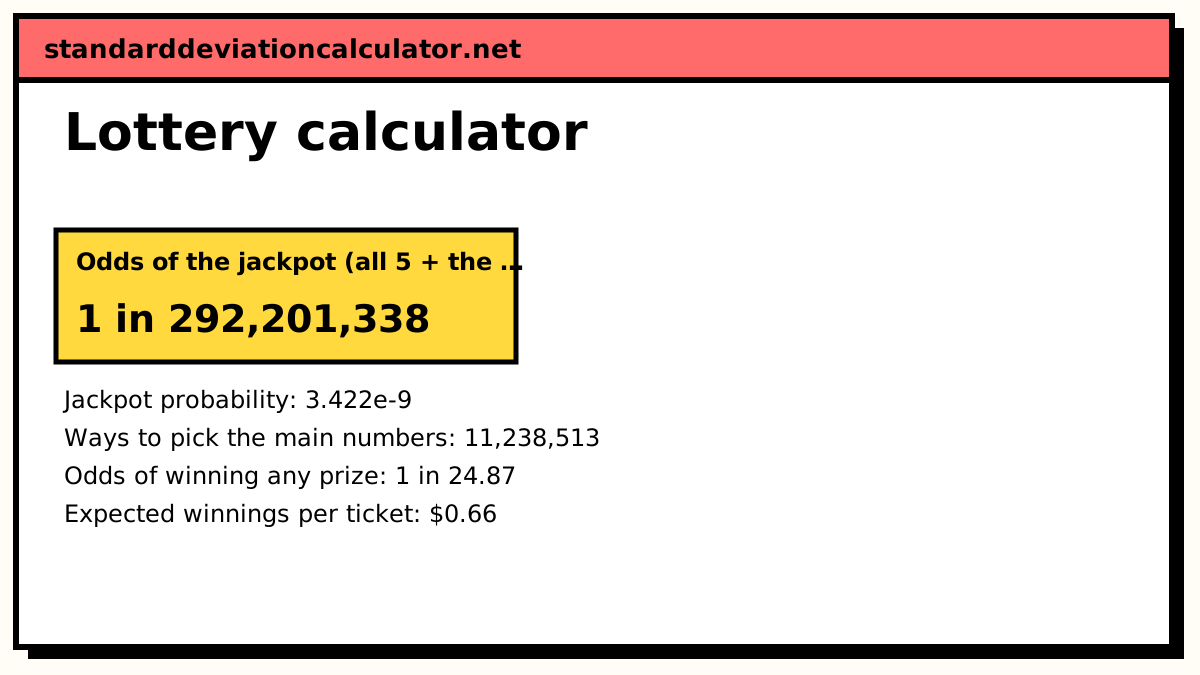
The defaults match a Powerball-style game: 5 numbers drawn from 69, plus 1 bonus ball from a separate pool of 26, with a $2 ticket. The number of ways to pick the main numbers is
C(69, 5) = 69 × 68 × 67 × 66 × 65 ÷ 120 = 11,238,513
and the bonus pool multiplies it by 26:
11,238,513 × 26 = 292,201,338
So the jackpot odds are 1 in 292,201,338. Matching 4 main numbers plus the bonus can happen in C(5, 4) × C(64, 1) = 320 ways, which is 1 in 913,129. Matching all 5 main numbers but not the bonus has 25 ways (the bonus can be any of the other 25 numbers), or 1 in 11,688,054.
The default prize table uses a $100 million jackpot and fixed lower prizes of $1,000,000, $50,000, $100, $100, $7, $7, $4 and $4. Multiplying each prize by its probability and adding gives expected winnings of about $0.66 per ticket. The chance of winning any prize is 1 in 24.87, but most of those wins are the $4 prizes. Subtracting the $2 price leaves an expected value of −$1.34: on average each ticket loses about two-thirds of its cost.
The jackpot contributes $0.34 of the $0.66. To bring the expected winnings up to the $2 ticket price, the jackpot would need to be about $490 million, before tax and before allowing for shared wins.
Other lottery types
For a plain 6-from-49 lottery, set the bonus to “None”, n = 49 and k = 6: the jackpot odds are 1 in 13,983,816. For a UK-Lotto style game with a bonus drawn from the main pool, choose that option with n = 59 and k = 6: the jackpot is 1 in 45,057,474 and 5 plus the bonus is 1 in 7,509,579. The prize table is optional; clear it to see the odds alone.
How to read the result
“1 in 292 million” means that if you bought one ticket a draw, three draws a week, you would expect to wait nearly 1.9 million years for a jackpot. The expected value is the long-run average result per ticket across all prize tiers; any single ticket almost always wins nothing.
Common mistakes
- Using permutations. The order of the balls does not matter, so the count is C(n, k), not P(n, k).
- Adding the bonus pool instead of multiplying. 11,238,513 + 26 is meaningless; each main combination pairs with each bonus number.
- Treating “1 in 24.87 to win a prize” as a good return. Most of those prizes are worth less than two tickets.
- Ignoring shared jackpots and tax in the expected value. Both reduce it further.
Common questions
How are lottery odds calculated?
Count the equally likely draws with combinations. Choosing k numbers from n can be done in C(n, k) ways, and only one of them matches the draw exactly. A 6-from-49 lottery has C(49, 6) = 13,983,816 combinations, so the jackpot odds are 1 in 13,983,816. A separate bonus pool multiplies that by its size.
What are the odds of matching some of the numbers?
To match exactly m of your k numbers, choose which m of the k winning numbers you have and which k − m of the n − k losing numbers make up the rest: C(k, m) × C(n − k, k − m) ÷ C(n, k). For 3 of 6 in a 6/49 game that is 20 × 12,341 ÷ 13,983,816, about 1 in 56.7.
How is a bonus ball from the main pool different?
In games like the UK Lotto, one extra ball is drawn from the numbers left after the main draw. It only matters for a ticket that misses one main number: 5 main numbers plus the bonus in 6/59 is 1 in 7,509,579. Choose “Drawn from the main pool” for this type.
Is a lottery ticket ever worth buying?
Its expected value is almost always negative: lotteries pay out well under half of ticket sales in prizes. Very large jackpots can push the headline figure above the ticket price, but taxes, taking a lump sum instead of an annuity, and the chance of sharing the jackpot with other winners usually pull it back below zero.
Does picking different numbers change my odds?
No. Every combination is equally likely to be drawn. Numbers do affect how many people you might share a jackpot with, though: popular picks such as birthdays (1 to 31) and patterns are chosen by many players.
Related calculators
-
Quiz: Lottery calculator
Practise lottery-odds questions with instant marking.
-
Combination calculator
The nCr counts behind every lottery.
-
Expected value
Expected value for any game of chance.