Odds calculator
Convert between odds and probability. Enter odds in favour, odds against, a probability, or odds written in fractional, decimal or American form, and the calculator shows every other form at once.
Write as 3:2, 3/2 or 3 to 2.
Decimal, fraction (1/6) or percentage.
Such as 5/2, 11/4 or evens.
Win: 60% Lose: 40%
Odds in favour 3 : 2: the bar is split win to lose in that ratio.
Show the working, step by step
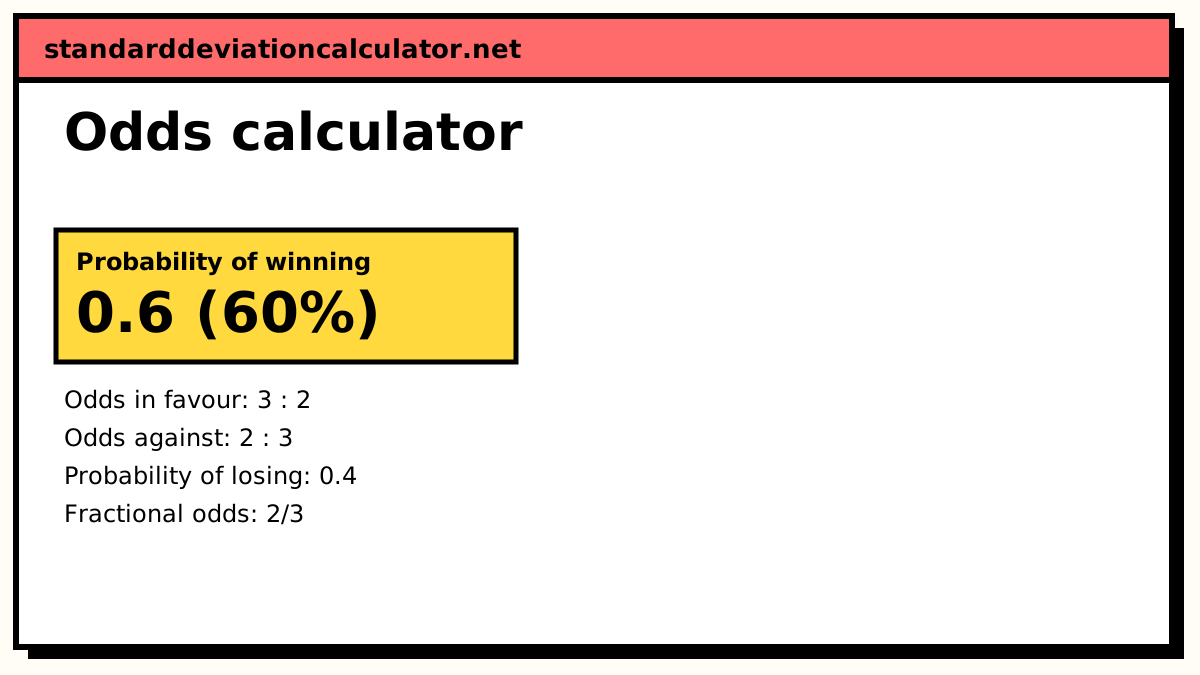
Odds of 3 : 2 in favour mean 3 chances to win for every 2 to lose, out of 5 in all.
P(win) = a ÷ (a + b) = 3 ÷ 5 = 0.6
Every other form follows from the probability.
odds against = (1 − p) : p = 2 : 3 decimal = 1 ÷ p = 1.6667 American = −100p ÷ (1 − p) = −150
Betting prices shown here are fair odds with no bookmaker margin. Real prices are shorter, so their implied probabilities add up to more than 100%.
The formulas
Odds a : b in favour → p = a ÷ (a + b) Odds a : b against → p = b ÷ (a + b) Probability p → odds in favour = p : (1 − p)
Betting odds are the same idea written for payouts:
Fractional a/b → p = b ÷ (a + b) Decimal d → p = 1 ÷ d American +A → p = 100 ÷ (A + 100) American −A → p = A ÷ (A + 100)
A worked example
A bag holds 3 red balls and 2 blue ones. The odds of drawing red are 3 : 2 in favour: three ways to succeed against two ways to fail. As a probability:
p = 3 ÷ (3 + 2) = 3/5 = 0.6
The odds against red are the same numbers swapped, 2 : 3, and the probability of drawing blue is 0.4. Written as fair betting odds, 60% is fractional 2/3, decimal 1.6667 (1 ÷ 0.6) and American −150 (you would stake 150 to win 100, since 100 × 0.6 ÷ 0.4 = 150).
Switch the first box to “Fractional betting odds” to see the second default, 5/2. That price pays 5 for every 2 staked, so the implied chance of winning is 2 ÷ 7 = 0.285714, or 28.57%. The same price is decimal 3.5 and American +250.
How to read the result
Odds and probabilities carry the same information, but odds grow without limit as an event gets more likely, while probabilities stop at 1. Odds of 1 : 1 (“evens”) are a probability of 0.5. Odds in favour above 1 : 1 mean the event is more likely than not.
For betting, the probability is the break-even point: a bet at decimal odds of 3.5 makes money in the long run only if the true chance of winning is above 28.57%. Real bookmaker prices include a margin, so the fair odds shown here are longer than what you will usually be offered.
Odds in statistics
Odds also appear outside betting. In medical research and logistic regression, results are often reported as an odds ratio: the odds of an outcome in one group divided by the odds in another. If 60% of treated patients recover (odds 1.5) and 40% of untreated ones do (odds 0.667), the odds ratio is 1.5 ÷ 0.667 = 2.25. Converting between odds and probability, as this calculator does, is the first step in reading those results.
Common mistakes
- Reading odds as a fraction of the total. Odds of 3 : 2 are not a probability of 3/2 or 2/3; the total is 3 + 2 = 5.
- Mixing up “for” and “against”. Bookmakers' 4/1 is odds against, a 20% chance, not 80%.
- Forgetting the stake in decimal odds. Decimal 2.5 includes the 1 you bet; the fractional equivalent is 3/2.
- Dropping the sign on American odds. +150 and −150 imply 40% and 60%.
Common questions
What is the difference between odds and probability?
Probability compares wins with all outcomes; odds compare wins with losses. With 3 winning tickets and 2 losing ones, the probability of winning is 3/5 = 0.6 and the odds in favour are 3 : 2. Convert with p = a ÷ (a + b), and back with odds = p : (1 − p).
What does “odds against” mean?
Odds against put losses first. Odds of 4 : 1 against mean four ways to lose for every one way to win, so the probability of winning is 1 ÷ 5 = 0.2. Bookmakers quote fractional odds this way: 4/1 pays 4 profit for every 1 staked.
How do I convert decimal odds to probability?
Divide 1 by the decimal odds. Decimal odds of 3.50 imply a probability of 1 ÷ 3.5 = 0.2857, or 28.57%. Decimal odds include your stake, so 3.50 returns 3.50 in total for every 1 bet.
How do American (moneyline) odds work?
Positive odds show the profit on a 100 stake: +250 wins 250, implying 100 ÷ 350 = 28.57%. Negative odds show the stake needed to win 100: −150 means stake 150 to win 100, implying 150 ÷ 250 = 60%. Favourites carry a minus sign.
Why don’t a bookmaker’s probabilities add up to 100%?
Bookmakers shorten every price to build in a profit margin, so the implied probabilities of all outcomes add to more than 100%. The odds on this page are fair odds with no margin. To measure and remove a bookmaker's margin, use the implied probability calculator.
Related calculators
-
Implied probability
Remove the bookmaker’s margin from a whole market.
-
Probability calculator
Combine probabilities of two events.
-
Expected value
Is a bet worth taking at a given price?