Coordinate geometry calculators
Calculators for points, lines and curves on a coordinate grid, and for lines and planes in three dimensions. They give exact surds and fractions where possible, and graph lines and curves so you can check the result at a glance.
Which calculator do I need?
| You have or want | Use |
|---|---|
| The distance and midpoint between two points | Distance and midpoint calculator |
| The equation of a line through two points, or from a slope and a point | Straight line equation calculator |
| Where two lines cross, or how far a point is from a line | Line calculator |
| A point dividing a segment in a ratio, or a triangle’s centroid | Point calculator |
| The tangent line, turning points or arc length of y = f(x) | Curve calculator |
| Whether an equation is a circle, ellipse, parabola or hyperbola | Conic sections calculator |
| The angle between two planes, or a line and a plane in space | 3D geometry calculator |
Points and distances
Measure between points and locate special points such as midpoints and centroids.
-
Distance and midpoint calculator
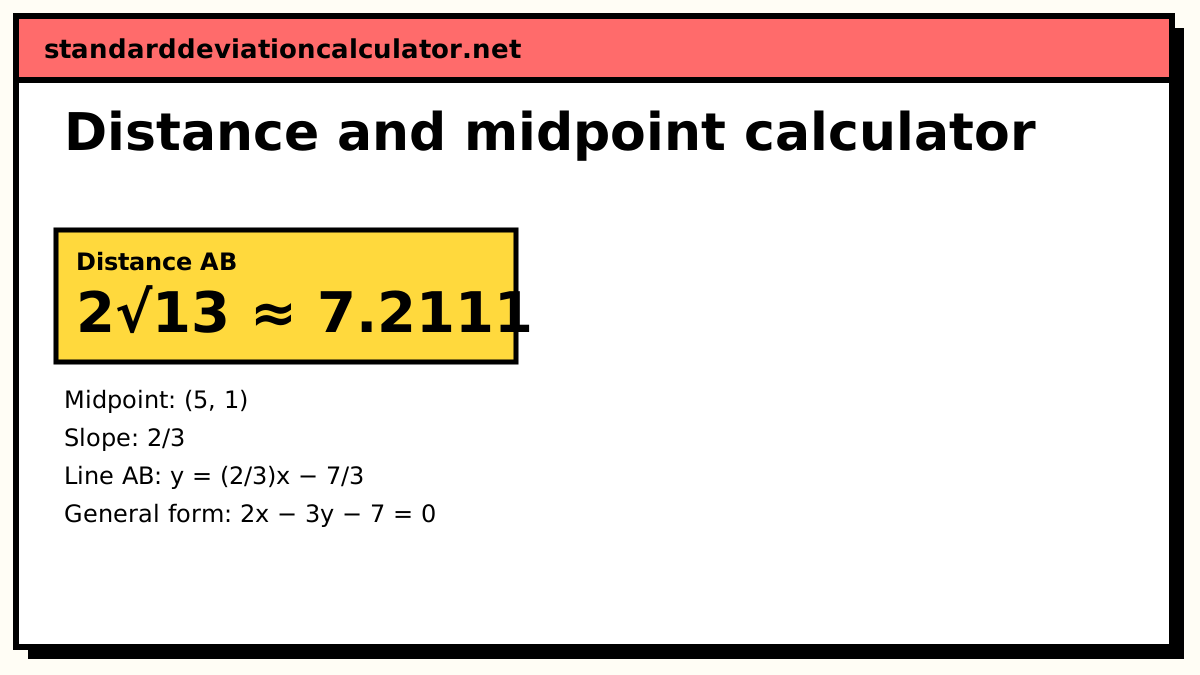
Distance as an exact surd, midpoint, slope and the line through two points, in 2D or 3D.
-
Point calculator
Section formula, centroid and area of a triangle, collinearity, quadrants and reflections.
Straight lines
Write a line’s equation in any form, and find how two lines relate.
-
Straight line equation calculator
A line’s equation from points, slope or intercepts, in slope-intercept, point-slope, general and intercept forms.
-
Line calculator
Where two lines meet, the angle between them, parallel-line distance and point-to-line distance.
Curves, conics and 3D
Go beyond straight lines: graphs of functions, second-degree curves and geometry in space.
-
Curve calculator
Intercepts, turning points, tangent and normal, area and arc length for y = f(x), with a graph.
-
Conic sections calculator
Classify a second-degree equation and find its standard form, foci, directrices and eccentricity.
-
3D geometry calculator
Direction cosines, lines and planes in space, angles between them and shortest distances.
-
Graphing calculator
Plot up to four functions of x and find their zeros and intersections.
Which calculator for which object
The calculators follow the objects they work on. Two points go to the distance and midpoint calculator. Three or more points, such as a triangle’s vertices or a segment divided in a ratio, go to the point calculator. One line goes to the straight line equation calculator, and two lines, or a line and a point, go to the line calculator. Curves go to the curve and conic sections calculators, and anything with a z-coordinate goes to the 3D geometry calculator.
Worked comparison: two points, four results
Take A(1, 2) and B(4, 6). The horizontal change is 3 and the vertical change is 4.
- Distance: √(3² + 4²) = 5.
- Midpoint: ((1 + 4)/2, (2 + 6)/2) = (2.5, 4).
- Slope: 4/3.
- Line through them: y = (4/3)x + 2/3, or in general form 4x − 3y + 2 = 0. Both points satisfy it: 4 − 6 + 2 = 0 and 16 − 18 + 2 = 0.
From the general form, the distance from the origin to the line is |2| ÷ √(4² + 3²) = 0.4. The line calculator finds this with the point-to-line formula.
Common mix-ups
- Undefined versus zero slope. A vertical line such as x = 3 has an undefined slope and no slope-intercept form. A horizontal line has slope 0. Use general form ax + by + c = 0 to write either.
- Perpendicular slopes multiply to −1. A line perpendicular to one with slope 4/3 has slope −3/4, not 3/4 or −4/3.
- Circle or ellipse? x² + y² terms with equal coefficients give a circle, and unequal coefficients with the same sign give an ellipse. The conic sections calculator classifies the general equation from its discriminant, B² − 4AC.
Guides to read alongside
-
Methodology
How results are rounded and when exact values are kept.
-
Learn
All of the site’s guides in one place.