Math
Curve calculator: intercepts, turning points, tangents and area
Enter a curve y = f(x) and the calculator sketches it and finds the features a curve-sketching question asks for: where it crosses the axes, its turning points, the tangent and normal at a point, the area under it and its length between two x-values.
Use ^ for powers, sqrt(), sin(), cos(), exp(), ln() (natural log) and log() (base 10).
| Feature | Point |
|---|---|
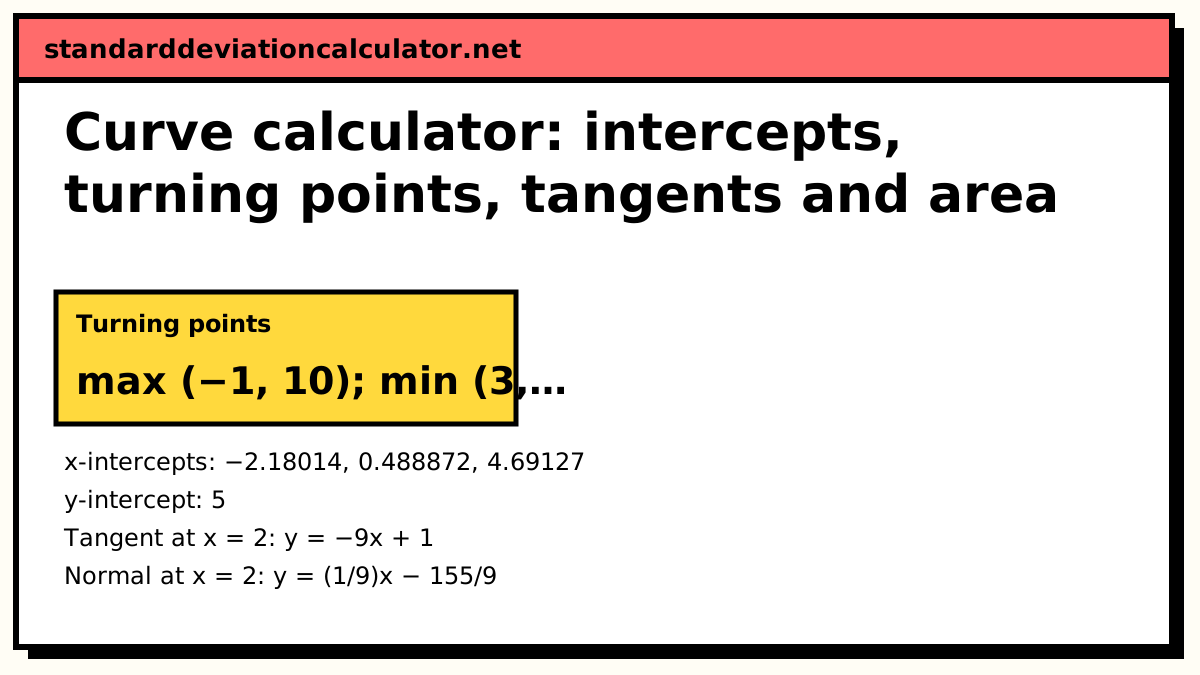
| x-intercept | (−2.18014, 0) |
| x-intercept | (0.488872, 0) |
| x-intercept | (4.69127, 0) |
| y-intercept | (0, 5) |
| Local maximum | (−1, 10) |
| Local minimum | (3, −22) |
| Point of inflection | (1, −6) |
━ y = x^3 - 3x^2 - 9x + 5 ━ tangent ┄ normal
Show the working, step by step
Intercepts: set x = 0 for the y-intercept; solve f(x) = 0 for the x-intercepts (sign changes on a fine grid, refined by bisection).
f(0) = 5 x-intercepts: −2.18014, 0.488872, 4.69127
Turning points: solve f′(x) = 0 and check the sign of f′ on either side.
f′(x) = 3x^2 − 9 − 6x x = −1: f = 10 (maximum) x = 3: f = −22 (minimum)
Tangent and normal: find the point and the gradient f′(x₀).
f(2) = −17 f′(x) = 3x^2 − 9 − 6x f′(2) = −9 tangent: y − (−17) = (−9)(x − 2) → y = −9x + 1 normal slope = −1 ÷ (−9) = 1/9 → y = (1/9)x − 155/9
Signed area: ∫ from 0 to 2 of f(x) dx (numerical, adaptive Simpson).
∫ = −12 The curve crosses the x-axis at x = 0.488872, so the regions below the axis count negatively. Adding the absolute value of each piece gives the geometric area: area = |∫0→0.488872| + |∫0.488872→2| = 14.5326
Arc length: L = ∫ √(1 + f′(x)²) dx, evaluated numerically.
L = 22.0914
Roots, turning points, areas and arc lengths are found numerically inside the window you set, so anything outside it is not listed. Widen the window if you expect more.
The formulas
Stationary points: f′(x) = 0 Inflection: f″(x) = 0 and changes sign Tangent at x₀: y − f(x₀) = f′(x₀)(x − x₀) Normal at x₀: y − f(x₀) = −(1 / f′(x₀))(x − x₀) Signed area: ∫ₐᵇ f(x) dx Arc length: ∫ₐᵇ √(1 + f′(x)²) dx
The derivative is found symbolically where possible (it appears in the working), then the equations f(x) = 0 and f′(x) = 0 are solved numerically: the calculator scans the window on a fine grid for sign changes and narrows each one down by bisection. Integrals use adaptive Simpson’s rule.
A worked example
The default curve is y = x³ − 3x² − 9x + 5, analysed between x = −4 and x = 6.
- y-intercept. f(0) = 5, so the curve crosses the y-axis at (0, 5).
- x-intercepts. The cubic has three real roots, none rational: x ≈ −2.18014, 0.488872 and 4.69127.
- Turning points. f′(x) = 3x² − 6x − 9 = 3(x + 1)(x − 3) = 0 at x = −1 and x = 3. f(−1) = 10 and f(3) = −22. The gradient goes from + to − at x = −1 (a maximum) and from − to + at x = 3 (a minimum).
- Inflection. f″(x) = 6x − 6 = 0 at x = 1, where f(1) = −6. The curve changes from bending down to bending up there.
- Tangent at x = 2. f(2) = −17, f′(2) = 12 − 12 − 9 = −9, so y + 17 = −9(x − 2), which is y = −9x + 1. The normal has gradient 1/9: y = x/9 − 155/9.
- Area from 0 to 2. ∫₀² f(x) dx = [x⁴/4 − x³ − 9x²/2 + 5x]₀² = 4 − 8 − 18 + 10 = −12. The curve crosses the axis at x ≈ 0.4889, so the geometric area is 1.2663 + 13.2663 = 14.5326.
- Arc length from 0 to 2. ∫₀² √(1 + (3x² − 6x − 9)²) dx ≈ 22.0914.
Typing functions
| You want | Type |
|---|---|
| 3x² − 2x + 1 | 3x^2 - 2x + 1 |
| √x, ∛x | sqrt(x), cbrt(x) |
| eˣ, natural log | exp(x) or e^x, ln(x) |
| log base 10 | log(x) |
| sin x (radians), |x| | sin(x), abs(x) |
| A fraction | (x + 1)/(x - 2) with brackets |
Interpreting the results
- A turning point is local: a local maximum is the highest point nearby, not necessarily the highest value of the function. The cubic above rises without limit, so it has no overall maximum.
- f′(x) = 0 does not always mean a turning point. For y = x³ the gradient is 0 at the origin but positive on both sides, so it is a stationary point of inflection.
- The signed integral is what physics uses for displacement or net change. The geometric area is what a question asking for “the area enclosed by the curve and the x-axis” wants.
- Numerical answers are shown to 6 significant figures. The working gives exact fractions where the numbers are simple, as in f′(2) = −9 or the integral −12.
Common questions
How do you find the turning points of a curve?
Differentiate, set f′(x) = 0 and solve. Each solution is a stationary point. Check the sign of f′ either side: + then − is a local maximum, − then + is a local minimum, and no sign change is a stationary point of inflection. For y = x³ − 3x² − 9x + 5, f′(x) = 3x² − 6x − 9 = 3(x + 1)(x − 3), giving a maximum at (−1, 10) and a minimum at (3, −22).
How do you find the equation of a tangent and a normal?
Find the point (x₀, f(x₀)) and the gradient m = f′(x₀). The tangent is y − f(x₀) = m(x − x₀). The normal is perpendicular to it, so its gradient is −1/m. If m = 0 the tangent is horizontal and the normal is the vertical line x = x₀. For the cubic above at x = 2: f(2) = −17 and f′(2) = −9, so the tangent is y = −9x + 1 and the normal is y = x/9 − 155/9.
Why is the integral negative when the area is positive?
A definite integral counts area below the x-axis as negative. From 0 to 2 the cubic is above the axis up to x ≈ 0.4889 and below it after that, so ∫ f(x) dx = 1.2663 − 13.2663 = −12. The area enclosed between the curve and the axis adds the sizes of the pieces: 1.2663 + 13.2663 = 14.5326. The calculator reports both.
What is the arc length formula?
The length of y = f(x) from x = a to x = b is L = ∫ₐᵇ √(1 + f′(x)²) dx.
Only a few functions give this integral in closed form, so the calculator evaluates it
numerically to about ten significant figures. For the default cubic from 0 to 2 it is
22.0914. That is much more than the horizontal distance of 2, because the curve falls
steeply.
Why does the calculator miss some roots?
It searches only the window you set (−4 to 6 by default) and finds roots where f changes sign, plus double roots where a turning point touches the axis. Roots outside the window are not listed, and neither are points where f jumps across the axis at a vertical asymptote, such as x = 0 for 1/x. Widen the window if you expect more.
Related calculators
-
Derivative calculator
Symbolic derivatives with the rules used at each step.
-
Integral calculator
Indefinite and definite integrals with working.
-
Graphing calculator
Plot one or more functions on the same axes.
-
Function calculator
Domain, range, composition and inverses of functions.
-
Conic sections
Circles, parabolas, ellipses and hyperbolas from the general equation.