Math
Conic sections calculator
Enter the six coefficients of a second-degree equation and the calculator names the conic, rewrites it in standard form, and lists its centre or vertex, foci, directrices, eccentricity, axes and asymptotes, with a graph. Exact surds are kept, so a focal distance shows as √5, not 2.23607 alone.
| Property | Value |
|---|---|
| Centre | (2, −3) |
| Semi-major axis a | 3 |
| Semi-minor axis b | 2 |
| Major axis | 6, along y = −3 |
| Minor axis | 4 |
| Focal distance c = √(a² − b²) | √5 ≈ 2.23607 |
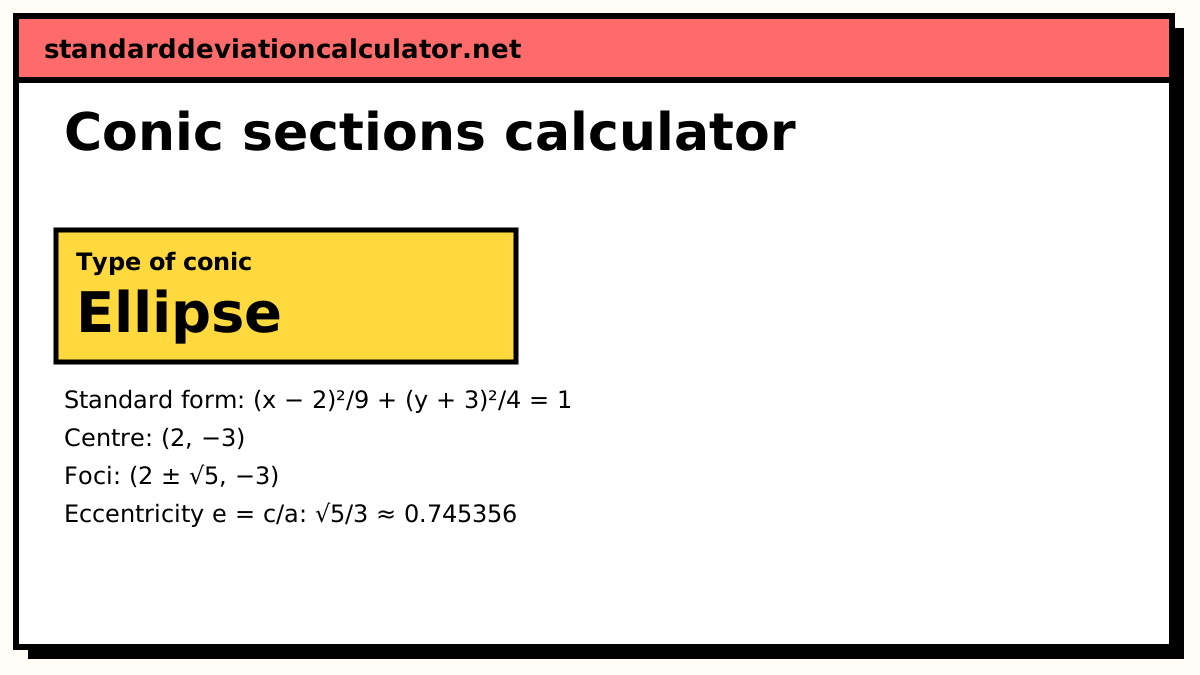
| Foci | (2 ± √5, −3) |
| Vertices | (−1, −3) and (5, −3) |
| Co-vertices | (2, −5) and (2, −1) |
| Eccentricity e = c/a | √5/3 ≈ 0.745356 |
| Directrices | x = 2 ± 9√5/5 |
| Latus rectum 2b²/a | 8/3 ≈ 2.66667 |
| Area πab | 6π ≈ 18.8496 |
━ directrices
Show the working, step by step
Discriminant of the second-degree terms.
B² − 4AC = 0² − 4·4·9 = −144 B² − 4AC < 0: ellipse family (ellipse, circle, point or nothing)
Group the x terms and the y terms, and complete the square in each.
4(x² − 4x) + 9(y² + 6y) = −61 4(x − 2)² + 9(y + 3)² = −61 + 16 + 81 = 36
Divide by the constant to get 1 on the right.
(x − 2)²/9 + (y + 3)²/4 = 1
Both denominators are positive, so it is an ellipse. The larger one is a², under x, so the major axis is horizontal.
a² = 9, a = 3 b² = 4, b = 2
Foci: c² = a² − b²; eccentricity e = c/a; directrices at distance a/e = a²/c from the centre.
c = √(9 − 4) = √5 ≈ 2.23607 e = √5 ÷ 3 = √5/3 ≈ 0.745356 a²/c = 9√5/5 ≈ 4.02492
Classifying the conic
Ax² + Bxy + Cy² + Dx + Ey + F = 0 discriminant Δ = B² − 4AC
| Δ = B² − 4AC | Conic | Standard form (centre or vertex at (h, k)) | Eccentricity |
|---|---|---|---|
| < 0, A = C, B = 0 | Circle | (x − h)² + (y − k)² = r² | 0 |
| < 0 | Ellipse | (x − h)²/a² + (y − k)²/b² = 1 | c/a, with c² = a² − b² |
| = 0 | Parabola | (x − h)² = 4p(y − k) or (y − k)² = 4p(x − h) | 1 |
| > 0 | Hyperbola | (x − h)²/a² − (y − k)²/b² = 1 | c/a, with c² = a² + b² |
The discriminant gives the family. Whether the curve is real is only clear after completing the square: x² + y² = −1 has Δ < 0 but no points, x² − y² = 0 has Δ > 0 but is a pair of lines, and x² = 4 is two parallel lines. The calculator reports these degenerate cases by name.
A worked example
The default equation is 4x² + 9y² − 16x + 54y + 61 = 0.
- Δ = 0² − 4 × 4 × 9 = −144 < 0, and A ≠ C, so it is an ellipse (if it is real).
- Complete the square: 4(x² − 4x) + 9(y² + 6y) = −61, so 4(x − 2)² + 9(y + 3)² = −61 + 4 × 4 + 9 × 9 = 36.
- Divide by 36: (x − 2)²/9 + (y + 3)²/4 = 1. The centre is (2, −3), a² = 9 and b² = 4. The larger denominator is under x, so the major axis is horizontal.
- a = 3, b = 2, and c = √(a² − b²) = √5 ≈ 2.236. The foci are (2 ± √5, −3), and the vertices are (−1, −3) and (5, −3).
- Eccentricity e = c/a = √5/3 ≈ 0.745. The directrices are x = h ± a²/c = 2 ± 9√5/5, about x = 6.025 and x = −2.025.
- Latus rectum 2b²/a = 8/3, and the area enclosed is πab = 6π ≈ 18.85.
Parabolas: focus and directrix
With only one squared term the curve is a parabola. For y² = 8x (A = 0, C = 1, D = −8), compare with y² = 4px: 4p = 8, so p = 2. The vertex is the origin, the focus is (2, 0), the directrix is x = −2, and the latus rectum is 8. Every point on the curve is the same distance from the focus as from the directrix, which is why e = 1.
Common mistakes
- Completing the square without taking out the coefficient. 4x² − 16x is 4(x² − 4x) = 4(x − 2)² − 16, not (2x − 4)² − 16 with a different centre.
- Forgetting to add the same amount to both sides. Adding 4 inside 4( ) adds 16 to the left, so 16 must be added on the right too.
- Taking a as the x-denominator every time. For an ellipse a² is always the larger denominator. For a hyperbola a² sits under the positive term.
- Using c² = a² − b² for a hyperbola. For a hyperbola c² = a² + b².
Common questions
How do you identify a conic from its general equation?
Use the discriminant of the squared terms, B² − 4AC, for Ax² + Bxy + Cy² + Dx + Ey + F = 0. Below zero it is an ellipse (a circle if A = C and B = 0); equal to zero, a parabola; above zero, a hyperbola. For 4x² + 9y² − 16x + 54y + 61 = 0, B² − 4AC = 0 − 144 = −144, so it is an ellipse. A degenerate case (a point, one or two lines, or no points at all) is still possible, and completing the square shows which.
How do you convert a conic to standard form?
Group the x terms and the y terms, take out the coefficient of each square, complete the square, and divide by the constant. For the ellipse above: 4(x² − 4x) + 9(y² + 6y) = −61, so 4(x − 2)² + 9(y + 3)² = −61 + 16 + 81 = 36, and dividing by 36 gives (x − 2)²/9 + (y + 3)²/4 = 1.
What is eccentricity?
The ratio e = c/a of the focal distance to the semi-major (or semi-transverse) axis. It also equals the distance to a focus divided by the distance to the directrix, the same for every point of the curve. A circle has e = 0, an ellipse 0 < e < 1, a parabola e = 1 and a hyperbola e > 1. The default ellipse has e = √5/3 ≈ 0.745.
What does the xy term do?
A non-zero B rotates the conic so its axes are no longer parallel to the x- and y-axes. Rotating the coordinate axes by θ, where cot 2θ = (A − C)/B, removes the xy term. The calculator does this rotation, gives the standard form in the rotated x′y′ axes, and converts the centre, foci, directrices and asymptotes back to x and y. For xy = 1, θ = 45° and the curve is a rectangular hyperbola with foci at (√2, √2) and (−√2, −√2).
How do I find the asymptotes of a hyperbola?
For (x − h)²/a² − (y − k)²/b² = 1 the asymptotes are y − k = ±(b/a)(x − h). For a hyperbola opening up and down, (y − k)²/a² − (x − h)²/b² = 1, they are y − k = ±(a/b)(x − h). For 9x² − 16y² = 144, a = 4 and b = 3, so the asymptotes are y = ±(3/4)x.
Related calculators
-
Circle calculator
Radius, diameter, circumference and area of a circle.
-
Quadratic equation
Roots, vertex and discriminant of ax² + bx + c = 0.
-
Curve calculator
Intercepts, turning points, tangents and area for y = f(x).
-
Distance and midpoint
Distance, midpoint and slope between two points.