Math
Circle calculator
Enter one measurement of a circle, whichever you have, and the calculator finds the radius, diameter, circumference and area. Add a central angle and it also gives the arc length, sector area, chord and segment area for that slice.
For an area, enter it in square units (cm² if the units are cm).
For the arc, sector, chord and segment. 0 to 360.
| Quantity | Formula | Value |
|---|---|---|
| Arc length | s = rθ (θ in radians) | 5.23599 cm |
| Sector area | A = ½r²θ | 13.09 cm² |
| Chord | c = 2r sin(θ/2) | 5 cm |
| Segment area | A = ½r²(θ − sin θ) | 2.26465 cm² |
| Segment height (sagitta) | h = r(1 − cos(θ/2)) | 0.669873 cm |
| Area in m² | 0.00785398 m² | |
| Area in ft² | 0.0845396 ft² |
Show the working, step by step
The radius is given.
r = 5
Diameter, circumference and area from the radius.
d = 2r = 10 C = 2πr = 2 × π × 5 = 31.4159 A = πr² = π × 25 = 78.5398
Convert the angle to radians for the arc formulas.
θ = 60° × π ÷ 180 = 1.0472 rad
Arc and sector are the fraction θ/2π of the circumference and area.
arc = rθ = 5 × 1.0472 = 5.23599 sector = ½r²θ = ½ × 25 × 1.0472 = 13.09
The chord closes the arc with a straight line; the segment is the sector minus the triangle under the chord.
chord = 2r sin(θ/2) = 2 × 5 × sin 30° = 5 segment = ½r²(θ − sin θ) = ½ × 25 × (1.0472 − 0.866025) = 2.26465
Circle formulas
d = 2r C = 2πr = πd A = πr² = πd² ÷ 4
Rearranged to start from each measurement:
| You know | Radius | Then |
|---|---|---|
| Diameter d | r = d ÷ 2 | C = πd, A = πd² ÷ 4 |
| Circumference C | r = C ÷ 2π | A = C² ÷ 4π |
| Area A | r = √(A ÷ π) | C = 2√(πA) |
For a central angle θ (in radians, θ = degrees × π ÷ 180):
arc s = rθ sector = ½r²θ chord = 2r sin(θ/2) segment = ½r²(θ − sin θ)
A worked example
The calculator opens on a radius of 5 cm and an angle of 60°.
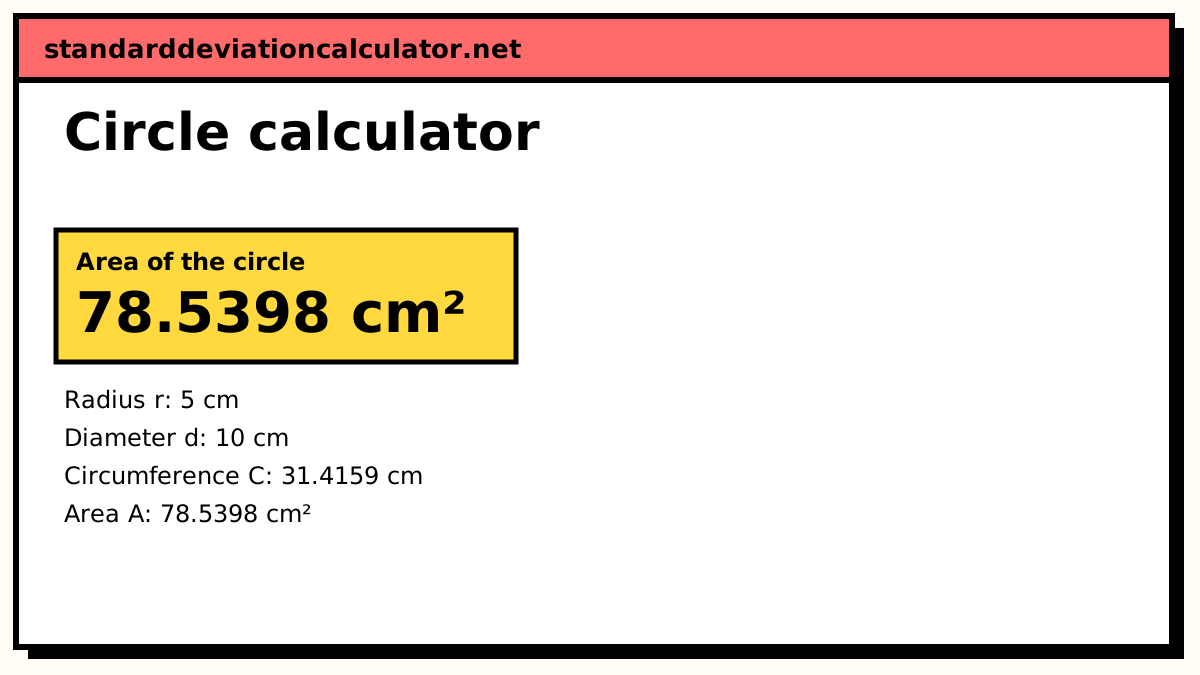
- Diameter 2 × 5 = 10 cm; circumference 2π × 5 = 31.4159 cm; area π × 25 = 78.5398 cm².
- 60° is π/3 = 1.0472 radians.
- Arc length 5 × 1.0472 = 5.23599 cm, one sixth of the circumference.
- Sector area ½ × 25 × 1.0472 = 13.0900 cm², one sixth of the area.
- Chord 2 × 5 × sin 30° = 5 cm. At 60° the chord equals the radius, because the triangle it makes with the centre is equilateral.
- Segment area ½ × 25 × (1.0472 − 0.866025) = 2.26465 cm².
Where the segment and chord are used
The chord and segment come up whenever a circle is cut by a straight line: the width of a tunnel at a given height, the liquid in a horizontal cylindrical tank (segment area × length gives the volume), an arched window, or the flat of a machined shaft. The segment height, also called the sagitta, is the distance from the chord's midpoint to the arc, r(1 − cos(θ/2)). For the example it is 0.669873 cm. Carpenters use it the other way round, measuring the chord and the rise of an arch to recover its radius.
Common mistakes
- Diameter in place of radius. πd² is four times the true area; use πr² or πd² ÷ 4.
- Degrees in a radian formula. s = rθ with θ = 60 gives 300 instead of 5.24. Convert first, or use (θ ÷ 360) × 2πr.
- Mixing up area and circumference. 2πr is a length (cm); πr² is an area (cm²). At r = 2 they happen to be equal in value, 12.566, which hides the error in homework checks.
- Rounding π to 3.14 too early. It changes the fourth significant figure; keep full precision until the end.
Common questions
How do I find the radius from the circumference?
Divide the circumference by 2π: r = C ÷ 2π. A circle with circumference 10 cm has radius 10 ÷ 6.28319 = 1.59155 cm. Measuring round a tree trunk or a pipe with a tape and dividing by π (3.14159) gives the diameter directly. Choose “Circumference C” above and the calculator does this for you.
How do I find the radius from the area?
Divide the area by π, then take the square root: r = √(A ÷ π). An area of 100 cm² gives r = √31.831 = 5.6419 cm. Because the area grows with the square of the radius, a circle with twice the area is only √2 = 1.414 times as wide.
What is the difference between a sector and a segment?
A sector is a pizza slice: the region between two radii and the arc. A segment is the region between a chord and the arc, with the triangle to the centre removed. For a radius of 5 and an angle of 60°, the sector has area 13.0900 and the segment 2.26465; the difference, 10.8253, is the area of the equilateral triangle under the chord.
Why do arc length formulas use radians?
A radian is defined as the angle whose arc equals the radius, so in radians the arc is simply s = rθ and the sector is ½r²θ. In degrees the same formulas need a conversion factor: s = (θ ÷ 360) × 2πr. Both give 5.23599 for r = 5 and θ = 60° (π/3 radians).
Is a 12-inch pizza bigger than two 8-inch pizzas?
Yes, a little. Pizza sizes are diameters, so the radii are 6 and 4 inches. One 12-inch pizza is π × 36 = 113.1 in²; two 8-inch pizzas are 2 × π × 16 = 100.5 in². Area goes with the square of the size, which is why the larger pizza usually works out cheaper per square inch.
Related calculators
-
Area calculator
Circles, sectors, ellipses and rings among thirteen shapes.
-
Perimeter calculator
Circumference, semicircles and sector perimeters.
-
Volume calculator
Cylinders, cones and spheres built on the circle.
-
Polygon calculator
Regular polygons and their circumscribed circles.