Math
Volume calculator
Pick a solid and enter its dimensions to get the volume and the surface area, with the formula worked through. The volume is also converted to litres, US gallons and UK gallons, so you can size a tank, a planter or a pond directly.
For a pyramid, the length of the base.
For a pyramid, the width of the base.
Perpendicular height, not the slant.
The distance between the two triangular ends.
The cylinder between the two rounded ends; 0 gives a sphere.
| Unit | Volume |
|---|---|
| Cubic millimetres (mm³) | 9424778 |
| Cubic centimetres (cm³, mL) | 9424.78 |
| Litres (L) | 9.42478 |
| Cubic metres (m³) | 0.00942478 |
| Cubic inches (in³) | 575.135 |
| Cubic feet (ft³) | 0.332833 |
| Cubic yards (yd³) | 0.0123271 |
| US gallons | 2.48976 |
| UK (imperial) gallons | 2.07316 |
Show the working, step by step
Area of the circular base times the height.
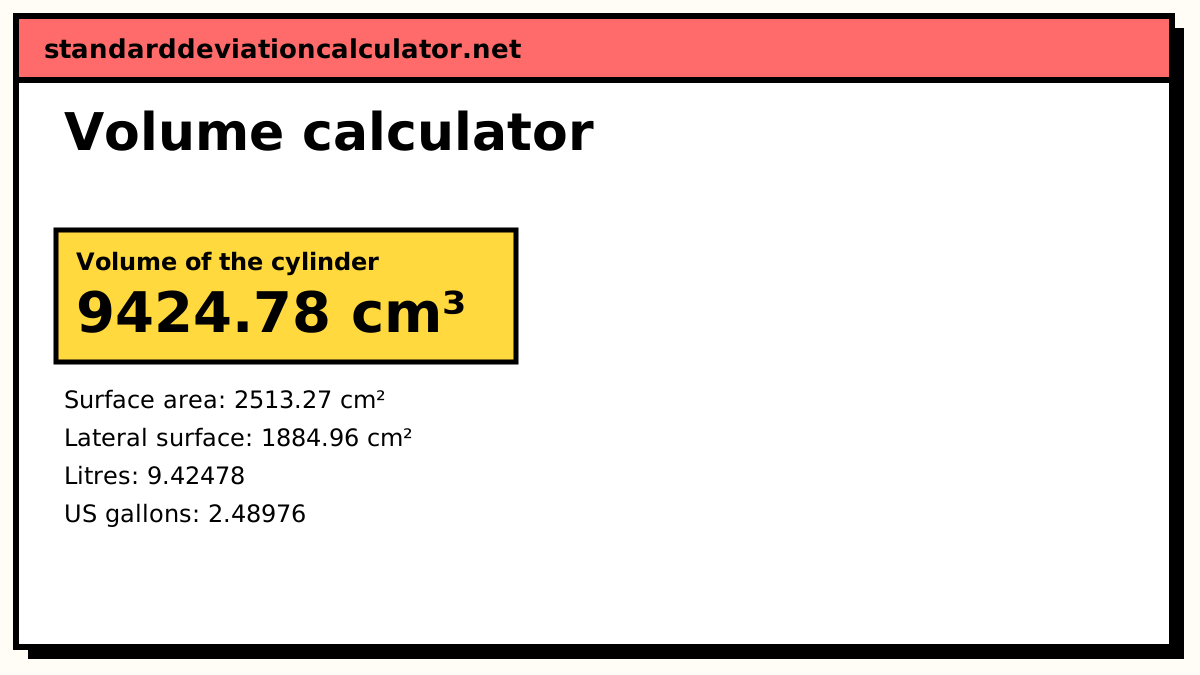
V = πr²h V = π × 10² × 30 = π × 3000 = 9424.78 cm³
Surface area: two circles plus the curved side, which unrolls into a rectangle 2πr by h.
SA = 2πr² + 2πrh = 628.319 + 1884.96 = 2513.27 cm²
1 litre = 1,000 cm³ = 0.001 m³; 1 US gallon = 3.785411784 L; 1 UK gallon = 4.54609 L.
Volume and surface area formulas
| Solid | Volume | Surface area |
|---|---|---|
| Cube | a³ | 6a² |
| Cuboid | lwh | 2(lw + lh + wh) |
| Cylinder | πr²h | 2πr² + 2πrh |
| Cone | ⅓πr²h | πr² + πrs, with s = √(r² + h²) |
| Sphere | ⁴⁄₃πr³ | 4πr² |
| Hemisphere | ⅔πr³ | 3πr² (dome 2πr² + base πr²) |
| Rectangular pyramid | ⅓lwh | lw + l√(h² + (w/2)²) + w√(h² + (l/2)²) |
| Triangular prism | T × L | 2T + (a + b + c)L, T = end triangle area |
| Frustum of a cone | ⅓πh(R² + Rr + r²) | π(R + r)s + πR² + πr² |
| Capsule | πr²a + ⁴⁄₃πr³ | 2πra + 4πr² |
| Torus | 2π²Rr² | 4π²Rr |
Most of these are one idea: base area × height for anything with straight sides (cube, cuboid, cylinder, prism), and a third of that for anything that tapers to a point (cone, pyramid). The torus comes from Pappus's theorem: the area of the tube's cross-section, πr², times the distance its centre travels round the ring, 2πR.
A worked example
The calculator opens on a cylinder with radius 10 cm and height 30 cm, about the size of a large paint tin or a small bin.
- Base area: π × 10² = 314.159 cm².
- Volume: 314.159 × 30 = 9,424.78 cm³.
- In litres: 9,424.78 ÷ 1,000 = 9.42478 L. In US gallons: 9.42478 ÷ 3.785411784 = 2.48976. In UK gallons: 2.07316.
- Surface area: two ends (2 × 314.159 = 628.319 cm²) plus the curved side (2π × 10 × 30 = 1,884.96 cm²) = 2,513.27 cm².
A cone with the same radius and height holds exactly a third as much, 3,141.59 cm³, and a sphere of radius 10 cm holds 4,188.79 cm³.
Scaling: why doubling the radius matters more
Volume grows with the cube of length. Double the height of the cylinder and the volume doubles to 18,849.6 cm³; double the radius and it quadruples to 37,699.1 cm³, because r is squared. Double every dimension and the volume goes up eight times while the surface area goes up only four times. This is why large tanks are cheaper per litre than small ones: less wall per unit of contents.
Common mistakes
- Using the diameter as r. A 20 cm wide pipe has r = 10 cm. Using 20 makes the volume four times too big.
- Using the slant height as h in a cone or pyramid. The volume needs the perpendicular height; the slant height is only for the surface area.
- Mixing units. A tank 2 m long, 80 cm wide and 60 cm deep is 2 × 0.8 × 0.6 = 0.96 m³, or 960 litres. Convert first, then multiply.
- Confusing US and UK gallons. They differ by about 20%.
- Forgetting wall thickness. A container's capacity uses the inside dimensions, not the outside ones.
Common questions
How do I convert cubic centimetres to litres?
Divide by 1,000. A litre is defined as a cubic decimetre, a cube 10 cm on each side, which is 10 × 10 × 10 = 1,000 cm³. So 1 cm³ is exactly 1 millilitre. The default cylinder above holds 9,424.78 cm³, which is 9.42478 litres. From cubic metres, multiply by 1,000: a 1 m³ tank holds 1,000 litres.
How many gallons are in a cubic foot?
7.48052 US gallons, or 6.22884 UK (imperial) gallons. The two gallons differ: a US gallon is defined as 231 cubic inches (3.785411784 L), while an imperial gallon is 4.54609 L, about 20% bigger. Check which one a spec means before ordering pool chemicals or sizing a tank. The calculator shows both.
Why is a cone one third of a cylinder?
Slice both into thin discs. At height y up a cone of height h, the disc radius has shrunk to r(1 − y/h), so its area is πr²(1 − y/h)². Adding up those discs (integrating) gives πr²h × ⅓. The same factor of ⅓ appears for any pyramid over any base, which is why a pyramid is ⅓ × base area × height. Archimedes also showed a sphere fills exactly ⅔ of the cylinder that just contains it: ⁴⁄₃πr³ against πr² × 2r.
What is the difference between volume and surface area?
Volume is how much space a solid fills (cubic units: cm³, litres, gallons). Surface area is the total area of its outside (square units: cm²). Volume tells you how much water a tank holds; surface area tells you how much paint or sheet metal it takes. The calculator gives both, and for cylinders, cones, pyramids and prisms also the lateral surface, which leaves out the ends.
How do I find the volume of an irregular object?
Either split it into standard solids (a silo is a cylinder plus a cone; a capsule is a cylinder plus a sphere), or measure it by displacement: lower it into a measuring jug of water and read how far the level rises. 1 mL of rise is 1 cm³ of object.
Related calculators
-
Area calculator
Area of thirteen flat shapes, with conversions.
-
Circle calculator
Radius, area and circumference of the circular ends.