Math
Triangle solver
Fill in any three of the six parts of a triangle and leave the rest blank. The solver identifies the case, finds the missing sides and angles with the law of sines or cosines, and draws every triangle that fits, including both answers in the ambiguous case.
| Triangle 1 | Triangle 2 | |
|---|---|---|
| Side a (given) | 6 | 6 |
| Side b (given) | 10 | 10 |
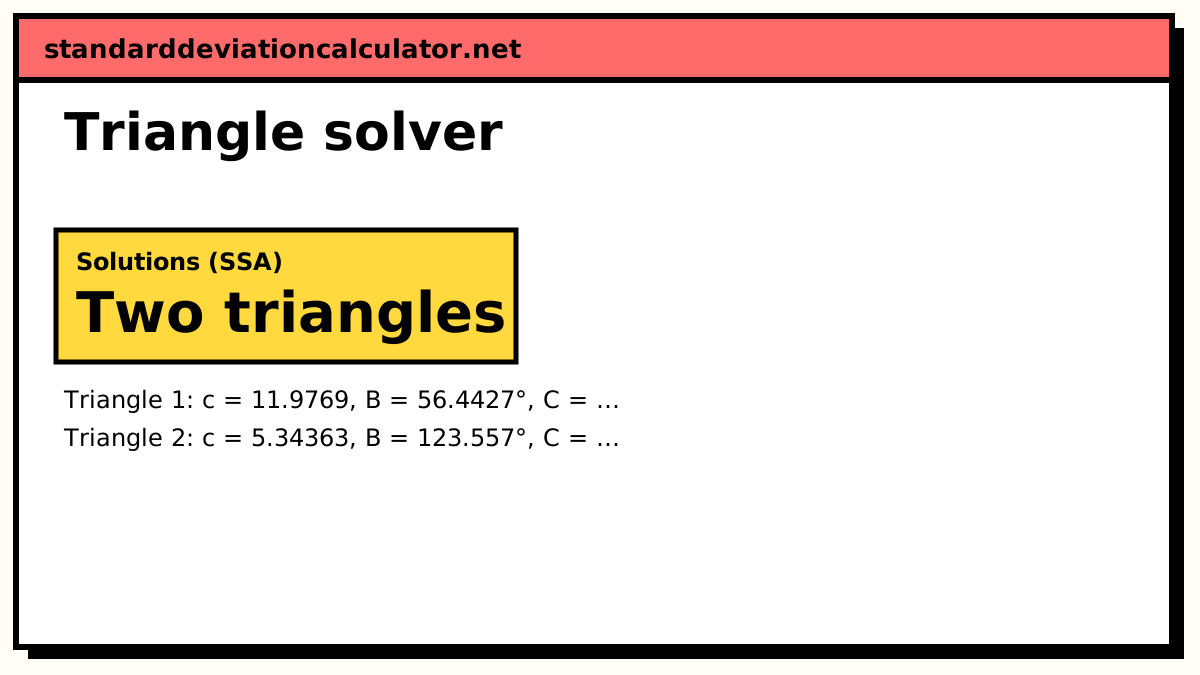
| Side c | 11.9769 | 5.34363 |
| Angle A (given) | 30° (30°0′0″) | 30° (30°0′0″) |
| Angle B | 56.4427° (56°26′33.68″) | 123.557° (123°33′26.32″) |
| Angle C | 93.5573° (93°33′26.32″) | 26.4427° (26°26′33.68″) |
| Area | 29.9422 | 13.3591 |
| Perimeter | 27.9769 | 21.3436 |
| Type | obtuse scalene | obtuse scalene |
Triangle 1
Triangle 2
Show the working, step by step
Two sides and an angle that is not between them (SSA): the law of sines gives B. This is the ambiguous case.
sin B = b·sin A ÷ a = 10 × sin 30° ÷ 6 = 0.833333
Both 56.4427° and 180° − 56.4427° = 123.557° have this sine. Test each.
B = 56.4427°, C = 180° − 30° − 56.4427° = 93.5573°, c = 6 × sin 93.5573° ÷ sin 30° = 11.9769 B = 123.557°, C = 180° − 30° − 123.557° = 26.4427°, c = 6 × sin 26.4427° ÷ sin 30° = 5.34363
Area = ½ab·sin C. Drawings are to scale, with A at the left of the base, B at the right and C at the top.
Labelling
Angles are capital letters A, B, C at the corners; each side takes the lower-case letter of the angle opposite it. So side a faces angle A. Angles are in degrees unless you type π (π/6 is read as radians).
The two laws
Law of sines: a ÷ sin A = b ÷ sin B = c ÷ sin C Law of cosines: c² = a² + b² − 2ab·cos C
| You know | Case | Method | Solutions |
|---|---|---|---|
| Three sides | SSS | Law of cosines for two angles, then 180° − the rest | 1 (or 0 if the triangle inequality fails) |
| Two sides and the angle between | SAS | Law of cosines for the third side | 1 |
| Two angles and the side between | ASA | Third angle, then law of sines | 1 |
| Two angles and another side | AAS | Third angle, then law of sines | 1 |
| Two sides and an angle not between | SSA | Law of sines, testing both arcsin answers | 0, 1 or 2 |
A worked example: the ambiguous case
The default input is a = 6, b = 10 and A = 30°, an SSA case.
- Law of sines: sin B = b·sin A ÷ a = 10 × 0.5 ÷ 6 = 0.833333.
- Two angles have this sine: B = 56.4427° and B = 180° − 56.4427° = 123.557°.
- First triangle: C = 180° − 30° − 56.4427° = 93.5573°, and c = 6 × sin 93.5573° ÷ sin 30° = 11.9769.
- Second triangle: C = 180° − 30° − 123.557° = 26.4427°, and c = 6 × sin 26.4427° ÷ sin 30° = 5.34363.
Both are valid: their angles are all positive and add to 180°. The picture shows why. The height from C to the base line is b·sin A = 5, and side a = 6 is long enough to reach the line but shorter than b, so it can land on either side of the foot of that height.
| Side a (with b = 10, A = 30°) | Triangles |
|---|---|
| a < 5 (below the height) | None |
| a = 5 exactly | One, with a right angle at B |
| 5 < a < 10 | Two |
| a ≥ 10 | One |
Right triangles
Choose “Right triangle” and the solver fixes C = 90°, so c is the hypotenuse. Enter two values: legs 3 and 4 give c = 5, A = 36.8699° and B = 53.1301°. A hypotenuse of 10 with A = 30° gives a = 5 and b = 8.66025. For single ratios, the sine, cosine and tangent calculators have right-triangle modes too.
Common mistakes
- Taking only the acute arcsin answer in SSA. The obtuse one is often valid too.
- Mixing up which side is opposite which angle. Side a must face angle A.
- Rounding early. Carry full precision through the steps; the solver does, and shows six significant figures.
For a triangle whose sides are already known and you want its heights, medians, inradius or other properties, use the triangle calculator.
Common questions
How many values do I need to solve a triangle?
Three, and at least one of them must be a side. Three angles alone fix the shape but not the size. For a right triangle the 90° angle is one of the three, so two more values are enough: two sides, or a side and an acute angle.
What is the ambiguous case (SSA)?
When you know two sides and an angle that is not between them, the side opposite the angle can sometimes swing into two positions. With A = 30°, a = 6 and b = 10 the height from C is 10 × sin 30° = 5. Because 5 < 6 < 10, side a meets the base twice, giving B = 56.44° or B = 123.56°. If a were shorter than 5 there would be no triangle; if a were 5 exactly, or at least 10, there would be one.
Should I use the law of sines or the law of cosines?
Law of cosines for SSS and SAS, where no angle is known together with its opposite side. Law of sines for ASA, AAS and SSA. When both are possible, the law of cosines is safer for angles, because arccos tells an obtuse angle from an acute one and arcsin does not.
How is the area worked out?
From two sides and the angle between them: Area = ½ab·sin C. For the first default triangle, ½ × 6 × 10 × sin 93.56° = 29.94. With only the three sides, Heron’s formula gives the same number.
Why does the calculator say the sides cannot form a triangle?
Each side must be shorter than the other two added together (the triangle inequality). Sides 3, 4 and 8 fail because 3 + 4 = 7 is less than 8: the two short sides cannot meet.
Related calculators
-
Triangle calculator
Area, perimeter, heights, medians and other properties.
-
Cosine calculator
The law of cosines on its own, plus cos θ and arccos.
-
Sine calculator
sin θ, arcsin and opposite over hypotenuse.
-
Tangent calculator
Right-triangle angles from rise and run.
-
Area calculator
Area of triangles and every other common shape.