Math
Cosine calculator
Enter an angle for its cosine, with the exact value for standard angles and the point on the unit circle. Other modes find the angle from a cosine, cos θ from a right triangle, and the missing side or angle of any triangle with the law of cosines.
Type 30, 30°, pi/6, π/3, 1.2 rad or 36°52′. Anything with π is read as radians.
Between −1 and 1. Fractions and roots work: -1/2, √2/2.
The point at θ on the unit circle is (cos θ, sin θ) = (0.5, 0.866025). The violet segment is cos θ, the horizontal distance of the point from the y-axis.
Show the working, step by step
60° is in quadrant I, where all six functions are positive, so it is its own reference angle.
reference angle = 60°
Evaluate cos directly (a standard angle, so the exact value is known).
cos 60° = 1/2 = 0.5
What cosine means
cos θ = adjacent ÷ hypotenuse
In a right triangle, cosine is the side next to the angle over the hypotenuse. On the unit circle it is the x-coordinate of the point at angle θ, so it starts at 1 for 0°, falls to 0 at 90° and reaches −1 at 180°. Cosine is the sine of the complementary angle: cos θ = sin(90° − θ), which is where the “co” in the name comes from.
A worked example
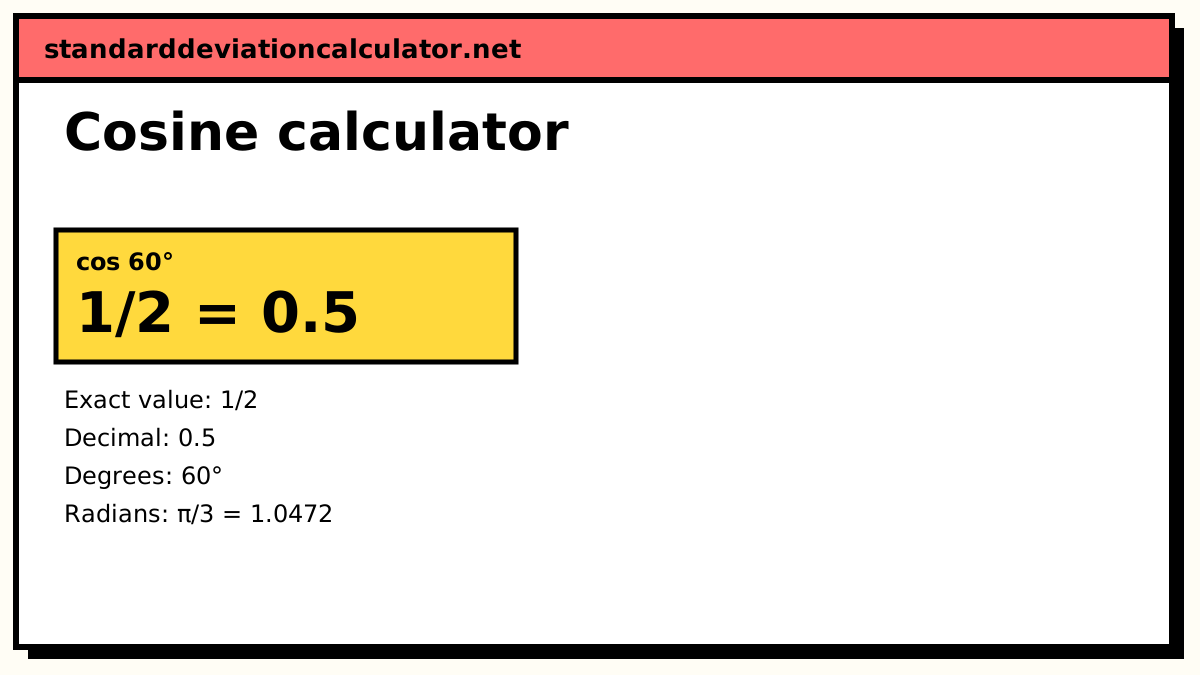
The default angle is 60°.
- 60° is in quadrant I, so cosine is positive and 60° is its own reference angle.
- 60° is a standard angle: cos 60° = 1/2 = 0.5.
- On the unit circle the point is (1/2, √3/2), and the violet segment in the drawing is its x-coordinate, 0.5.
In arccos mode the default value is −0.5. The principal value is arccos(−0.5) = 120°. Because cos(−θ) = cos θ, the other solution in one turn is 360° − 120° = 240°.
The law of cosines
For any triangle with sides a, b, c and the angle C opposite c:
c² = a² + b² − 2ab·cos C cos C = (a² + b² − c²) ÷ 2ab
The first form finds a side from two sides and the angle between them. With the defaults a = 7, b = 9 and C = 60°: c² = 49 + 81 − 126 × 0.5 = 67, so c = √67 = 8.18535. The second form finds an angle from three sides. With a = 7, b = 9, c = 8: cos C = (49 + 81 − 64) ÷ 126 = 0.52381, so C = 58.4119°.
A worked problem: two ships leave port on courses 120° apart, one sailing 40 km and the other 55 km. The distance between them is √(40² + 55² − 2 × 40 × 55 × cos 120°) = 82.6 km. Because cos 120° is negative, the gap is larger than Pythagoras alone would give.
Cosine values to know
| θ | Radians | cos θ exact | Decimal |
|---|---|---|---|
| 0° | 0 | 1 | 1 |
| 30° | π/6 | √3/2 | 0.866025 |
| 45° | π/4 | √2/2 | 0.707107 |
| 60° | π/3 | 1/2 | 0.5 |
| 90° | π/2 | 0 | 0 |
| 120° | 2π/3 | −1/2 | −0.5 |
| 180° | π | −1 | −1 |
Common mistakes
- Wrong angle mode. cos 1 is 0.540302 in radians and 0.999848 in degrees. Anything with π in it is read as radians here, whatever the unit menu says.
- Only one solution. cos θ = k has two solutions per turn, ±arccos k, except for k = 1 and k = −1.
- Using the wrong angle in the law of cosines. The angle must be the one between the two known sides, opposite the side you want.
Common questions
What is cos 60°?
Exactly 1/2. In radians the angle is π/3, and cos(π/3) = 1/2 too. Cosine of 60° equals the sine of 30°, because cos θ = sin(90° − θ).
What are the solutions of cos θ = −1/2?
arccos(−1/2) = 120°. Cosine is even, so −120°, which is 240° in one turn, has the same cosine. Between 0° and 360° the solutions are 120° and 240°, and in general θ = ±120° + 360°n.
When do I use the law of cosines instead of the law of sines?
Use the law of cosines when you know three sides (SSS) or two sides and the angle between them (SAS). The law of sines needs an angle together with its opposite side, which those two cases do not give you. The law of cosines is also safer for obtuse angles, since arccos returns angles up to 180° while arcsin cannot tell 50° from 130°.
Is the law of cosines the same as Pythagoras?
It includes it. With C = 90°, cos C = 0 and c² = a² + b² − 2ab·cos C becomes c² = a² + b². The extra term corrects for the angle: an obtuse C makes c longer than √(a² + b²), an acute C makes it shorter.
Where is cosine negative?
In quadrants II and III, between 90° and 270°, where the point on the unit circle is left of the y-axis. cos 120° = −1/2, cos 180° = −1 and cos 240° = −1/2.
Related calculators
-
Sine calculator
sin θ, arcsin and opposite over hypotenuse.
-
Tangent calculator
tan θ, arctan and the angle of a slope.
-
Triangle solver
All six parts of any triangle from SSS, SAS, ASA, AAS or SSA.
-
Triangle calculator
Area, perimeter, heights and other properties of a triangle.
-
All six trig functions
sin, cos, tan and their reciprocals at once.