Trigonometry calculators
Calculators for the trig functions and their inverses, for solving triangles with the sine and cosine rules, and for solving and graphing trig equations. Exact values such as √3/2 appear alongside the decimals, in degrees, radians or gradians.
Which calculator do I need?
| You have or want | Use |
|---|---|
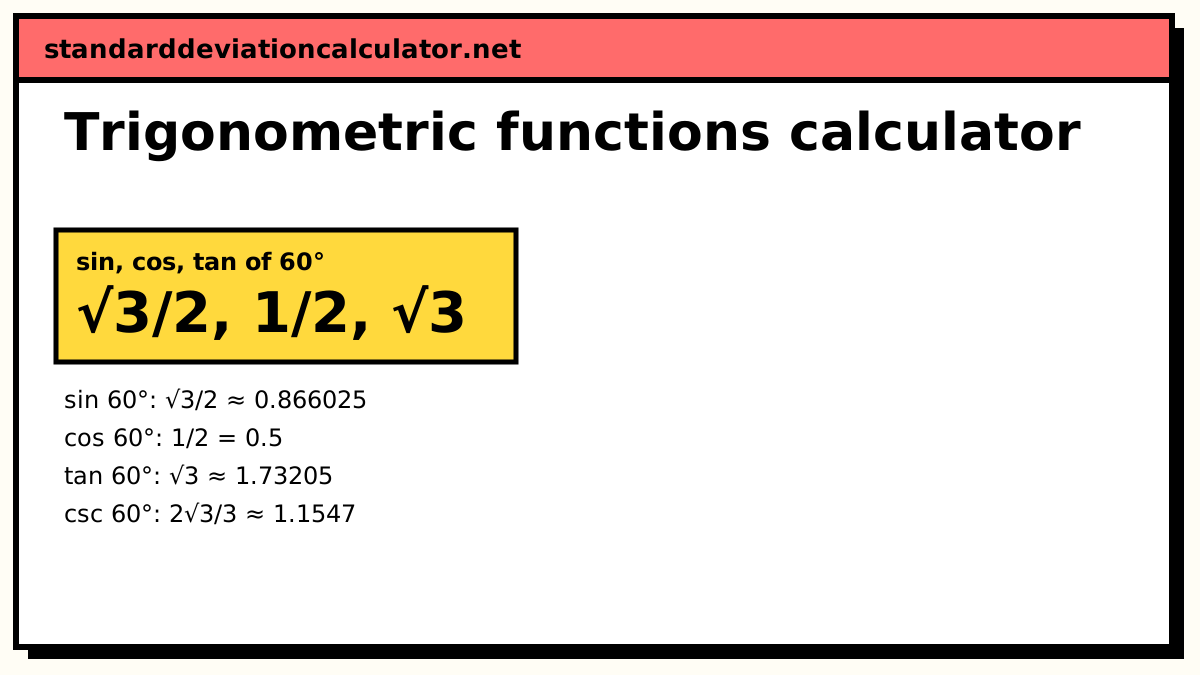
| All six trig ratios of one angle, with exact values | Trigonometric functions calculator |
| sin θ, or every angle whose sine is a given value | Sine calculator |
| cos θ, arccos, or a side from the law of cosines | Cosine calculator |
| The angle of a slope, ramp or roof pitch | Tangent calculator |
| The missing sides and angles of any triangle | Triangle solver |
| Every solution of 2 sin x − 1 = 0 between 0° and 360° | Trigonometric equation solver |
| Amplitude, period and phase shift of y = A sin(Bx − C) + D | Trig graph calculator |
Trig functions and their inverses
The value of a trig function at an angle, or the angle that gives a value.
-
Trigonometric functions calculator
All six trig functions of an angle with exact values, plus the inverse functions.
-
Sine calculator
sin θ in degrees, radians or gradians, arcsin with every solution, and opposite over hypotenuse.
-
Cosine calculator
cos θ with exact values, arccos, adjacent over hypotenuse and the law of cosines.
-
Tangent calculator
tan θ, arctan, opposite over adjacent, and the angle of a slope or grade.
Triangles and equations
Put the functions to work: solve triangles from three parts and equations on an interval.
-
Triangle solver
Solve any triangle from three parts, with the ambiguous SSA case and a drawing to scale.
-
Trigonometric equation solver
Solve trig equations on an interval, with the general solution and a graph of both sides.
-
Triangle calculator
Area, angles, type, heights, medians and radii of a triangle from any three parts.
Graphs
See the shape of a trig function and read its key features off the plot.
-
Trig graph calculator
Graph y = A sin(Bx − C) + D and friends: amplitude, period, phase shift and asymptotes.
-
Graphing calculator
Plot up to four functions of x and find their zeros and intersections.
From one angle to a whole triangle
Start with the trig functions calculator when you have an angle and want its ratios. It gives all six at once, and exact forms for the standard angles. The sine, cosine and tangent pages go deeper into one function: its inverse, the right-triangle ratio, and the rule it belongs to. For a triangle, go to the triangle solver, which picks the sine rule or the cosine rule based on the parts you enter.
Worked comparison: one equation, several answers
A calculator’s sin⁻¹ key gives one angle, but sin x = 0.5 has two solutions between 0° and 360°: x = 30° and x = 180° − 30° = 150°. The general solution is x = 30° + 360°k or x = 150° + 360°k for any whole number k. The equation solver lists every solution in the interval you choose and graphs both sides, so you can see where they cross.
Triangles can have the same problem. With a = 7, b = 10 and A = 30°, the sine rule gives sin B = 10 × 0.5 ÷ 7 ≈ 0.7143. That means B ≈ 45.58° or B ≈ 134.42°. Both work, so two different triangles fit the data. This is the ambiguous SSA case, and the triangle solver draws both triangles.
Common mix-ups
- Degrees versus radians. sin 30 is 0.5 in degree mode but about −0.988 in radian mode, because 30 radians is more than four full turns. Check the unit selector before trusting a result.
- sin⁻¹ x is not 1/sin x. sin⁻¹ is the inverse function (arcsin). The reciprocal is cosecant, csc x.
- Undefined tangents. tan 90° does not exist, because cos 90° = 0. The graph calculator marks these points as vertical asymptotes.
Guides to read alongside
-
Methodology
How results are rounded and when exact values are shown.
-
Learn
All of the site’s guides in one place.