Math
Sine calculator
Type an angle to get its sine, exact where the angle allows it (sin 60° = √3/2), with the point drawn on the unit circle. Switch mode to go backwards from a sine value to every angle that has it, or to get sin θ from the sides of a right triangle.
Type 30, 30°, pi/6, π/3, 1.2 rad or 36°52′. Anything with π is read as radians.
Between −1 and 1. Fractions and roots work: -1/2, √3/2.
The point at θ on the unit circle is (cos θ, sin θ) = (0.866025, 0.5). The red segment is sin θ, the height of the point.
Show the working, step by step
30° is in quadrant I, where all six functions are positive, so it is its own reference angle.
reference angle = 30°
Evaluate sin directly (a standard angle, so the exact value is known).
sin 30° = 1/2 = 0.5
What sine means
In a right triangle, the sine of an angle is the side opposite it divided by the hypotenuse:
sin θ = opposite ÷ hypotenuse
That definition only covers angles between 0° and 90°. The unit circle extends it to every angle: turn θ anticlockwise from the positive x-axis, and the point where you land on a circle of radius 1 has coordinates (cos θ, sin θ). Sine is the height of that point, which is why it is positive above the x-axis, negative below it, and never outside −1 to 1.
A worked example
The calculator starts with θ = 30°.
- 30° is in quadrant I, so it is its own reference angle and the sine is positive.
- 30° is a standard angle, so its sine is known exactly: sin 30° = 1/2 = 0.5.
- The point on the unit circle is (√3/2, 1/2) ≈ (0.866, 0.5).
For an angle outside the first quadrant, find the reference angle and then the sign. Take 210°: it is in quadrant III, 30° past 180°, so the reference angle is 30°. Sine is negative in quadrant III, so sin 210° = −sin 30° = −1/2.
Exact values of sine
| θ (degrees) | θ (radians) | sin θ exact | Decimal |
|---|---|---|---|
| 0° | 0 | 0 | 0 |
| 15° | π/12 | (√6 − √2)/4 | 0.258819 |
| 30° | π/6 | 1/2 | 0.5 |
| 45° | π/4 | √2/2 | 0.707107 |
| 60° | π/3 | √3/2 | 0.866025 |
| 75° | 5π/12 | (√6 + √2)/4 | 0.965926 |
| 90° | π/2 | 1 | 1 |
Every other multiple of 15° reuses one of these values with a sign from its quadrant, and the calculator shows it exactly. Other angles, such as sin 35° = 0.573576, have no simple closed form and are given as decimals.
Inverse sine and the second solution
arcsin undoes sine, but only returns one angle, between −90° and 90°. The equation sin θ = k has two solutions in each full turn (unless k is ±1):
θ = arcsin k + 360°·n or θ = 180° − arcsin k + 360°·n
For sin θ = 0.5 that gives 30° and 150° between 0° and 360°. Forgetting the 180° − α solution is the most common mistake in trigonometric equations. The trig equation solver handles harder cases such as sin 2x = 0.5 or 2sin²x − sin x = 0.
Right triangles: opposite over hypotenuse
In right-triangle mode the default sides are opposite 3 and hypotenuse 5, the 3-4-5 triangle. sin θ = 3 ÷ 5 = 0.6, so θ = arcsin 0.6 = 36.8699° (36°52′12″), and the third side is √(5² − 3²) = 4. A 6 m ladder leaning at 70° reaches 6 × sin 70° = 5.64 m up the wall.
Degrees or radians?
Choose the unit in the calculator, or type it with the number: 30°, 1.2 rad
or 50 grad. Anything containing π, such as pi/6 or 5π/4, is read
as radians. A bare number in the wrong mode is the usual cause of odd answers: sin 1 is 0.841471 in
radians but 0.0174524 in degrees.
Common questions
What is sin 30°?
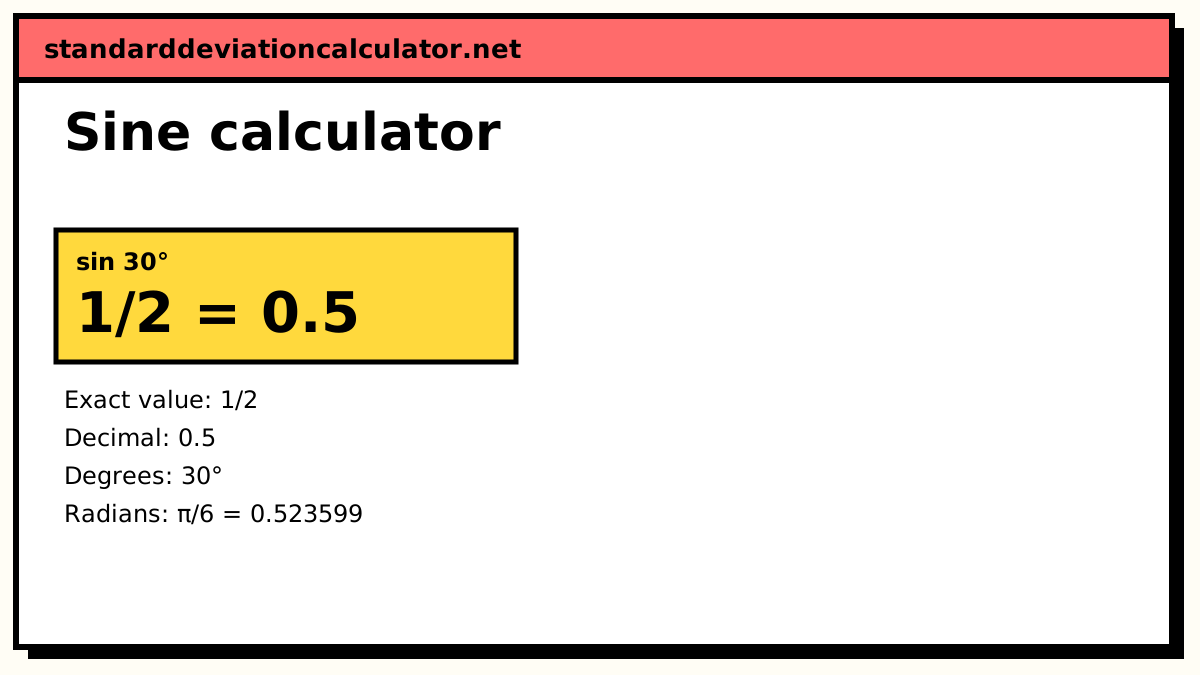
Exactly 1/2, or 0.5. In radians the same angle is π/6, so sin(π/6) = 1/2 as well. It comes from an equilateral triangle cut in half: the side opposite the 30° angle is half the hypotenuse.
Why does my calculator say sin 30 = −0.988?
It is in radian mode, so it worked out the sine of 30 radians (about 1,719°), which is −0.98803. Switch the calculator to degrees (DEG) or type the angle as 30° here. A quick check: sin 30 should be 0.5 in degrees.
How do I find the angle from a sine value?
Use the inverse sine, arcsin (sin⁻¹ on a calculator). arcsin(0.5) = 30°. That is only the principal value, between −90° and 90°. Sine is also positive in the second quadrant, so 180° − 30° = 150° has the same sine, and every angle 360° away from either one does too.
Can sine be greater than 1?
Not for a real angle. Sine is the y-coordinate of a point on a circle of radius 1, so it always lies between −1 and 1. That is why sin θ = 1.5 has no solution and arcsin(1.5) gives an error.
In which quadrants is sine negative?
In quadrants III and IV, the angles between 180° and 360°, where the point on the unit circle is below the x-axis. For example sin 210° = −1/2 and sin 330° = −1/2.
Related calculators
-
Cosine calculator
cos θ, arccos and the law of cosines.
-
Tangent calculator
tan θ, arctan and the angle of a slope.
-
All six trig functions
sin, cos, tan, csc, sec and cot of one angle, with exact values.
-
Triangle solver
Any triangle from three sides or angles, with the law of sines.
-
Trig graph calculator
Graph y = A sin(Bx − C) + D with its amplitude and period.