Math
Trigonometric functions calculator
Enter one angle and get all six trigonometric functions at once, exact where the angle is a multiple of 15° and as decimals otherwise. Switch to inverse mode to go from a value back to the angle, with every solution in one turn.
Type 30, 30°, pi/6, π/3, 1.2 rad or 36°52′. Anything with π is read as radians.
Fractions and roots work: -1/2, √3/2, 2/√3.
| Function | Definition | Exact | Decimal |
|---|---|---|---|
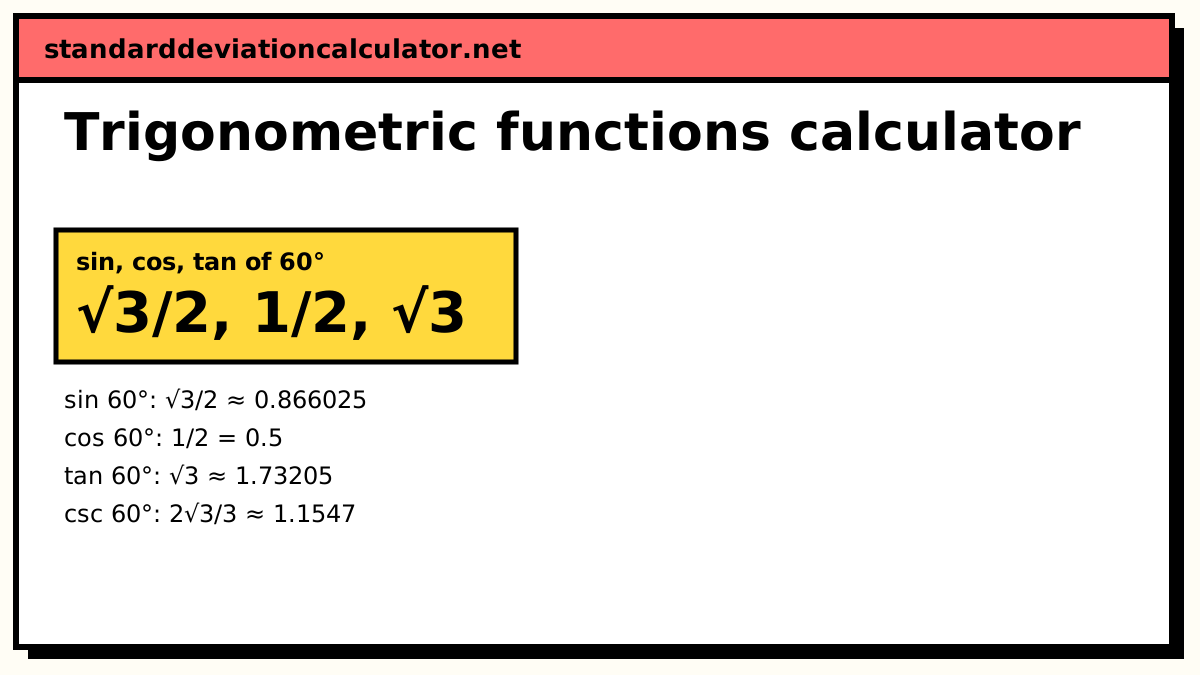
| sin θ (sine) | y | √3/2 | 0.8660254038 |
| cos θ (cosine) | x | 1/2 | 0.5 |
| tan θ (tangent) | y ÷ x | √3 | 1.732050808 |
| csc θ (cosecant) | 1 ÷ sin θ | 2√3/3 | 1.154700538 |
| sec θ (secant) | 1 ÷ cos θ | 2 | 2 |
| cot θ (cotangent) | 1 ÷ tan θ | √3/3 | 0.5773502692 |
On the unit circle the point at θ is (x, y) = (cos θ, sin θ) = (0.5, 0.866025). Violet: cos θ. Red: sin θ.
Show the working, step by step
Place θ on the unit circle. 60° is in quadrant I, with reference angle 60°.
(x, y) = (cos θ, sin θ) = (1/2 = 0.5, √3/2 ≈ 0.866025)
Tangent is y ÷ x.
tan θ = 0.866025 ÷ 0.5 = √3 ≈ 1.73205
The other three are reciprocals.
csc θ = 1 ÷ sin θ = 2√3/3 ≈ 1.1547 sec θ = 1 ÷ cos θ = 2 cot θ = 1 ÷ tan θ = √3/3 ≈ 0.57735
Check with the Pythagorean identity.
sin²θ + cos²θ = 0.75 + 0.25 = 1
Exact values are given for every multiple of 15°. Any other angle gets the decimal value only.
Definitions
Put the angle θ on the unit circle, turning anticlockwise from the positive x-axis, and let (x, y) be the point where it lands.
sin θ = y cos θ = x tan θ = y ÷ x csc θ = 1 ÷ y sec θ = 1 ÷ x cot θ = x ÷ y
Wherever a denominator is zero the function is undefined: tan and sec at 90° and 270°, csc and cot at 0° and 180°. In a right triangle the same ratios become the familiar SOH CAH TOA: sine is opposite over hypotenuse, cosine adjacent over hypotenuse, tangent opposite over adjacent.
A worked example
The default angle is 60° (π/3 radians).
- The point on the unit circle is (1/2, √3/2), so cos 60° = 1/2 and sin 60° = √3/2 ≈ 0.866025.
- tan 60° = (√3/2) ÷ (1/2) = √3 ≈ 1.73205.
- The reciprocals: csc 60° = 2/√3 = 2√3/3 ≈ 1.1547, sec 60° = 2, cot 60° = 1/√3 = √3/3 ≈ 0.57735.
- Check: sin²60° + cos²60° = 3/4 + 1/4 = 1.
Exact values table
| θ | sin | cos | tan | csc | sec | cot |
|---|---|---|---|---|---|---|
| 0° | 0 | 1 | 0 | undef. | 1 | undef. |
| 30° (π/6) | 1/2 | √3/2 | √3/3 | 2 | 2√3/3 | √3 |
| 45° (π/4) | √2/2 | √2/2 | 1 | √2 | √2 | 1 |
| 60° (π/3) | √3/2 | 1/2 | √3 | 2√3/3 | 2 | √3/3 |
| 90° (π/2) | 1 | 0 | undef. | 1 | undef. | 0 |
For any other quadrant, find the reference angle (the acute angle to the x-axis) and attach the sign for that quadrant. For 135°, the reference angle is 45° and the point is in quadrant II, where only sine and cosecant are positive: sin 135° = √2/2, cos 135° = −√2/2, tan 135° = −1.
Identities the results obey
sin²θ + cos²θ = 1 1 + tan²θ = sec²θ 1 + cot²θ = csc²θ sin(90° − θ) = cos θ
These are useful for checking an answer by hand, and for turning one known value into the rest. If sin θ = 3/5 and θ is acute, cos θ = √(1 − 9/25) = 4/5 and tan θ = 3/4.
Inverse functions
Each inverse returns a single principal value from a fixed range: arcsin in [−90°, 90°], arccos in [0°, 180°], arctan in (−90°, 90°), arccot in (0°, 180°), with arccsc and arcsec following arcsin and arccos. The calculator then lists every solution between 0° and 360° and the general solution. The default, arcsin(√3/2), gives 60° and 120°.
Common questions
What are the six trigonometric functions?
Sine, cosine and tangent, and their reciprocals cosecant (csc = 1/sin), secant (sec = 1/cos) and cotangent (cot = 1/tan). For a point (x, y) on the unit circle at angle θ: sin θ = y, cos θ = x, tan θ = y/x, csc θ = 1/y, sec θ = 1/x and cot θ = x/y.
Which angles have exact trig values?
Every multiple of 15°, that is, of π/12. The core ones are 30°, 45° and 60°, from the half equilateral triangle and the half square. 15° and 75° come from the angle-difference formulas, for example sin 15° = sin(45° − 30°) = (√6 − √2)/4. The calculator shows the exact form for all of these and a decimal for anything else.
Is csc the same as sin⁻¹?
No. csc θ = 1/sin θ is a reciprocal; sin⁻¹ x = arcsin x is an inverse, which gives an angle back. csc 30° = 2, while arcsin(1/2) = 30°. The superscript −1 means inverse function, not a power, which is why sin²θ means (sin θ)² but sin⁻¹θ does not mean 1/sin θ.
What does ASTC (All Students Take Calculus) mean?
A way to remember which functions are positive in each quadrant: All in quadrant I, Sine in II, Tangent in III, Cosine in IV. Their reciprocals share the same signs, so csc is positive where sin is, and so on.
What range does arccot use?
This calculator uses (0°, 180°), the usual textbook convention, so arccot(−1) = 135°. Some software defines arccot x as arctan(1/x), with range (−90°, 90°], which gives −45° for the same input. Both give the same full set of solutions, 135° + 180°n.
Related calculators
-
Sine calculator
sin θ in detail, with arcsin and right triangles.
-
Cosine calculator
cos θ, arccos and the law of cosines.
-
Tangent calculator
tan θ, arctan and slope angles.
-
Trig equation solver
Solve sin x = 0.5, tan 2x = 1 and harder equations on an interval.
-
Trig graph calculator
Graph all six functions with amplitude, period and asymptotes.