Math
Area calculator
Choose a shape, enter its dimensions and pick a unit. The calculator gives the area with the formula worked through, draws the shape with its measurements, and converts the answer to every common square unit, from mm² to acres.
The angle between sides a and b.
Half the longest width.
Half the shortest width.
| Unit | Area |
|---|---|
| Millimetres squared (mm²) | 40000000 |
| Centimetres squared (cm²) | 400000 |
| Metres squared (m²) | 40 |
| Kilometres squared (km²) | 4.00000e-5 |
| Hectares (ha) | 0.004 |
| Inches squared (in²) | 62000.1 |
| Feet squared (ft²) | 430.556 |
| Yards squared (yd²) | 47.8396 |
| Miles squared (mi²) | 1.54441e-5 |
| Acres | 0.00988422 |
Show the working, step by step
Multiply the length by the width.
A = l × w A = 8 × 5 = 40 m²
Area formulas
Every formula below gives the area in square units of whatever length unit you use: metres in, square metres out. The letter h always means the perpendicular height, measured at right angles to the base.
| Shape | Formula | What the letters mean |
|---|---|---|
| Square | A = a² | a = side |
| Rectangle | A = l × w | length and width |
| Triangle | A = ½bh | base and perpendicular height |
| Triangle (Heron) | A = √(s(s − a)(s − b)(s − c)) | s = (a + b + c) ÷ 2 |
| Triangle (SAS) | A = ½ab sin C | two sides and the angle between them |
| Circle | A = πr² | r = radius |
| Sector | A = (θ ÷ 360) × πr² | θ = central angle in degrees |
| Ellipse | A = πab | a, b = semi-axes (half the widths) |
| Trapezoid | A = ½(a + b)h | a, b = the parallel sides |
| Parallelogram | A = bh | base and perpendicular height |
| Rhombus | A = ½pq | p, q = the diagonals |
| Regular polygon | A = ns² ÷ (4 tan(180°/n)) | n sides of length s |
| Annulus (ring) | A = π(R² − r²) | outer and inner radii |
A worked example
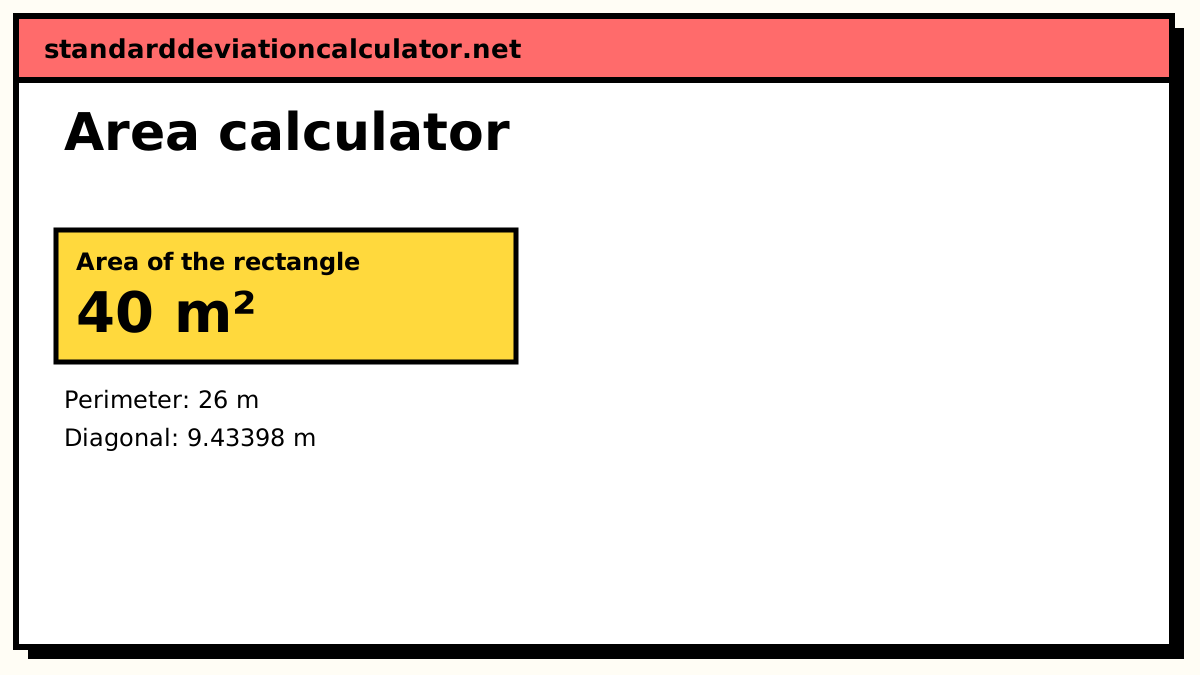
The calculator opens on a rectangle 8 m long and 5 m wide, a typical living room.
- Multiply length by width: 8 × 5 = 40 m².
- The perimeter, shown alongside, is 2 × (8 + 5) = 26 m, and the diagonal is √(8² + 5²) = 9.43398 m.
- In square feet: 40 × 10.7639 = 430.556 ft². In acres it is 0.00988.
Switch the shape to “Triangle: three sides” with sides 5, 6 and 7. The semi-perimeter is 9, so Heron's formula gives √(9 × 4 × 3 × 2) = √216 = 14.6969 square units. A circle of radius 5 has area π × 25 = 78.5398, and a regular hexagon with 4-unit sides has area 41.5692.
Choosing the right triangle formula
Which triangle formula to use depends on what you measured. With a base and the height to it, ½bh is quickest. With three sides and no height (the usual situation when measuring a real plot of ground with a tape), Heron's formula avoids needing any angle. With two sides and the angle between them, ½ab sin C works directly. All three give the same answer for the same triangle: the 5–6–7 triangle has a height of 4.89898 onto the side of 6, and ½ × 6 × 4.89898 = 14.6969. For every other property of a triangle (its angles, medians and circles), use the triangle calculator.
Units and conversions
Area units are squares of length units, so the conversion factor is squared too. There are 100 cm in a metre, so there are 100² = 10,000 cm² in a square metre. There are 12 inches in a foot, so 144 in² in a square foot, and 9 ft² in a square yard. Land is measured in hectares (10,000 m²) and acres (43,560 ft², or 4,046.86 m²). The table under each result gives the area in all of these at once.
Common mistakes
- Using the slant side as the height. For triangles, parallelograms and trapezoids, h is perpendicular to the base. A slanted side is longer and inflates the area.
- Using the diameter in πr². The formula needs the radius, half the diameter. Using the diameter makes the answer four times too big.
- Mixing units. A room 4 m by 350 cm is 4 × 3.5 = 14 m², not 4 × 350. Convert every length to one unit first.
- Converting with the length factor. 1 m = 3.28084 ft, but 1 m² = 10.7639 ft². Square the factor.
- Treating a trapezoid as a rectangle. Multiply the height by the average of the parallel sides, not by the longer one.
Common questions
How do you calculate area?
Area is the number of unit squares that fit inside a flat shape. For a rectangle you multiply length by width; every other formula on this page comes from that one. A triangle is half a rectangle (½ × base × height), a parallelogram is a rectangle with one end slid across (base × height), and a circle is πr². Pick the shape above and the calculator shows the formula with your numbers in it.
How do I find the area of a triangle with three sides and no height?
Use Heron's formula. Work out the semi-perimeter s = (a + b + c) ÷ 2, then Area = √(s(s − a)(s − b)(s − c)). For sides 5, 6 and 7, s = 9 and the area is √(9 × 4 × 3 × 2) = √216 = 14.6969. Choose “Triangle: three sides” above. If you know two sides and the angle between them instead, use ½ab sin C.
How do I convert square metres to square feet?
Multiply by 10.7639. One foot is exactly 0.3048 m, so one square foot is 0.3048² = 0.09290304 m², and one square metre is 1 ÷ 0.09290304 = 10.7639 ft². The calculator's default 40 m² room is 430.556 ft². Note that you square the length factor: multiplying square metres by 3.28 (the feet-per-metre figure) is a common mistake that undercounts by a factor of more than three.
Why does the area of a parallelogram use the height and not the slanted side?
Because area measures how much flat space is covered, and sliding the triangle off one end onto the other turns the parallelogram into a rectangle with the same base and the perpendicular height as its width. The slanted side is longer than the height, so using it overstates the area. The same applies to triangles and trapezoids: the height is always measured at right angles to the base.
What is the area of an irregular shape?
Split it into shapes this calculator handles (rectangles, triangles, circular pieces), find each area and add them, subtracting any holes. If you have the corner coordinates of a many-sided outline, such as a plot of land, the polygon calculator uses the shoelace formula to get the area in one step.
Related calculators
-
Perimeter calculator
The distance round the same shapes, with the ellipse approximation.
-
Volume calculator
Volume and surface area of eleven solids, in litres and gallons too.
-
Triangle calculator
Every property of a triangle from any three parts.
-
Circle calculator
Radius, diameter, circumference, area, arcs and segments.
-
Polygon calculator
Regular n-gons, and any polygon from its coordinates.