Dice, coin and game probability calculators
Tools for games of chance and the probability puzzles that defeat intuition. There are calculators for coin and dice probabilities, simulators for flipping coins, rolling dice and drawing random numbers, roulette odds, and step-by-step answers to paradoxes such as Monty Hall and the birthday problem.
Which calculator do I need?
| You have or want | Use |
|---|---|
| The chance of k heads in n flips, fair or biased coin | Coin flip probability calculator |
| The chance of a run of k heads in a row | Coin toss streak calculator |
| The chance of rolling a given total with several dice | Dice probability calculator |
| The average damage or total of a roll like 4d6 drop lowest | Dice average calculator |
| The payout and house edge of a roulette bet | Roulette payout calculator |
| How many people it takes for a shared birthday to be likely | Birthday paradox calculator |
| Whether to switch doors in the Monty Hall game | Monty Hall problem calculator |
Coins
Flip virtual coins and work out the chances of heads counts and streaks.
-
Coin flipper
Flip one coin or thousands, and compare the tally with a 50–50 split.
-
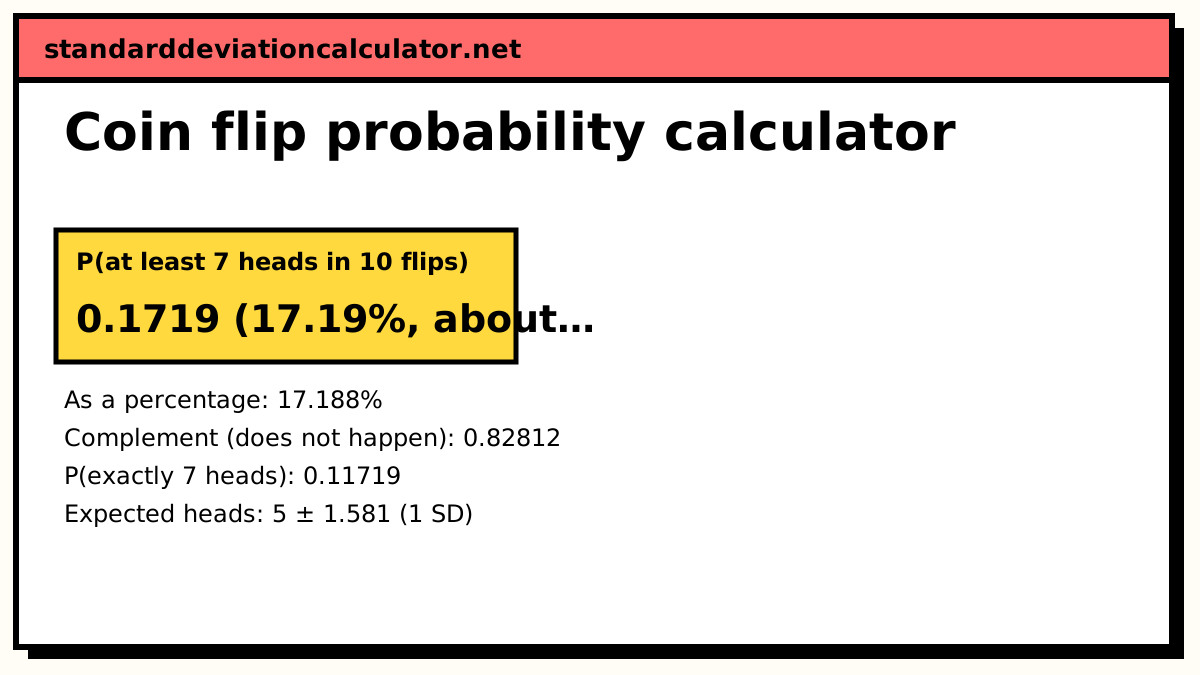
Coin flip probability calculator
The chance of exactly, at least or at most k heads in n flips.
-
Coin toss streak calculator
The exact chance of k heads (or either side) in a row, and the expected longest run.
Dice
Probabilities, averages and virtual rolls for any combination of dice.
-
Dice probability calculator
The chance of rolling a sum exactly, at least, at most or in a range with N dice.
-
Dice average calculator
The average, variance and SD of any NdS + M roll, with drop lowest or highest.
-
Dice roller
Roll any dice in NdS+M notation and keep a history of recent rolls.
-
Quiz: Dice average calculator
Random dice-average questions with instant marking and worked answers.
Casino games and random draws
The house edge on roulette bets, and fair random numbers for draws and raffles.
-
Roulette payout calculator
Payout, win probability, house edge and expected loss for every roulette bet.
-
Random number generator
Random whole numbers or decimals in a range, with no-repeat and sort options.
Probability puzzles and paradoxes
Classic puzzles with the exact answer, the reasoning, and a simulation to check it.
-
Birthday paradox calculator
The chance two people share a birthday, and the group size for any target.
-
Monty Hall problem calculator
Win chances for staying and switching with any number of doors, plus a simulation.
-
Bertrand's box paradox
Draw a gold coin: why the other coin is gold two times in three, with custom boxes and simulation.
-
Bertrand's paradox simulator
Random chords by three methods give 1/3, 1/2 and 1/4; simulated and drawn.
-
Boy or girl paradox calculator
The two-child problem: at least one boy, older boy, and the boy born on a Tuesday.
-
Two envelopes paradox calculator
The 1.25× switching argument against the correct analysis, with simulated strategies.
-
Parrondo's paradox calculator
Two losing games that win when mixed: exact drift and simulated runs.
Calculators, simulators and puzzles
This category has three kinds of page. The calculators give exact probabilities: the coin flip calculator uses the binomial distribution, the dice calculator counts every combination of faces, and the dice average calculator gives the expected value and SD of a roll. The simulators (coin flipper, dice roller, random number generator) produce actual random outcomes, which is useful for games and for seeing how results scatter around the expected values. The puzzle pages explain the famous paradoxes and let you simulate them.
Worked comparison: dice sums
With two six-sided dice there are 36 equally likely outcomes. A total of 7 can be made 6 ways (1+6, 2+5, 3+4 and the reverses), so P(7) = 6/36 = 16.7%. A total of 2 or 12 can be made only one way each, so each has probability 1/36 = 2.8%. The average total is 7 and the standard deviation is 2.42. With three dice the most likely totals are 10 and 11, each at 27/216 = 12.5%.
Puzzle answers at a glance
| Puzzle | Intuitive answer | Correct answer |
|---|---|---|
| Monty Hall: win by switching | 1/2 | 2/3 |
| Bertrand’s box: other coin is gold | 1/2 | 2/3 |
| Boy or girl: two boys, given at least one boy | 1/2 | 1/3 |
| Birthday: shared birthday among 23 people | about 6% | 50.7% |
Common mix-ups
- The gambler’s fallacy. After five heads, the next flip of a fair coin is still 50–50. Streaks are more common than people expect, as the streak calculator shows.
- European vs American roulette. The single zero gives a house edge of 2.70%; the extra double zero raises it to 5.26% on most bets.
- Bertrand’s paradox has no single answer. “A random chord” is not well defined, and three natural methods give 1/3, 1/2 and 1/4.