Boy or girl paradox calculator
Two children, at least one a boy: what is the chance both are boys? Choose how you learned about the boy, and the calculator gives the probability with the working, including the famous Tuesday version.
Use about 0.512 for real birth ratios.
1/7 for a weekday, 1/365 for a birthday.
| Family | Probability | At least one boy? | Older is a boy? |
|---|---|---|---|
| BB | 0.25 | yes | yes |
| BG (older boy) | 0.25 | yes | yes |
| GB (younger boy) | 0.25 | yes | no |
| GG | 0.25 | no | no |
Show the working, step by step
List the four birth orders with their probabilities.
BB = 0.25, BG = 0.25, GB = 0.25, GG = 0.25
“At least one boy” removes only GG.
P(at least one boy) = 1 − 0.5² = 0.75
Both boys is one of what remains.
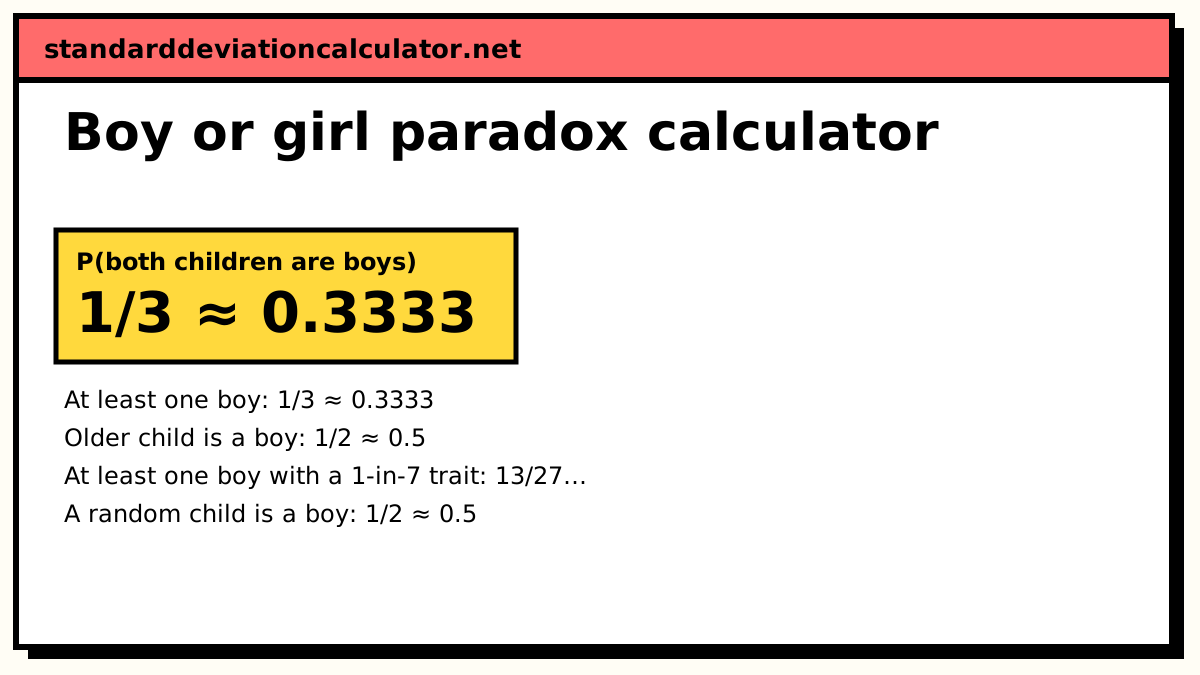
P(BB | ≥ 1 boy) = 0.25 ÷ 0.75 = 1/3 ≈ 0.3333
The answer depends on how you learned the fact. “At least one is a boy” in answer to that exact question gives 1/3; hearing about one particular child gives 1/2.
The formulas
With P(boy) = p for each child independently, and q = 1 − p:
P(BB | at least one boy) = p² ÷ (1 − q²) P(BB | older is a boy) = p P(BB | at least one boy has a trait of probability t) = p²(1 − (1 − t)²) ÷ (1 − (1 − pt)²)
Worked example: at least one boy
With the default p = 1/2 the four birth orders BB, BG, GB and GG each have probability 1/4. "At least one boy" rules out only GG, which leaves three equally likely cases:
P(BB | at least one boy) = (1/4) ÷ (3/4) = 1/3
If instead you are told the older child is a boy, only BB and BG remain, and the answer is (1/4) ÷ (1/2) = 1/2. Knowing which child is a boy gives more information than knowing that one of them is.
Worked example: a boy born on a Tuesday
Choose the trait version with t = 1/7. Each child is one of 14 equally likely (sex, weekday) types, so a family is one of 14 × 14 = 196 equally likely pairs.
- Pairs with at least one Tuesday boy: 14 with the older child a Tuesday boy, plus 14 with the younger one, minus the 1 counted twice = 27.
- Of those, both boys: 7 + 7 − 1 = 13.
- So P(BB | at least one Tuesday boy) = 13/27 ≈ 0.4815.
The formula gives the same: p·t = 1/14, 1 − (13/14)² = 27/196, and (1/4)(1 − (6/7)²) = 13/196. The rarer the trait, the closer the answer gets to 1/2, because a rare detail nearly pins down one particular child. With t = 1/365 (a birthday) the answer is about 0.4997.
How to interpret the result
The probabilities are correct for the process they assume: families with two children are sampled at random, and you learn whether they match the description. The last option in the calculator, meeting a random child who turns out to be a boy, assumes a different process and gives 1/2. Before you trust either number, ask how the information reached you. That question, rather than the arithmetic, is the real lesson of the paradox.
Common mistakes
- Treating BG and GB as one case. They are two different families, each with probability 1/4, so "one boy and one girl" is twice as likely as "two boys".
- Assuming irrelevant details cannot matter. The Tuesday detail changes the set of families that fit, even though weekdays and sex are independent.
- Ignoring how the information was selected. A parent who mentions "my son" is not the same as a survey asking "do you have at least one son?".
Common questions
What is the boy or girl paradox?
A family has two children and at least one is a boy. What is the chance both are boys? The usual answer is 1/3, not 1/2. Martin Gardner published it in 1959, and it is also called the two-child problem.
Why does "the older child is a boy" give 1/2?
Knowing which child is a boy leaves only BB and BG (older first), which are equally likely. Knowing only that "at least one" is a boy leaves BB, BG and GB, and just one of those three is two boys.
How can a Tuesday make any difference?
The day is not relevant to the sex of the other child, but it changes how many families fit the description. A family with two boys has two chances to have a Tuesday boy, a mixed family only one. Counting the 196 equally likely (sex, weekday) pairs, 27 contain a Tuesday boy and 13 of those are two boys: 13/27 ≈ 0.481.
So is the answer 1/3 or 1/2?
It depends on how you came to know the fact. If you asked "Is at least one a boy?" and heard yes, it is 1/3. If you met one of the children at random and it was a boy, it is 1/2, because a family with two boys is more likely to show you a boy. Gardner himself later said the original question was ambiguous for this reason.
What value of P(boy) should I use?
1/2 is the textbook assumption. Real birth ratios are closer to 0.512 boys. With p = 0.512 the "at least one boy" answer becomes p² ÷ (1 − (1 − p)²) ≈ 0.344.
Related calculators
-
Conditional probability
P(A|B) from probabilities or a two-way table.
-
Bertrand's box paradox
Another case where equally likely is the wrong assumption.
-
Bayes' theorem
Turn P(evidence | cause) into P(cause | evidence).