Finance
Inflation calculator
Inflation means the same money buys less each year. Pick an average inflation rate and see what today’s prices become, what a past amount is worth now, and how much buying power is lost. Or enter two prices to find the average yearly inflation between them.
━ Cost of the same things ┄ What $1,000 buys, in today’s money
| Year | Cost of the same things | Buying power of $1,000 | Buying power lost |
|---|---|---|---|
| 0 | $1,000.00 | $1,000.00 | 0.0% |
| 1 | $1,030.00 | $970.87 | 2.9% |
| 2 | $1,060.90 | $942.60 | 5.7% |
| 3 | $1,092.73 | $915.14 | 8.5% |
| 4 | $1,125.51 | $888.49 | 11.2% |
| 5 | $1,159.27 | $862.61 | 13.7% |
| 6 | $1,194.05 | $837.48 | 16.3% |
| 7 | $1,229.87 | $813.09 | 18.7% |
| 8 | $1,266.77 | $789.41 | 21.1% |
| 9 | $1,304.77 | $766.42 | 23.4% |
| 10 | $1,343.92 | $744.09 | 25.6% |
Show the working, step by step
Grow the amount by the inflation rate, compounded yearly.
FV = A × (1 + i)^n = $1,000.00 × (1 + 0.0300)^10.00 = $1,000.00 × 1.343916 = $1,343.92
The loss of buying power is the reverse view: what the same money buys later.
1 − 1 ÷ 1.343916 = 25.59%
Rate-based estimates: real prices do not rise by the same percentage every year, and each person’s basket of spending inflates at its own rate. For official history, use the consumer price index published by your national statistics office (the BLS in the US, MOSPI in India, the ONS in the UK).
The formulas
future cost = A × (1 + i)^n past value = A ÷ (1 + i)^n buying power lost = 1 − 1 ÷ (1 + i)^n average rate = (P₁ ÷ P₀)^(1/n) − 1
i is the average inflation rate as a decimal and n the number of years. Inflation compounds like interest: each year’s rise applies to prices that have already gone up.
A worked example
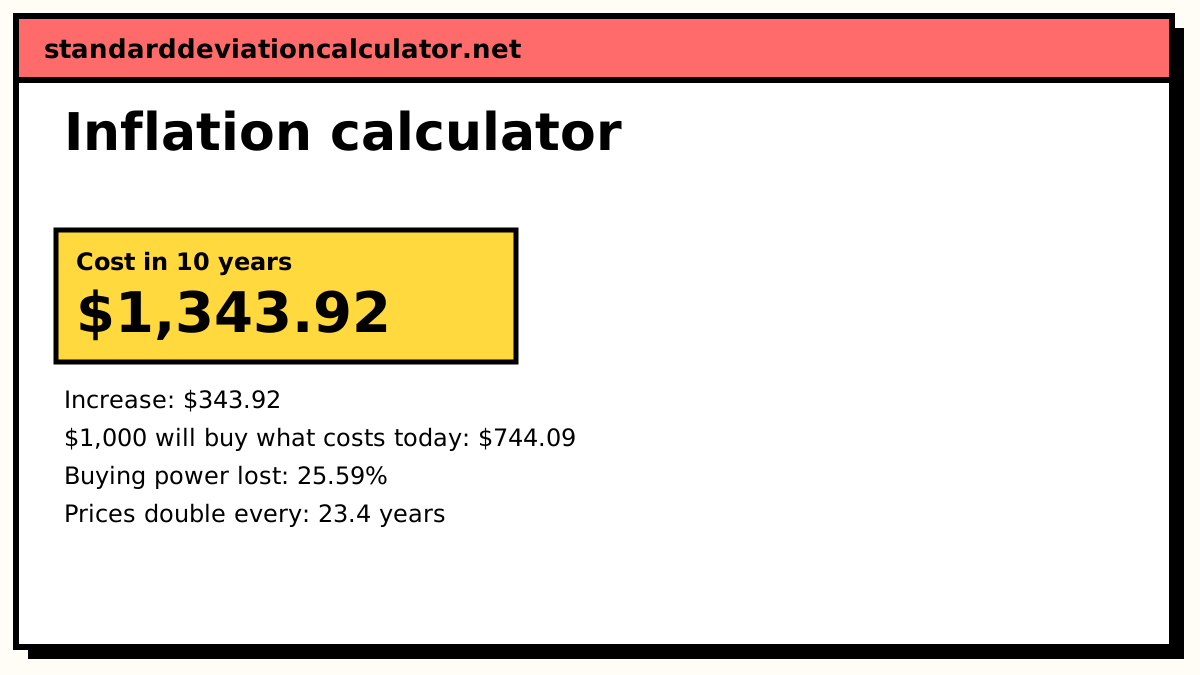
The calculator starts with $1,000, 3% inflation and 10 years.
- Growth factor: 1.03^10 = 1.343916.
- Future cost: $1,000 × 1.343916 = $1,343.92. What costs $1,000 today costs $343.92 more in 10 years.
- Buying power: $1,000 ÷ 1.343916 = $744.09, so cash loses 25.59% of its buying power.
For the average-rate mode, the default prices are $2.50 and $4.00, ten years apart: (4.00 ÷ 2.50)^(1/10) − 1 = 1.6^0.1 − 1 = 4.812% a year.
Buying power lost at different rates
| Inflation | After 10 years | After 20 years | Prices double in |
|---|---|---|---|
| 2% | 17.97% | 32.70% | 35.0 years |
| 3% | 25.59% | 44.63% | 23.4 years |
| 4% | 32.44% | 54.36% | 17.7 years |
| 6% | 44.16% | 68.82% | 11.9 years |
| 8% | 53.68% | 78.55% | 9.0 years |
Using the results
- Real returns. A savings rate below inflation loses buying power even though the balance grows. The real return is (1 + nominal) ÷ (1 + inflation) − 1: 5% interest with 3% inflation is a real return of 1.94%, not 2%.
- Your own inflation. The headline CPI is an average basket. Rent, school fees or medical costs can rise faster, so a household’s own rate can differ.
- Averages hide swings. A decade that averages 3% may include a year of 8%. The compound average is right for the total change, not for any single year.
These are estimates from a constant rate. For official figures, use your national statistics office’s consumer price index.
Common questions
How do I calculate the future cost of something with inflation?
Multiply today’s price by (1 + inflation rate)^years. At 3% a year, something that costs $1,000 today costs $1,000 × 1.03^10 = $1,343.92 in 10 years.
How much buying power does money lose to inflation?
The share lost after n years is 1 − 1 ÷ (1 + i)^n. At 3% for 10 years that is
25.59%: $1,000 kept in cash will buy what $744.09 buys today. At 6% for 10 years the loss is
44.16%.
How do I find the average inflation rate between two prices?
Use the compound annual growth formula: (later ÷ earlier)^(1/years) − 1. A price
that went from $2.50 to $4.00 over 10 years rose 60% in total, an average of 4.812% a year. The
simple average, 60% ÷ 10 = 6%, overstates it because it ignores compounding.
Why does this calculator not use official CPI data?
It works from an average rate you choose, so it is useful for planning and for any country. Actual inflation varies year to year. For exact historical comparisons, use the official consumer price index: the US Bureau of Labor Statistics CPI Inflation Calculator, or the CPI series published by MOSPI in India or the ONS in the UK.
How long does it take for prices to double?
ln 2 ÷ ln(1 + i) years, or roughly 72 ÷ the rate in percent. At 3% inflation prices double in about 23.4 years; at 6%, in about 11.9 years.
Related calculators
-
Compound interest
The same compounding applied to savings.
-
Retirement calculator
Plan an income that keeps up with prices.
-
Investment calculator
Project savings, then convert them to today’s money.
-
Laspeyres price index
How a price index like the CPI is built.