Math
Point calculator: section formula, centroid and triangle area
Work with points on the coordinate plane: find the point that divides a segment in a given ratio, the centroid and area of a triangle, whether three points lie on a line, and where a point lands when you reflect it. Answers are exact where possible, with the working shown.
Show the working, step by step
Internal section formula: P = ((mx₂ + nx₁)/(m + n), (my₂ + ny₁)/(m + n)).
m = 2, n = 3, A = (−1, 7), B = (4, −3)
Substitute.
x = (2·4 + 3·(−1)) ÷ (2 + 3) = 5 ÷ 5 = 1 y = (2·(−3) + 3·7) ÷ (2 + 3) = 15 ÷ 5 = 3 P = (1, 3)
Check: AP : PB should equal m : n.
AP : PB = 2√5 : 3√5 = 2 : 3
The formulas
For A(x₁, y₁), B(x₂, y₂) and C(x₃, y₃):
Internal division in m : n: P = ( (mx₂ + nx₁)/(m + n), (my₂ + ny₁)/(m + n) ) External division in m : n: P = ( (mx₂ − nx₁)/(m − n), (my₂ − ny₁)/(m − n) ) Centroid: G = ( (x₁ + x₂ + x₃)/3, (y₁ + y₂ + y₃)/3 ) Area: ½ | x₁(y₂ − y₃) + x₂(y₃ − y₁) + x₃(y₁ − y₂) |
The midpoint is the section formula with m = n = 1. Three points are collinear exactly when the area formula gives 0.
A worked example
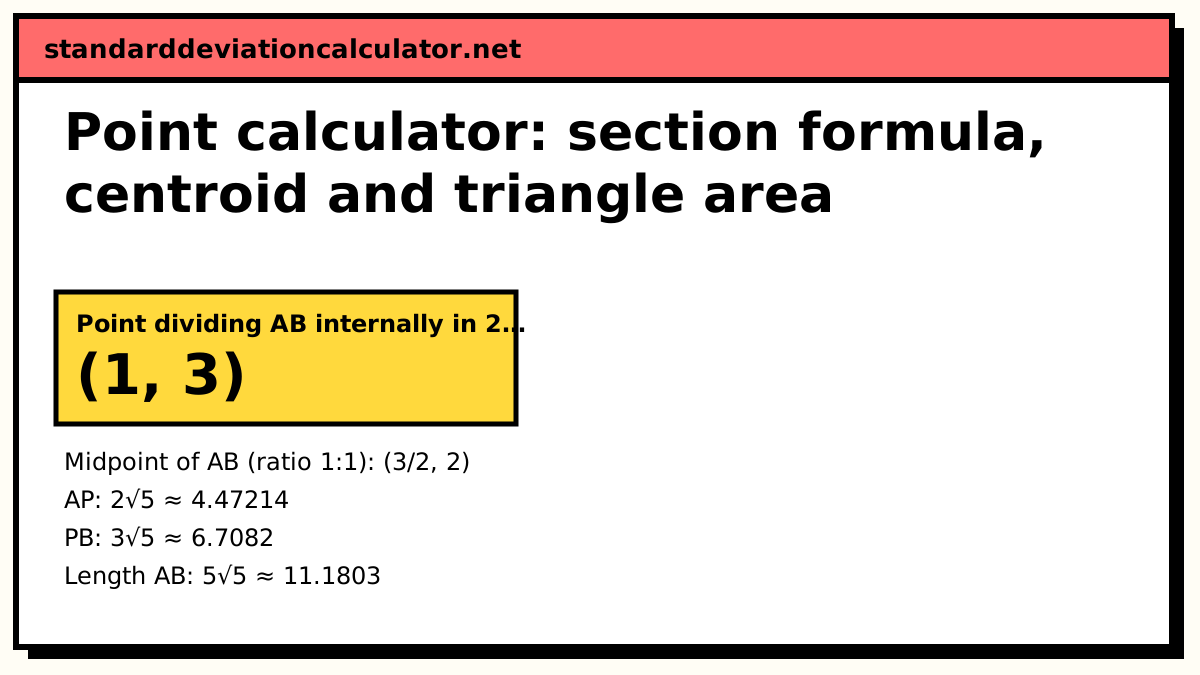
The calculator opens on a standard textbook question: find the point that divides the join of A(−1, 7) and B(4, −3) in the ratio 2 : 3.
- x = (2 × 4 + 3 × (−1)) ÷ (2 + 3) = 5 ÷ 5 = 1.
- y = (2 × (−3) + 3 × 7) ÷ (2 + 3) = 15 ÷ 5 = 3.
- So P = (1, 3). Check: AP = 2√5 and PB = 3√5, which are in the ratio 2 : 3.
Switch to external division and the same numbers give (−11, 27). The point lies on line AB extended beyond A, with AP = 10√5 and PB = 15√5, again in the ratio 2 : 3.
Choose “Three points” and add C(5, 4). The shoelace sum is (−1)(−3 − 4) + 4(4 − 7) + 5(7 − (−3)) = 7 − 12 + 50 = 45, so the area is 45 ÷ 2 = 22.5 square units. The centroid is ((−1 + 4 + 5)/3, (7 − 3 + 4)/3) = (8/3, 8/3).
When to use each operation
| Question | Use |
|---|---|
| Where is the point one third of the way from A to B? | Section formula with m : n = 1 : 2 |
| Where do the medians of a triangle meet? | Centroid (it divides each median 2 : 1 from the vertex) |
| How large is a plot given by corner coordinates? | Triangle area (split a polygon into triangles) |
| Do three survey points lie on one straight line? | Collinearity: area = 0 |
| Where does a shape land after a flip? | Reflections in the axes, the origin or y = ±x |
Common mistakes
- Swapping the weights. In the section formula m multiplies B’s coordinates and n multiplies A’s. Putting m on A gives the point that divides the segment in n : m, which is a different point unless m = n.
- Dropping the sign of a negative coordinate. Put brackets round every substituted value: 3 × (−1), not 3 × −1 written as 3 − 1.
- Forgetting the ½ or the absolute value in the area formula. The bracket gives twice the signed area.
- Treating a point on an axis as being in a quadrant. (0, −2) is on the y-axis, not in quadrant III or IV.
For the distance between two points and the midpoint alone, the distance and midpoint calculator is quicker. For the equation of the line through the points, use the straight line equation calculator.
Common questions
What is the section formula?
The point P that divides the segment from A(x₁, y₁) to B(x₂, y₂) internally in the ratio
m : n is P = ((mx₂ + nx₁)/(m + n), (my₂ + ny₁)/(m + n)). Each coordinate is a
weighted average of the endpoints, with the weight m on B and n on A, so P sits closer to
whichever endpoint carries the smaller number in the ratio. For A(−1, 7), B(4, −3) and 2 : 3
the point is (1, 3).
What is the difference between internal and external division?
Internal division puts P between A and B. External division puts P on the line AB but
outside the segment, still with AP : PB = m : n. The formula changes the plus signs to minus
signs: ((mx₂ − nx₁)/(m − n), (my₂ − ny₁)/(m − n)). Dividing (−1, 7) and (4, −3)
externally in 2 : 3 gives (−11, 27), beyond A. A ratio of 1 : 1 has no external point
because m − n = 0.
How do you check whether three points are collinear?
Work out the area of the triangle they form. If the area is zero the three points lie on one straight line. With the formula ½|x₁(y₂ − y₃) + x₂(y₃ − y₁) + x₃(y₁ − y₂)|, the points (1, 5), (2, 3) and (−2, 11) give ½|1(−8) + 2(6) + (−2)(2)| = 0, so they are collinear. Equal slopes AB and BC give the same answer, but the area test also works when a line is vertical.
Why does the triangle area formula use an absolute value?
The bracket (the shoelace sum) is positive when you list the vertices anticlockwise and negative when you list them clockwise. The area itself cannot be negative, so the formula takes the absolute value before halving. The sign is still useful: it tells you the orientation of the three points.
What are the rules for reflecting a point?
In the x-axis, (x, y) → (x, −y). In the y-axis, (x, y) → (−x, y). In the origin, both signs change: (x, y) → (−x, −y). In the line y = x the coordinates swap, (x, y) → (y, x), and in y = −x they swap and change sign, (x, y) → (−y, −x). The point (−3, 5) reflects to (−3, −5), (3, 5), (3, −5), (5, −3) and (−5, 3) respectively.
Which quadrant is a point on an axis in?
None. The quadrants are open regions, so a point with x = 0 lies on the y-axis and a point with y = 0 lies on the x-axis. (0, 0) is the origin. The calculator reports these cases separately instead of forcing them into a quadrant.
Related calculators
-
Distance and midpoint
Length, midpoint, slope and line through two points, in 2D or 3D.
-
Line calculator
Where two lines meet, the angle between them, and point-to-line distance.
-
Straight line equation
The equation of a line in slope-intercept, general and intercept forms.
-
Triangle calculator
Sides, angles, area and perimeter of a triangle.