Math
Line calculator: intersection, angle and distance between lines
Type two straight lines in any linear form, such as y = 2x + 1 or 3x − 4y = 5, and the calculator tells you how they relate: where they cross and at what angle, or how far apart they are if they are parallel. Add a point to get its perpendicular distance to each line.
Any linear form: y = 2x + 1, 3x − 4y = 5, x = 2.
━ L₁: 2x − y + 1 = 0 ━ L₂: x + y − 4 = 0
Show the working, step by step
Write both lines in the general form ax + by + c = 0 and read off the slopes m = −a/b.
L₁: 2x − y + 1 = 0, m₁ = 2 L₂: x + y − 4 = 0, m₂ = −1
Compare the coefficients: a₁b₂ − a₂b₁ = 0 means parallel; a₁a₂ + b₁b₂ = 0 means perpendicular.
a₁b₂ − a₂b₁ = 2·1 − 1·(−1) = 3 a₁a₂ + b₁b₂ = 2·1 + (−1)·1 = 1
Solve the two equations together (Cramer’s rule).
x = (b₁c₂ − b₂c₁) ÷ (a₁b₂ − a₂b₁) = ((−1)·(−4) − 1·1) ÷ 3 = 1 y = (c₁a₂ − c₂a₁) ÷ (a₁b₂ − a₂b₁) = (1·1 − (−4)·2) ÷ 3 = 3 intersection = (1, 3)
Angle between the lines: tan θ = |(m₁ − m₂) ÷ (1 + m₁m₂)|.
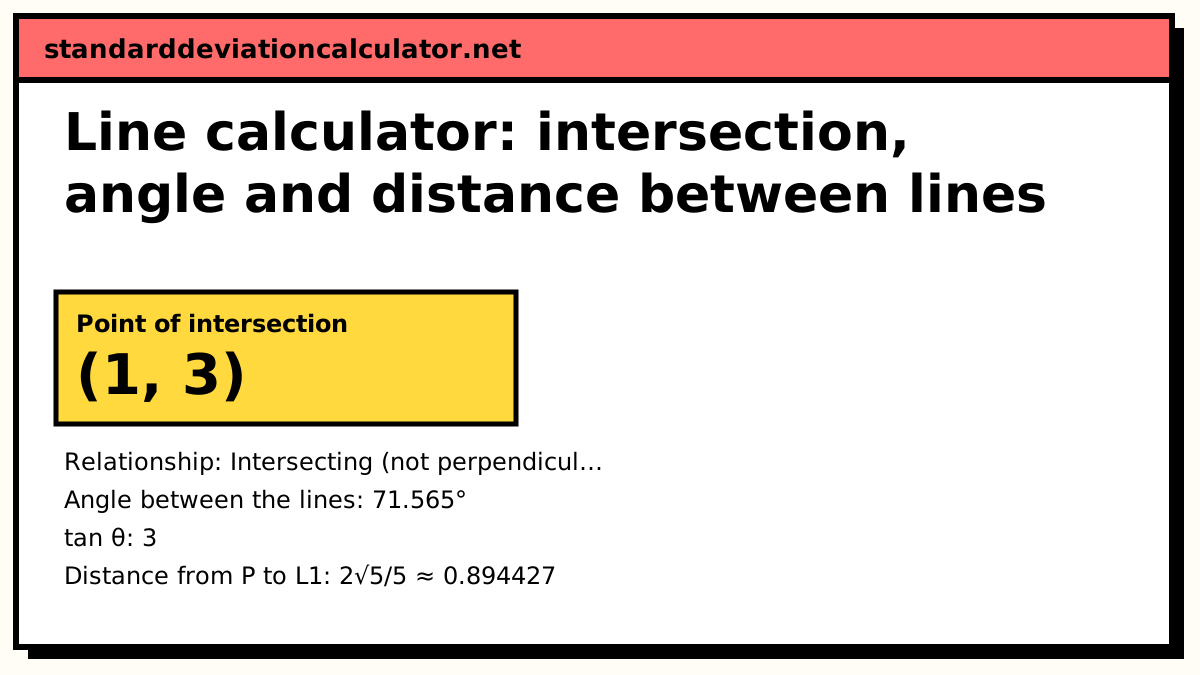
tan θ = |(2 − (−1)) ÷ (1 + 2·(−1))| = 3 θ = arctan(3) = 71.565°
Distance from P(3, 5) to L1: d = |ax₀ + by₀ + c| ÷ √(a² + b²).
d = |2·3 + (−1)·5 + 1| ÷ √5 = 2 ÷ √5 = 2√5/5 ≈ 0.894427 foot of the perpendicular: (11/5, 27/5)
Distance from P(3, 5) to L2: d = |ax₀ + by₀ + c| ÷ √(a² + b²).
d = |1·3 + 1·5 + (−4)| ÷ √2 = 4 ÷ √2 = 2√2 ≈ 2.82843 foot of the perpendicular: (1, 3)
The formulas
With the lines written as a₁x + b₁y + c₁ = 0 and a₂x + b₂y + c₂ = 0, and slopes m = −a/b:
Intersection: x = (b₁c₂ − b₂c₁)/(a₁b₂ − a₂b₁), y = (c₁a₂ − c₂a₁)/(a₁b₂ − a₂b₁) Angle: tan θ = | (m₁ − m₂) / (1 + m₁m₂) | Parallel lines ax + by + c₁ = 0, ax + by + c₂ = 0: d = |c₁ − c₂| / √(a² + b²) Point (x₀, y₀) to ax + by + c = 0: d = |ax₀ + by₀ + c| / √(a² + b²)
If a₁b₂ − a₂b₁ = 0 the intersection formula divides by zero: the lines are parallel or the same line, and the calculator switches to the distance between them.
A worked example
The defaults are L₁: 2x − y + 1 = 0, L₂: x + y − 4 = 0 and P(3, 5).
- Slopes: m₁ = 2 and m₂ = −1. They are not equal, and m₁m₂ = −2 ≠ −1, so the lines intersect but are not perpendicular.
- Intersection: a₁b₂ − a₂b₁ = 2 × 1 − 1 × (−1) = 3. Then x = ((−1)(−4) − 1 × 1) ÷ 3 = 1 and y = (1 × 1 − (−4) × 2) ÷ 3 = 3, so they meet at (1, 3).
- Angle: tan θ = |(2 − (−1)) ÷ (1 + 2 × (−1))| = |3 ÷ (−1)| = 3, so θ = arctan 3 = 71.565°.
- Distance from P(3, 5) to L₁: |2 × 3 − 5 + 1| ÷ √(4 + 1) = 2 ÷ √5 = 2√5/5 ≈ 0.894.
- Distance from P to L₂: |3 + 5 − 4| ÷ √2 = 4 ÷ √2 = 2√2 ≈ 2.828. The foot of that perpendicular is (1, 3), which happens to be the point where the two lines cross.
Reading the answer
| Result | Test in general form | What you get |
|---|---|---|
| Intersecting | a₁b₂ − a₂b₁ ≠ 0 | One point and an acute angle between 0° and 90° |
| Perpendicular | a₁a₂ + b₁b₂ = 0 | One point and an angle of 90° |
| Parallel | a₁b₂ − a₂b₁ = 0, constants not in the same ratio | No point; a fixed distance apart |
| Coincident | All three coefficients in the same ratio | The same line; distance 0 |
Common mistakes
- Using the point-to-line formula on y = mx + c. Move every term to one side first: y = 2x + 1 becomes 2x − y + 1 = 0, so a = 2, b = −1, c = 1.
- Forgetting the absolute value. Without it the angle formula can give the obtuse angle’s tangent as a negative number, and the distance formula can give a negative distance.
- Dividing by 1 + m₁m₂ when it is zero. That case is not an error: it means the lines are perpendicular.
To build a line from points or a slope, use the straight line equation calculator.
Common questions
How do I tell whether two lines are parallel or perpendicular?
Compare slopes. Parallel lines have equal slopes (m₁ = m₂); perpendicular lines have slopes whose product is −1 (m₁m₂ = −1). In general form a₁x + b₁y + c₁ = 0 and a₂x + b₂y + c₂ = 0 the tests are a₁b₂ − a₂b₁ = 0 for parallel and a₁a₂ + b₁b₂ = 0 for perpendicular. These versions also cover vertical lines, which have no slope.
How do you find the angle between two lines?
Use tan θ = |(m₁ − m₂) ÷ (1 + m₁m₂)|, which gives the acute angle. For
slopes 2 and −1, tan θ = |3 ÷ (−1)| = 3, so θ = 71.565°. The obtuse angle between the same
lines is 180° − 71.565° = 108.435°. If 1 + m₁m₂ = 0 the lines are perpendicular and
θ = 90°.
What is the formula for the distance from a point to a line?
For the point (x₀, y₀) and the line ax + by + c = 0,
d = |ax₀ + by₀ + c| ÷ √(a² + b²). The line must be in general form first. For
(3, 5) and 2x − y + 1 = 0: |6 − 5 + 1| ÷ √5 = 2/√5 = 2√5/5 ≈ 0.894.
How do you find the distance between two parallel lines?
Write both lines with the same x and y coefficients, ax + by + c₁ = 0 and
ax + by + c₂ = 0, then d = |c₁ − c₂| ÷ √(a² + b²). For 3x + 4y − 10 = 0 and
6x + 8y + 5 = 0, halve the second to 3x + 4y + 5/2 = 0; the distance is
|−10 − 5/2| ÷ 5 = 5/2. Skipping the rescaling is the usual mistake.
What does it mean if the lines are coincident?
The two equations describe the same line, one a multiple of the other (for example y = 2x + 1 and 4x − 2y + 2 = 0). Every point of one is on the other, so there is no single intersection point and the distance between them is 0.
Related calculators
-
Straight line equation
Build a line from two points, a point and a slope, or intercepts.
-
Point calculator
Section formula, centroid, triangle area and reflections.
-
Distance and midpoint
Distance, midpoint and slope between two points.
-
Linear equation calculator
Solve linear equations and systems step by step.