Math
3D geometry calculator: lines, planes and direction cosines
Solve three-dimensional geometry problems of the kind in the NCERT Class 12 chapter “Three Dimensional Geometry”: distances, direction cosines, lines and planes, and the angles and shortest distances between them. Each answer comes with the vector working and exact values such as 3√2/2.
Any linear form in x, y and z.
Show the working, step by step
Direction ratios of AB: subtract A from B.
(4 − 1, 6 − 2, 15 − 3) = (3, 4, 12)
Distance: |AB| = √(a² + b² + c²).
√(3² + 4² + 12²) = √169 = 13
Direction cosines: divide each ratio by the length. They satisfy l² + m² + n² = 1.
l, m, n = 3/13, 4/13, 12/13
Line through A with direction AB.
vector: r = (î + 2ĵ + 3k̂) + λ(3î + 4ĵ + 12k̂) Cartesian: (x − 1)/3 = (y − 2)/4 = (z − 3)/12
The formulas
Distance AB: √((x₂ − x₁)² + (y₂ − y₁)² + (z₂ − z₁)²) Direction cosines: l, m, n = a/r, b/r, c/r, r = √(a² + b² + c²) Line through A and B: r = a + λ(b − a) Plane through A, B, C: n = AB × AC, n · (r − a) = 0 Angle between lines: cos θ = |b₁ · b₂| / (|b₁||b₂|) Skew lines: d = |(a₂ − a₁) · (b₁ × b₂)| / |b₁ × b₂| Angle between planes: cos θ = |n₁ · n₂| / (|n₁||n₂|) Point to plane: d = |ax₁ + by₁ + cz₁ + d| / √(a² + b² + c²)
Worked examples
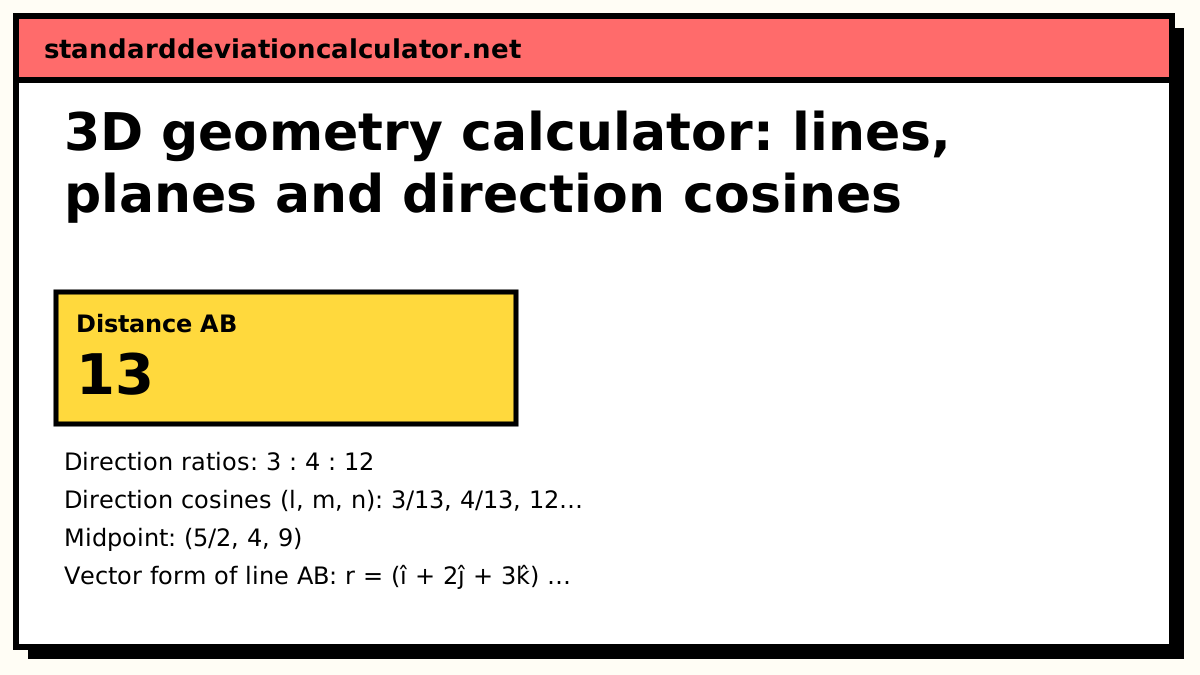
Two points. The calculator opens with A(1, 2, 3) and B(4, 6, 15). The direction ratios of AB are 3, 4, 12, and |AB| = √(9 + 16 + 144) = √169 = 13. The direction cosines are 3/13, 4/13, 12/13, and the line is r = (î + 2ĵ + 3k̂) + λ(3î + 4ĵ + 12k̂), or (x − 1)/3 = (y − 2)/4 = (z − 3)/12.
Plane through three points. For (1, 1, 0), (1, 2, 1) and (−2, 2, −1), AB = (0, 1, 1) and AC = (−3, 1, −1). Then AB × AC = (−2, −3, 3), so a normal is (2, 3, −3), and the plane through (1, 1, 0) is 2(x − 1) + 3(y − 1) − 3z = 0, which is 2x + 3y − 3z = 5.
Skew lines. For r = (î + 2ĵ + k̂) + λ(î − ĵ + k̂) and r = (2î − ĵ − k̂) + μ(2î + ĵ + 2k̂): a₂ − a₁ = (1, −3, −2) and b₁ × b₂ = (−3, 0, 3), with magnitude 3√2. The scalar triple product is −3 + 0 − 6 = −9, so the shortest distance is 9 ÷ 3√2 = 3√2/2 ≈ 2.121. The angle between the lines is arccos(√3/3) ≈ 54.74°.
Two planes. 2x + y − 2z = 5 and 3x − 6y − 2z = 7 have normals (2, 1, −2) and (3, −6, −2), with dot product 6 − 6 + 4 = 4 and magnitudes 3 and 7. So cos θ = 4/21 and θ ≈ 79.02°.
Point to plane. From (2, 5, −3) to 6x − 3y + 2z − 4 = 0 the distance is |12 − 15 − 6 − 4| ÷ 7 = 13/7.
How two lines in space can relate
| Case | Test | Distance |
|---|---|---|
| Parallel | b₁ × b₂ = 0 | |(a₂ − a₁) × b| / |b| |
| Same line | Parallel and the distance is 0 | 0 |
| Intersecting | b₁ × b₂ ≠ 0 and (a₂ − a₁) · (b₁ × b₂) = 0 | 0, and they meet at one point |
| Skew | (a₂ − a₁) · (b₁ × b₂) ≠ 0 | |(a₂ − a₁) · (b₁ × b₂)| / |b₁ × b₂| |
Common mistakes
- Treating direction ratios as direction cosines. Divide by the magnitude first; check that l² + m² + n² = 1.
- Getting the cross product signs wrong. The middle component is a₃b₁ − a₁b₃, not a₁b₃ − a₃b₁. A normal with every sign flipped is still correct.
- Forgetting the absolute value in the angle formulas. The angle between lines or planes is taken as acute. Without it you may get the obtuse supplement.
- Leaving the plane as ax + by + cz = d in the distance formula. Move d across first, so its sign flips.
Common questions
What is the difference between direction ratios and direction cosines?
Direction ratios are any three numbers a, b, c proportional to the direction of a line: 3, 4, 12 and 6, 8, 24 describe the same direction. Direction cosines are the one set that also satisfies l² + m² + n² = 1, found by dividing each ratio by √(a² + b² + c²). For 3, 4, 12 that is 13, so l, m, n = 3/13, 4/13, 12/13. They are the cosines of the angles the line makes with the x-, y- and z-axes.
How do you find the equation of a line through two points in 3D?
Take the direction as B − A and write r = a + λ(b − a) in vector form, or
(x − x₁)/(x₂ − x₁) = (y − y₁)/(y₂ − y₁) = (z − z₁)/(z₂ − z₁) in Cartesian form.
Through (1, 2, 3) and (4, 6, 15): (x − 1)/3 = (y − 2)/4 = (z − 3)/12. If one ratio is 0,
write that coordinate as a constant instead of dividing by 0.
How do you find the plane through three points?
Form two vectors in the plane, AB and AC. Their cross product is a normal n = (a, b, c), and the plane is a(x − x₁) + b(y − y₁) + c(z − z₁) = 0. If AB × AC = 0 the points are collinear and no single plane is fixed. The NCERT example through (1, 1, 0), (1, 2, 1) and (−2, 2, −1) gives 2x + 3y − 3z = 5.
What is the shortest distance between two skew lines?
For r = a₁ + λb₁ and r = a₂ + μb₂, d = |(a₂ − a₁) · (b₁ × b₂)| ÷ |b₁ × b₂|.
Skew lines are neither parallel nor intersecting, which only happens in three dimensions. If
the result is 0 the lines meet. If b₁ × b₂ = 0 they are parallel, and the distance is
|(a₂ − a₁) × b| ÷ |b|.
How do you find the distance from a point to a plane?
Write the plane as ax + by + cz + d = 0 and use
|ax₁ + by₁ + cz₁ + d| ÷ √(a² + b² + c²). For (2, 5, −3) and
6x − 3y + 2z − 4 = 0: |12 − 15 − 6 − 4| ÷ √49 = 13/7. The calculator also gives the foot of
the perpendicular and the mirror image of the point in the plane.
Related calculators
-
Distance and midpoint
Distance and midpoint in 2D or 3D, with exact surds.
-
Cross product calculator
a × b with the determinant working.
-
Vector calculator
Add, subtract and take dot products of vectors.
-
Line calculator (2D)
Intersection and angle of two lines in the plane.